


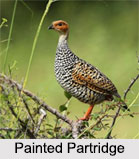
 Indian Partridges are squat and short-tailed ground-dwelling birds of the size of a half-grown domestic hen. They belong to the game bird family namely, Phasianidae, which also includes pheasants and junglefowls. Species of partridges like Grey Partridges, Black Partridge and Painted Partridges are good runners and prefer to trust their legs and lie low in thickets instead of flying to escape predators. They will burst out of cover with a whirl of wings, only when beaten out. Indian Partridges are squat and short-tailed ground-dwelling birds of the size of a half-grown domestic hen. They belong to the game bird family namely, Phasianidae, which also includes pheasants and junglefowls. Species of partridges like Grey Partridges, Black Partridge and Painted Partridges are good runners and prefer to trust their legs and lie low in thickets instead of flying to escape predators. They will burst out of cover with a whirl of wings, only when beaten out.
Types of Partridges The commonest and the best known species both as a sporting bird and a table delicacy is the Grey Partridge (Francolinus pondicerianus). It is a grayish brown, barred and vermiculated bird with buff, rufous and black color blending, creating a camouflage pattern. Young Grey Partridges can act as free living pets. The male Black Partridge can be recognized as a completely glossy black plumaged bird, with a black bill. The female counterpart is a chestnut-brown partridge, with dark horn-colored bill. It has a whitish throat and belly. Painted Partridge can be recognized as a bird with bright rufous face and throat. There are white spots present on the underside of the bird. Tibetan Partridge can be recognized with the help of a brown back, blackish belly patch, chestnut flanks and black and white face pattern, which contrasts with the rufous colored collar. A male Hill Partridge has orange crown. 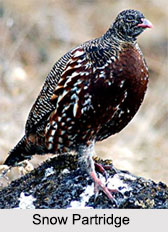 The head is black and the throat is streaked. The female bird is devoid of the patterns on the head, grey chest and upper belly possessed by the male bird. Chukar Partridge is a round bird, with grey colored breast and buff belly. Snow Partridge is a bird with grey upper part and chestnut underside. The head is black and the throat is streaked. The female bird is devoid of the patterns on the head, grey chest and upper belly possessed by the male bird. Chukar Partridge is a round bird, with grey colored breast and buff belly. Snow Partridge is a bird with grey upper part and chestnut underside.
Distribution of Partridges A number of species of partridges are found mostly in the plains. Some species like Chukor Partridge and Snow Partridge are found high up in the Himalayas. Grey Partridges are found throughout the drier parts of the subcontinent. In the better-watered parts of north India and the peninsular India southward, the place of the Grey Partridge is taken by the Black Partridge and the Painted Partridge, respectively. Tibetan Partridge has been recorded in Kashmir and northwestern India. Snow Partridge has been traced in Arunachal Pradesh. Calls of Partridges The challenging and spirited call of the male partridge enlivens the open countryside. The female partridge often weaves in a single high-pitched note, producing a perfectly timed duet. |
| |||



Indian Partridges
| Indian Partridges are medium-sized game birds. They are non-migratory in nature and are known to nest on the ground. Some of these partridges are Grey Partridge, Black Partridge, Painted Partridge and Tibetan Partridge. |
| ||||||||||||||||||||||||||||

