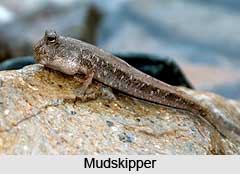
 Mudskippers are goggle-eyed animals hopping from place to place and sometimes disappearing into their holes. Even if they move about in the air and on the mud are all true fishes belonging to the family Gobiidae. Two important genera are the Boleopthalmus and Periopthalmodon. The common mudskippers are known around Bombay as nivta. They are small, growing to about twenty centimetres in length, elongate with rounded bodies and eyes almost on the top of the head with partially closing eyelids. Their bodies are bluish grey, with slightly oblique black stripes interspersed by iridescent light blue spots; the head is darker but its sides are covered with black and blue spots. The second dorsal and pectoral fins are similarly coloured but tipped with orange. The first dorsal fin is tipped bright blue.
Another species is dull olive grey with white irregular streaks on the body and a pink anal fin. These colours deepen and become brighter during the breeding season. Mudskippers possess gills which have become so functionless that if they are compelled to remain under water for a long time they get asphyxiated. They depend on their accessory respiratory organs. It is reported that in some cases the tail also is vascular and aids in respiration.
When high tide submerges the mud-flats the mudskippers swim on the surface and are usually seen resting on the stems of branches of mangrove plants. When the tide recedes they distribute themselves on the mud-flats and make temporary burrows in which they live during the inter-tidal period, and skip about with the help of their large pectoral fins which have an unusually strong muscular base. These hopping movements are mostly in search of food - the copepods, small fish, prawns, crabs and even algal matter which may be stranded in tiny puddles.
Mudskippers are known for their territorial instinct. A male does not allow other males to enter the area round its hole and fights to drive out the intruders. During such fights, the colourful dorsal fins are raised and the gill-chambers inflated to frighten the opponent. With binoculars an observer can see how the dominant male knocks down his opponent.
Observations on Boleopthalmus dussumierei near Mumbai indicate that the fish has preference for vegetable matter, especially the diatoms which they obtain on the muddy bottom. They make Y shaped burrows, become sexually mature when about ten millimetres long and breed from the month of July to September. Eggs (1000 to 5000) are attached to the walls of the burrows and guarded by the male.