


 Monuments of Varanasi are an important tourist attraction. Located on the banks of Ganga River these monuments attract many tourists. Most of them date back to the ancient times and have a history associated with them. Many mosques have been built here during the Muslim rule. The Muslim influence can be traced back to the early raids of Mahmud of Ghazni in 1033. In 1194 the Hindu Raja of Varanasi was defeated by Ala-ud-Din Khiliji, who had destroyed the temples and had built mosques. Since this date the city has been under continuous Muslim control. As a consequence, few temples date from before the time of Akbar, in the late 16th century. The Muslim monuments are interspersed among the ghats and temples. Some of the important monuments in Varanasi have been described below: Monuments of Varanasi are an important tourist attraction. Located on the banks of Ganga River these monuments attract many tourists. Most of them date back to the ancient times and have a history associated with them. Many mosques have been built here during the Muslim rule. The Muslim influence can be traced back to the early raids of Mahmud of Ghazni in 1033. In 1194 the Hindu Raja of Varanasi was defeated by Ala-ud-Din Khiliji, who had destroyed the temples and had built mosques. Since this date the city has been under continuous Muslim control. As a consequence, few temples date from before the time of Akbar, in the late 16th century. The Muslim monuments are interspersed among the ghats and temples. Some of the important monuments in Varanasi have been described below:
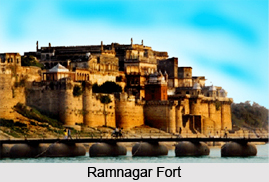
Ramnagar Fort The most notable monument of Varanasi is the Ramnagar Fort which reflects the blend of both Hindu and Muslim forms of architecture. In the town ample influences of Hinduism, Islam, Buddhism and British styles can be witnessed amidst its architectural piece of work. The Ramnagar Fort in Varanasi is made of red sandstone and depicts a wonderful confluence of Hindu and Islamic Architecture. The temple which is located within the Ramnagar Fort is so beautiful in its architectural magnificence that it holds a prominent place among the monuments of Varanasi. Ramnagar Fort also houses a museum. Here one can see the magnificent treasure of the Royal family. The Durbar Hall of the Ramnagar Palace is sumptuously decorated. The throne is made of sandalwood. Furniture made of gold and silver brocades, tiger skins, inlaid ivory, carpets and crystal chandeliers create a vision of great opulence. Outside the Durbar Hall is a splendid marble balcony and verandah, from which there are fine views across the river. 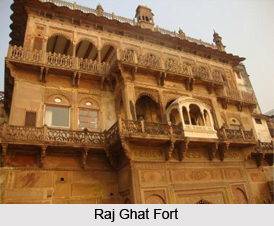
St Mary's Church St Mary's Church is a typical cantonment church of Upper India with a low tower and spire and projecting portico. In the church there are louvered doors to the sides, in lieu of windows, and the hooded ventilation slots beneath the cornice. The Churchyard is a pleasant, shaded compound containing a number of tombs and memorials removed from the old city cemetery at Chaitganj. The large column, crowned by an urn, commemorates officers massacred at Sewaleh on 16th of August 1781. A pavilion marks the remains of twelve bodies and was removed here by James Princep in 1829. Above each doorway is a rectangular fanlight protected from the glare of the sun by a plain timber canopy-a simple device, which has a major architectural impact. The Churchyard with its serene atmosphere has many tombs and memorials. Arhai Kangura Mosque It has a Hindu inscription of 1190 but dates from the early Muslim conquest. The pillars are of Hindu origin and were taken from an older temple. Madho Rai Ki Masjid The Smaller Mosque of Aurangzeb is also called the Madho Rai Ki Masjid or Minarets. The mosque occupies the site of an earlier temple of Lord Vishnu, which accounts for its mixture of Hindu and Muslim details. The minarets were dismantled and reconstructed by James Princep in the early 19th century. There is a magnificent view of the entire city from the top. The Buddhist stupas at Sarnath can be seen at a distance. Aurungzeb's Mosque 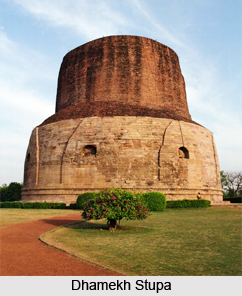 Aurangzeb's Mosque is situated on the north-west side of the famous Gyan Bapi kund or Well of Knowledge. The mosque was built by the Mughal Emperor Aurangzeb on the foundations of old Vireswar temple. It is a remarkable piece of masonry construction. The columns in the front of the mosque were taken from the old temple, the remains of which can still be discerned at the rear. It has two colossal octagonal minarets towering 70-7 m above the river Aurangzeb's Mosque is situated on the north-west side of the famous Gyan Bapi kund or Well of Knowledge. The mosque was built by the Mughal Emperor Aurangzeb on the foundations of old Vireswar temple. It is a remarkable piece of masonry construction. The columns in the front of the mosque were taken from the old temple, the remains of which can still be discerned at the rear. It has two colossal octagonal minarets towering 70-7 m above the river
Raj Ghat Fort The fort is presently in a dismantled state. Within the confines of the fort on the south corner of the plateau is the Tomb of Lal Khan, the minister of a former raja. The tomb is enriched with tiles and mosaics. It is one of the few original Muslim buildings of any great beauty in the city. To the north-west of the tomb is the Palang Shahid which is a small Muslim cemetery. Chaukhandi Stupa Chaukhandi Stupa is a mound like structure that contains the remains of Gautama Buddha. According to the history Chaukhandi Stupa, has been built during the Gupta period between the 4th and 6th Century. In 1567, Emperor Akbar of the Mughal Dynasty raised an octagonal tower above the stupa to commemorate the visit of his father Humayun in 1532 here. Dhamekh Stupa Dhamek Stupa was built in 500 CE. It was built to replace an earlier structure that was commissioned by the great Mauryan king Ashoka in 249 BCE. This stupa is a circular mound that is encircled by large stones. The Dhamek Stupa has a deer park (Rishipattana) where Lord Buddha gave the first sermon to his five disciples 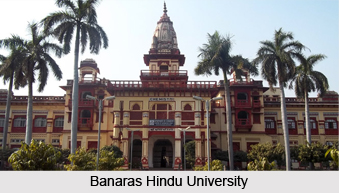 Queen's College of Varanasi Queen's College of Varanasi
The Queen's College of Varanasi had been designed by Major Kittoe in 1847-52. It is one of the earliest secular buildings in a scholarly Gothic style in India. It has been designed in a perpendicular style and has been built of Chunar stone with a lofty central tower and corner towers joined by open arcades. Inside the main entrance in the south-east corridor is a plaque recording the foundation of the original Sanskrit College by Jonathan Duncan in 1791. Banaras Hindu University The building of Banaras Hindu University is among the most ancient buildings of Varanasi built by Pandit Madan Mohan Malviya in 1916. Banaras Hindu University lies on a large campus to the south of the city. It has a number of interesting secular buildings, erected since its foundation at the turn of the century. It also has various departments. Bharat Kala Bhavan Bharat Kala Bhavan Bharat Kala Bhavan is an art and architecture museum situated in within the campus of the Banaras Hindu University. It has a vast collection of paintings, Hindu and Buddhist sculptures and other archaeological materials. It also houses an idol of Lord Krishna. It has been separated into several sections and houses many galleries. It can be said that the monuments of Varanasi for their antiquity and beautiful architectural style and variety have been an important tourist attraction. In fact the monuments of Varanasi are part of its heritage. |
| |||



Home > Art & Culture > Indian Monuments > Indian Regional Monuments > Monuments of Uttar Pradesh > Monuments of Varanasi
Monuments of Varanasi
| Monuments of Varanasi serve as prime tourist attractions. They are widely varied in their architectural styles and have been constructed under the influence of various rulers. |
| ||||||||||||||||||||||||||||

