


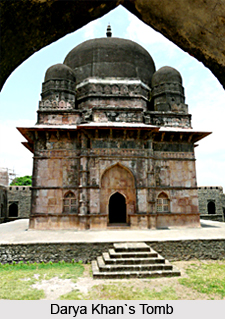
 The monuments of Mandu are the main points of interest for a tourist who is visiting the city. In the city there are altogether sixty one monuments. Among the important monuments of Mandu are included several cave temples, fortresses and many buildings depicting Islamic architecture. The most notable buildings of the region are Darya Khan's Tomb and Hathi Mahal. The monuments of Mandu date back to very early times. Mandu has a fine architectural heritage of buildings designed in a distinctive provincial style. At the same time the ruins of architectural excellence occupy about 21 sq. km. of area. The monuments of Mandu are the main points of interest for a tourist who is visiting the city. In the city there are altogether sixty one monuments. Among the important monuments of Mandu are included several cave temples, fortresses and many buildings depicting Islamic architecture. The most notable buildings of the region are Darya Khan's Tomb and Hathi Mahal. The monuments of Mandu date back to very early times. Mandu has a fine architectural heritage of buildings designed in a distinctive provincial style. At the same time the ruins of architectural excellence occupy about 21 sq. km. of area.
Mandu gained prominence at the end of the 10th century, when the Paramaras formed an independent kingdom based initially at Ujjain and then at Dhar under Raja Bhoj and his successors. It was conquered by the Muslim Khaljis of Delhi in 1304 and the Hindu kingdom of Malwa became part of the Delhi Sultanate under Muslim governors. With the Mongol invasion of Delhi in 1401, Malwa seized independence under its Afghan governor and entered a golden age of prosperity, which persisted long after the Mughal invasion until control was eventually lost to the Marathas in l732. Architecturally, Mandu is important as one of the two great centres of a provincial style of Islamic Architecture. Most of the extant buildings were erected between 1401 and 1526, initially using salvaged masonry from local Hindu temples. The early mosques of Dilawar Khan and Malik Mughis are from this first period. Most of the other buildings belong to the second phase, of which the best examples are the Jama Masjid and Tomb of Hos-hang Shah. Stylistically, this provincial expression of Islamic architecture eschewed elaborate ornament, in favour of simplicity, mass and power. Battered or buttressed walls, bold but austere masonry and the prominent use of colour, of which only vestiges now remain, are the hallmarks of the style. Traces of glazed patterns, tiles and inlay work of semi-precious stones remain. The potters of Mandu were renowned for the brilliant colours of their work. 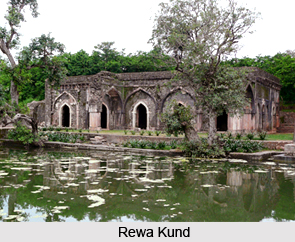 Originally, the Fortifications extended 595 km in circumference around the plateau, built from rubble and stone boulders. Within the perimeter walls are two fortified enclosures where the royal palaces are located: the great Royal Enclave and another near the Rewa Kund, protecting the palace of Baz Bahadur. In addition there is the impregnable citadel of Songarh, separated from the main hill by a narrow neck of land.
The fort is littered with many early Hindu remains and fragments of masonry, much of which was used in the construction of the later buildings of Mandu. The walls of the Hindola Mahal, for instance, show that their core is composed of huge quantities of early remains. In Mandu there are both historical as well as religious monuments. The historical monuments of the region include mostly a number of palaces, tombs and some forts here and there. On the other hand the historical monuments of Mandu include a number of mosques. This is because Mandu had been under Muslim influence for a long time. The monuments of Mandu can also be divided into six different groups. They are the Royal Enclave, the group around the village, the Sagar Talao group, the Rewa Kund group, the group between the Sagar Talao and the village, and finally a group of miscellaneous monuments. Hence, it can be concluded saying that both historical as well religious monuments of Mandu add to the tourist attraction of the region. |
| |||



Home > Art & Culture > Indian Monuments > Indian Regional Monuments > Monuments of Madhya Pradesh > Monuments Of Mandu
Monuments Of Mandu
| Monuments of Mandu have made the city a prominent tourist destination. Monuments of Mandu include both historical as well as religious monuments. |
| ||||||||||||||||||||||||||||

