


 Bharuch is one of the oldest seaports located in Western India, a municipality in the Bharuch district of Gujarat. Monuments of Bharuch, named Broach by the British, are evidence of the religious and communal harmony of the place. Bharuch was originally a small village on then banks of the Narmada River. It flourished in the first century as one of the chief trading centres of Gujarat, with trade links to western Asia and beyond. East-West course of the Narmada gave access to the rich inland empires at the upper reaches of the Narmada, including easy caravan access to the Ganges valley and the plains of Delhi. It grew and prospered as a trading transhipment centre and ship building port. In the 17th century its ships traded with Java and Sumatra. In 1614 an English factory was established here, followed three years later by the Dutch. By order of Emperor Aurangzeb the fortifications were partly demolished in 1660, leaving the city open to Maratha attacks in 1675 and 1686, after which the walls were rebuilt. In 1771 the British attempted but failed to take the town, although a year later they succeeded. Bharuch is one of the oldest seaports located in Western India, a municipality in the Bharuch district of Gujarat. Monuments of Bharuch, named Broach by the British, are evidence of the religious and communal harmony of the place. Bharuch was originally a small village on then banks of the Narmada River. It flourished in the first century as one of the chief trading centres of Gujarat, with trade links to western Asia and beyond. East-West course of the Narmada gave access to the rich inland empires at the upper reaches of the Narmada, including easy caravan access to the Ganges valley and the plains of Delhi. It grew and prospered as a trading transhipment centre and ship building port. In the 17th century its ships traded with Java and Sumatra. In 1614 an English factory was established here, followed three years later by the Dutch. By order of Emperor Aurangzeb the fortifications were partly demolished in 1660, leaving the city open to Maratha attacks in 1675 and 1686, after which the walls were rebuilt. In 1771 the British attempted but failed to take the town, although a year later they succeeded.
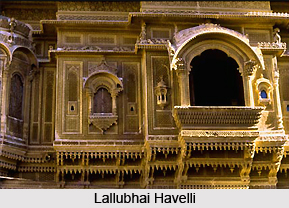
At the water's edge, the river frontage has a massive stone wall. The town of Baruch lies above this. The southern city wall is intact, with five gateways, and the city proper lies on a narrow spit of land 4 km long by 1-2 km broad. There is found a fort here which stands at a height of 296 ft above the river. Within the fort are the Collector's Office, Civil Courts, the Old Dutch factory, the English Church, public offices, Victoria Clock tower and other civic buildings. 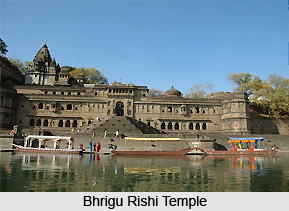 The Lallubhai Havelli was built nearly 2000 years back, reckoned as one of te top forts among the monuments of Gujarat. The foundation date of the Lallubhai Havelli dates back to 1791 AD. The fort was constructed by Lallubhai, a former divan of the former Nawab of Broach. It is a one storied building, the fa‡ade of which has been adorned with rich wood carvings. There is a bungli or small room found here where Lallubhai is said to have conducted his court meet. Arrangements are found made in the fort for placing matchlock guns. Also found within is an underground passage, a common feature of most of the traditional structures. A number of religious monuments are found at Bharuch, catering to Hindu, Muslim and even Zoroastrian worshippers.
The Bhrigu Rishi temple is situated in the eastern part of the city of Bharuch, along then banks of the Narmada. The name of the city of Baruch has been derived from 'Bhrigukachba' the name of the temple. The temple is dedicated to the mythological saint, Maharishi Bhrigu, one of the prominent Rishis of the group of seven seers, or the Sapta Rishi Mandal. The walls of the temple were constructed by the Marathas between 1675 and 1686. The temple attracts a large number of devotees. The Jami Masjid lies at the eastern base of the fort. It was built in the early 14th century from the materials of an old Jain temple. Although constructed from recycled masonry, it was planned and built according to conventional mosque design, comprising a courtyard with gateways on three sides and an open pillared sanctuary at its western end. The interior has three compartments based on three temple mandapas, removed and reassembled in their present position. The three mihrabs in the western wall are clearly indigenous in design and are copies of temple niches, but with pointed Islamic arches. The roof of the sanctuary has three large domes and ten smaller ones. The ceilings are enriched with cusped and geometrical patterns. Another mosque is found lying in the south-west corner of the fort. It dates back to may be as early as 1037. The Tomb of Brigadier David Wedderburn lies about 592 feet from the bastion at the north-west corner of the fort. He was killed during the storming of the city in 1772. An interesting complex of early Dutch tombs is found lying 2 miles to the west of the fort. Two of them are 16 ft high. They lie about 296 ft off the road and are worth a visit. Opposite the tombs are fine Parsee Towers of Silence, one of which is still used. The tomb of Bawa Rahan lies 1 mile to the north west of the city. The monuments of Baruch, chiefly religious in nature, are well worth a visit. |
| |||



Home > Art & Culture > Indian Monuments > Indian Regional Monuments > Monuments of Gujarat > Monuments Of Bharuch
Monuments Of Bharuch
| Monuments of Bharuch are contained in the forts and temples; Bharuch was an important seaport of western India. |
| ||||||||||||||||||||||||||||

