


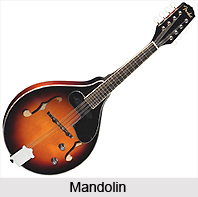
 The mandolin is a double-coursed lute which has descended from the mandore in Italy. The mandolin resembles the guitar, in the shape of the neck, frets, and tuning-post. The steel strings are plucked with a plectrum. The instrument remains popular, especially in Italy, and not least because of the relative ease with which it can be played. As a result of this popularity, the mandolin was subjected to variations, such as the mandola (a tenor-mandolin). There is also a bass mandolin that is commonly found in mandolin and accordion-orchestras. The mandolin is a double-coursed lute which has descended from the mandore in Italy. The mandolin resembles the guitar, in the shape of the neck, frets, and tuning-post. The steel strings are plucked with a plectrum. The instrument remains popular, especially in Italy, and not least because of the relative ease with which it can be played. As a result of this popularity, the mandolin was subjected to variations, such as the mandola (a tenor-mandolin). There is also a bass mandolin that is commonly found in mandolin and accordion-orchestras.
The body of the mandolin has a teardrop or oval-shaped soundboard with a soundhole, or soundholes, of varying shapes which are open. Unlike the Baroque-era mandolins these are not decorated with intricately carved grilles. A typical mandolin has a hollow wooden body with a neck that holds a flat fretted fingerboard, a nut and floating bridge, a tailpiece or pinblock at the edge of the face to which the strings are attached, and mechanical tuning machines, to accommodate metal strings. The mandolin has a bridge on its sounding board that raises the strings away from the body slightly in order to make chord-playing easier. Initially, the original mandolins had six double courses of gut strings which were tuned similarly to lutes and needed to be plucked with the fingertips. The design that is common today has eight metal strings in four pairs (courses) which are plucked with a plectrum. This style originated in Naples, Italy during the third quarter of the eighteenth century. There are a number of different varieties of the mandolin which are found all over the world. These include the four-string, twelve-string and sixteen string mandolins along with variations of the regular mandolin such as the Lombard, Brescian and Milanese. The Portuguese mandolin is a variation of the Italian version. The body of this instrument has a slightly curved base, straight sides, and a flat top, often inlaid with decorative woods, that narrows at the neck. When playing the mandolin, apart from fingerpicking, the use of tremolo is a popular method of playing. Tremolo means the rapid picking of one or more strings which is done to create note or chords. This technique works particularly well with a mandolin's paired strings, where one of the pair is sounding while the other is being struck by the pick, giving a more rounded and continuous sound than is possible with a single coursed instrument. Mandolins enjoyed great popularity in Europe and the Americas in the first half of the twentieth century. The mandolin is not a standard instrument in the symphony orchestra, but orchestral works have been written in which the instrument played a part .A number of professional and amateur mandolin groups and orchestras were formed to play light classical string repertory. When this slowly started fading out, mandolins got a new lease of life in American country and old-time music, bluegrass and folk music. More recently, the Baroque and Classical mandolin repertory and styles have benefited from the raised awareness of and interest in early music. In India too the mandolin has been extensively used. It was used in Hindi movies as far back as the 1940's. This was mainly done by the Raj Kapoor studios in the different movies that were produced by them. Another very recent use of the mandolin is its adoption in Carnatic music. U. Srinivas has, over the last couple of decades, made his version of the mandolin very popular in India and abroad. In order to cater to the special needs of Carnatic music many adaptations of the mandolin have taken place. The mandolin is also used in India in the Bhangra, dance music from Punjab. |
| |||



Home > Movies & Entertainment > Indian Music > Indian Musical Instruments > String Instruments > Mandolin
Mandolin
| Mandolin is a string-instrument belonging to the lute family; it has been extensively used in India in the Indian film industry. |
| ||||||||||||||||||||||||||||

