


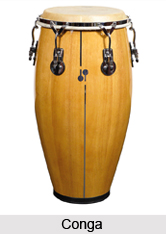
 The Conga is a musical instrument that resembles the shape of a tall drum with a deep bass tone belonging to the genre of percussion instruments. The word conga came from the rhythm la conga used during carnival in Cuba. The widely used Conga is Cuban in origin and has African antecedents. It is thought to be derived from the Makuta drums or similar drums associated with Afro-Cubans of Central African descent. The wide use of the Conga today and its incorporation into world music has seen a number of variants of the Conga being used in different countries of the world. The Conga is a musical instrument that resembles the shape of a tall drum with a deep bass tone belonging to the genre of percussion instruments. The word conga came from the rhythm la conga used during carnival in Cuba. The widely used Conga is Cuban in origin and has African antecedents. It is thought to be derived from the Makuta drums or similar drums associated with Afro-Cubans of Central African descent. The wide use of the Conga today and its incorporation into world music has seen a number of variants of the Conga being used in different countries of the world.
Construction of Conga The instrument has a stubby, tapered base and the drumhead is made of stretched donkey hide or pigskin. The wooden frame is usually 26-80 inches high, with a diameter of 10-16 inches. The pitch can be tuned by means of adjustable tension screws. Where the modern Congas are concerned, most of them have a staved wooden or fiberglass shell with a screw-tensioned drumhead. Typical congas stand approximately 75 cm from the bottom of the shell to the head. They are usually played in sets of two to four with the fingers and palms of the hand. The drums may be played while seated. A player can also play the Conga while standing by mounting it on a rack or stand. Techniques of Playing Conga Similar in playing style to the Bongo, the Conga is played with the fingers and palms. As a result of this, many different kinds of tone may be produced while playing the conga. The instrument is usually held between the knees, and sometimes it is propped up on a tripod stand. The conga may also have a carrying strap attached. There are five basic strokes which are employed in playing the Conga. The aiberto or open tone is played with the fingers near the rim of the head, producing a clear resonant tone with a distinct pitch. Tapado or muffled tone is again made by striking the drum with the four fingers but holding the fingers against the head to muffle the tone. The bajo de palma or bass tone is played with the full palm on the head and produces a low muted sound. The seco or slap is the most difficult technique and produces a loud clear popping sound and finally the toque de punta or touch is produced by just touching the fingers or heel of the palm to the drum head. The glissando or moose call is accomplished by rubbing the third finger, supported by the thumb, across the head of the drum. Occasionally, sticks are also used to drum on the Congas though it is originally a hand drum. The sticks are made in such a way so as to imitate the sound of a hand hitting a conga. The conga is played not only singly, but also in pairs, in which case the instruments are tuned differently. There is special form of conga known as the cocktail drum. A person who plays conga is called a 'conguero'. Originally, Congas have been used both in Afro-Caribbean religious music and as the principal instrument in Rumba. Congas are today extensively used the world over in many different music forms. They are very common in Latin music, including salsa music, merengue music, Reggaeton, as well as many other forms of American popular music. |
| |||



Home > Movies & Entertainment > Indian Music > Indian Musical Instruments > Percussion Instruments > Conga Musical Instrument
Conga Musical Instrument
| The Conga is a hand-drum of Afro-Cuban descent. It is a versatile percussion instrument consisting of a single-headed drum with a narrow body and a tapered neck. Played with the hands, its deep, resonant tones has made way into contemporary Indian music. |
| ||||||||||||||||||||||||||||

