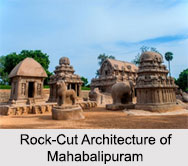
 The city of Mahabalipuram also known as Mamallapuram is famously known for its rock-cut monuments or temples, which were cut and decorated in the Mamalla style of the Pallava period in 7th century. These Cave Temples were a centre of art, architecture and literature during the reign of the Pallavas. During the rule of Mahendravarman I, Mahabalipuram flourished as a centre of art and culture. This period of artistic excellence was duly continued by his son Narasimhavarman I and subsequent Pallava kings. The Cave Temples are located on a hillock of the town, overlooking the Coromandel Coast of the Bay of Bengal.
Architecture of the Cave Temples of Mahabalipuram
The Pallavas were founders of this rock-cut architecture which later came to be known as the Dravidian style which became quite popular in South India during the medieval times. The procedure in creating these caves involved creation of a smooth rock face, then cutting columns through the polished rock faces of required size and then carving bas-reliefs on the walls of the cave. One of its unique features is its several striking mythological scenes carved in relief. The caves have a simple plan and elegant architectural style.
The distinctive features of the Pallava style includes finely carved slender, multi-faceted and sometimes fluted or round columns mounted on lions in a sitting posture in front of the entrances. These caves also have carvings of oval shaped human faces with slim bodies, tapering limbs and high cheekbones. The main figures are slender, delicate and elegant. Another particular feature noted in the caves is that the lingam are individual carvings and in prismatic shape.
The Cave Temples of Mahabalipuram
Out of the eleven temples or caves seen in Mahabalipuram, the most notable are the Varaha, Mahishasurmardini, Krishna and the Panchapandava Cave Temples.
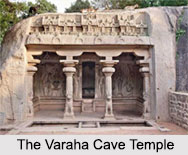 The Varaha Temple:This is the earliest of all Pallava structures in Mahabalipuram. The temple is dedicated to Lord Vishnu and was built before the reign of Mahendravarman I. The architecture of this temple is simple with a touch of Vaishnavism. This temple has fluted columns separating the openings, thus representing a certain Greco-Roman form of architectural style. This temple houses two relief sculptures of Pallava kings, Simhavishnu and Mahendravarman I, accompanied by their respective wives.
The temple is known for its four sculptures depicting Hindu legends, the prominent being the Varaha legend, where a wild boar similar to the avatar of Lord Vishnu rescues his wife Bhumi (the earth goddess) from Naga, the snake king from the waters of Patala. The legend of Vamana Trivikrama is another fascinating piece sculpted on the southern panel of the temple. It shows Vishnu Trivikrama as a dwarf with his third huge step covering the heavens with Bali sitting below amazed. Next to Vishnu are Brahma and Shiva seated on lotuses as witnesses.
Another panel in the east shows Gajalakshmi, the Goddess of Wealth seated on a lotus holding two lotus buds and is accompanied with elephants and maidens, who are holding auspicious jars of water. She also wears patra kundalas, one of five types of golden ear ornament, symbolizing her link to wealth. The fourth panel depicts Goddess Durga with four arms standing on a lotus. Durga symbolizes the Shakti (power) tradition and is called Vijaya Sri which means the goddess of victory. In the panel, there is a warrior ready to sacrifice himself for the goddess, and a devotee on one knee adoring her. This panel also portrays a frightened fleeing lion, which is her vahana, and an antelope depicting the medieval iconography common in South India.
 The Mahishasuramardini Cave Temple: Located on a hillock above the ruins of the Olakkannesvara temple, found at the southern end of the site locally known as Yamapuri lies the Mahishasurmardini Cave Temple. Mahishasuramardini is another name of the goddess Durga who is an incarnation of Shakti. She earned this name after slaying the buffalo headed demon Mahishasura.
The temple is an example of parallel construction by multiple artisans. The front mandapa has a triple cell with four pillars and two pilasters. It has two carved frescoes of Durga, one where she is seated on her lion with all her weapons in the posture of slaying the demon Mahishasura and the other panel carved the scene of Vishnu in a reclining posture on the bed of Ananta, the multi-hooded serpent. The central shrine has a large rock relief of Somaskanda, with Lord Shiva seated in a cross-legged yoga posture (Sukhasana) with Parvati and the infant Skanda next to him. Behind them Brahma, Vishnu and Surya stand as guardians.
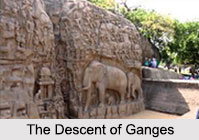
The Krishna Cave Temple: The Krishna Cave Temple with its sophistication and large detailed panels depicting the Hindu mythology shows the 7th century culture of Tamil Nadu. The temple is near the gigantic open air bas-relief called the Descent of Ganges. Alternatively known as Arjuna"s Penance, the Descent of Ganges is a sublime early sculpture made from pink granite narrating the tales from Indian epics like Mahabharata. It is a huge monolithic rock-cut structure which includes the biggest rock cut of India. The largest rock cut is 31m X 9m in length which depicts the penance of Arjuna to obtain weapons against his enemies.
The Krishna Cave Temples consist of four leonine mythical figures holding up the pillars and two pilasters. It depicts the story of Lord Shri Krishna who lifts up the Govardhan Parvat to save the people of Nandgaon against the curse of Lord Indra. There also scenes of Lord Krishna playing his flute and frolicking with the gopis (milk-maids).
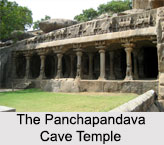 The Panchapandava Cave Temple: An unfinished cave temple with a largest cavern at 50 feet length. It is near the open air bas-relief of Arjuna"s Penance. There are six ferocious looking lions carved at the base of the pillars and pilasters, the brackets above the capitals of these pillars are decorated with lions and griffins with human riders.
The Cave Temples of Mahabalipuram are special in their architectural beauty in the sense that they reflect the excellent sculptures on the surface of the rock.
The nearest railway station is Chengalpattu Railway Station at 22 km, and the Chennai Airport is at a distance of 52 km.