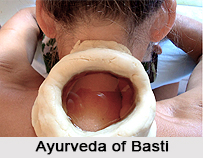
 Ayurveda mentions that just like all the process of Panchakarma, proper preparation is also required before the administration of basti. The preparation step is also considered as crucial for the administering a successful basti treatment. Firstly, snehana and swedana are administered for loosening aama and for opening the channels of the body so that it can be easily removed. It aids the effectiveness of both the cleansing and nourishing bastis. The procedure of basti is always carried out immediately after oleation and heating. These preparatory procedures help in making the patient feel calm and settled and his shrotas or channels are dilated. It also facilitates the work of the doshas that is mainly to remove the aama from the colon and deliver substances to the dhatus.
The ingredients of basti are freshly prepared. For instance, a typical anuwasan basti contains proportional amount of herbalized sesame oil and Nirooha basti contains herbal decoctions of water with a little oil. Black salt is also used to increase secretions in the colon. In order to facilitate the movement of the basti fluids from the rectum up through the descending colon and the patient always lies on the left side while receiving bastis. Moreover, the patient extends his left leg while bending his right knee and drawing it up towards the chest. The patient`s head is supported on a pillow. He should be made to feel completely relaxed and warm.
While administering basti, the temperature of this therapy must be somewhere near or at a level of body temperature for increasing the body`s receptivity to the treatment. The decoction is drawn up into a rectal syringe and introduced into the rectum through a thin rubber catheter. After the basti, the patient lies on his/her back and is allowed to take rest for 10 to 20 minutes. This quiet time is required as it gives the body the chance to make the most effective use of the basti. The time of basti administration is carefully noted along with the time of each subsequent bowel movement. Because of the small volume of anuwasan basti, it can be easily retained for a long period of time. However, in case of nirooha basti, there is the possibility that the patient might feel the urge to defecate within 45 minutes or even sooner.
Properly prepared and administered basti have proven remarkably successful in treating situations that have not responded to any other form of therapy.