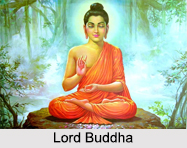
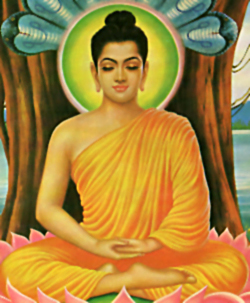
 Self-Purification is the fourth postulate of Spiritual Training or Sadhana according to Buddhism. In fact self-purification is the most essential thing in the spiritual training. Celibacy, restraint in thought, word and deed are the stepping-stones for this Path. It has been said that whether it is Yoga or Bhakti or the Path of Action, the practice of the five disciplines- Yamas, non-violence, truth, non-stealing, celibacy and non-possession is inevitable. Lord Buddha had emphasised a lot on self-purification. He had said, "The restraint in the body is good. The restraint in the speech is good. The restraint in the mind is good. The restraint in all things is good. The Bhikku, who is restrained in all things, is freed from all sorrow".
In fact in Dhammapada, Gautama Buddha had given emphasis on renunciation by citing his own example. He had said that he had won the bliss of renunciation which is not enjoyed by the worldling. The Lord had also advised his disciples to attain the extinction of all impurities.
Lord Buddha had spoken of several impurities like indolence, heedlessness, unchastity, niggardliness and evil deeds but he had said that the greatest impurity of all is ignorance. He in his sermons had advised his disciples to keep away from this impurity. According to the Lord an individual should practice restraint of the body, speech and mind. One must abandon all sins from the body and must practice virtue with his body. Similarly with speech and mind one should abandon the sins and practice virtue with their mind and speech. A man who is wise and steady is perfectly restrained with regard to their body, mind and speech. In fact an individual who is restrained in all things is free from all sorrow. The Lord had claimed that an individual who lives an immoderate and uncontrolled life Mar or the Tempter overwhelms him. On the other hand, an individual who leads a restrained and controlled life is not overwhelmed by the Tempter.
Dhammapada has said that defilement of such individuals increases if they are unruly and heedless. On the other hand the defilement of the ever vigilant and wise people comes to an end. Such persons whose defilement comes to an end are always alert about the nature of the body and neglect which should be avoided and does only that which should be done. In fact all defilements of that man eventually disappear, who is ever vigilant, and who is busy in study by day and by night and who strives after Nirvana.
The Lord had claimed that the virtuous people go to heaven and those who are free from all worldly desires go to Nirvana. Similarly those whose minds are well perfected in the elements of enlightenment, who without clinging to anything delight in the freedom from attachment whose appetites have been vanquished, who are full of light attain Nirvana in this world.
Lord Buddha had said towards the conclusion that Nirvana is not possible with the mere practice of disciplined conduct, austerities, study, meditation and secluded lodging but the most important of all is to get rid from all kinds of impurities in order to achieve salvation.