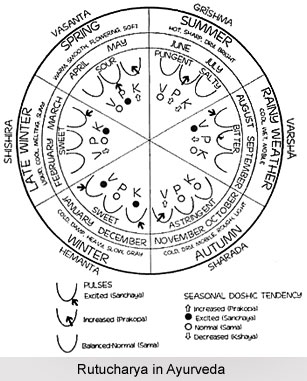
 Rutucharya in Ayurveda implies seasonal routine exercises. Human beings are integral parts of the nature. It is said that whatever takes place in the environment also happens inside the body. The human body is intimately affected by the various changes in the season, locale and climate. In Ayurveda, it is stated that maintaining rutucharya makes the body strong and healthy. People experience the seasonal changes as revitalizing and invigorating if their bodies are healthy and strong. Each season has its own impact on the balance of the doshas. Vihara in Ayurveda, which means the life supporting activities, recommends a seasonal specific routine that is required for keeping the body fit and healthy all the 12 months of the year.
Rutucharya helps in maintaining the proper lubrication of the body. Each and every season has different affects and influences over the body. For instance, during the cold winter season, elements of jala and prithvi dominate and the Kapha collects in the body. The body protects itself from the severe cold by holding and constricting on to its substances. Rasayanas are highly recommended during the winter season. As vata manifest excessively at this season, it is advisable to seek out Panchakarma therapy with more stress on nasya and basti karma.
Again, in the spring season, when the sun warms the air and likewise, kapha liquefies in the body and gets expelled through the dilated strotas. In the environment the element of vayu becomes lively in the environment. Spring is the season of new growth. At this time Vata increases its movements in the body and this particular aspect helps in the kapha eliminate its associated wastes in the body.
Moreover, during the spring season, mucous secretions become readily available for removal. Hence, rutucharya recommends gargling with a warm saline solution or gandush, first thing in the morning. It is recommended to clear mucus from the nasal passages and throat. In addition, rutucharya also recommends wearing warm dresses until the coolness in the environment drops. If kapha gets vitiated during the spring season then Ayurveda suggests Panchakarma therapy with more emphasis on Vamana.
It is a common fact that in spring, airborne allergens grow abundant. According to rutucharya one of the best ways to protect oneself from these types of irritants is applying ghee inside the nasal passages for trapping the allergens. Ayurveda also suggests that Agni gains more strength in the summer months in both the body as well as the environment. Therefore, rutucharya recommends eating light, less spicy and easily digestible food products along with the consumption of more liquid foods. Fresh fruits and juices are the best food items for summer season. It is also advised to avoid strenuous exercise and less exposure to the sun. Vata-reducing lifestyle and diet is advisable vata becomes aggravated during the summer months. Ayurveda suggests that if the symptoms specify that vata has become excessive in the body then one should undergo Panchakarma with more stress on Basti karma.
In the autumn season, Agni and Vayu bhutas command the environment. The Pitta that combined in the body during the summer starts to move out of its normal location when the influence of vata grows stronger. At this season, the natural efforts of the body to set out the wastes and toxins can produce acidity, erratic bowels and skin allergies. These are all the effects of the growth of the vita`s drying influence.
Rutucharya in Ayurveda recommends the use of external and internal oblation for maintaining proper lubrication in the body. At this season, since pitta gets aggravated, an excess accumulation can be eradicated by going through Panchakarma with an importance on Virechana.
Rutucharya in Ayurveda recommends effective therapies for every season that help in maintaining sound health throughout the year.