


 Role of actors in Kathakali is important as the audience deduce the basic message from them. Kathakali actors are masters in both Lasya and Tandava styles of classical dance. It is marvellous to watch these experts change from Lasya to Tandava and vice versa in the course of a performance. Their acting is both subjective and objective realisation of what they feel and describe. The aesthetic spiritual self-identification of the actors is complete. The Kathakali actors engage the audience for an hour with an elaborate description of a garden in full bloom. The audience will be so involved that he may not even realise that he has spent an hour in watching the performance.
The main characters are types in Kathakali. Each actor presents a particular type. The thematic content is derived from the myths and legends of the Hindu epics and the Indian Puranas. Kathakali drama has been restricted to about six character types. This is much larger when compared to the two or three types of characters of the folk-drama tradition. 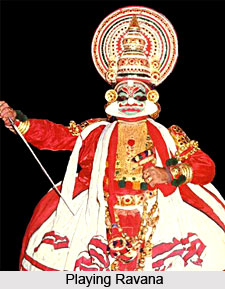 First is the satvika character of the Mahabharata and the Ramayana. Gods, demi Gods and heroes belong to this category of good characters. Lord Krishna and Lord Rama are characterized as gods and as good heroes. They are calm, good-humored and heroic. They are seen in moods of grace and valour only. In their angry mood they assume the Raudra rupa, mood of anger. Thus a character like Bhima assumes Raudra manifestation when he is in a state of anger which prompts him to kill Dussasana.
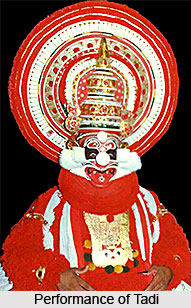
Secondly there are anti-heroes and villains, both human and demon. They represent the negative forces and are usually aggressive and ferocious. These are the stories of the Puranas. There is a further sub-division of villainous types. Humorous portions in Kathakali are occasionally presented in numbers in which Lord Hanuman appears. There are humour elements in the story of the meeting of Bhima with Hanuman. Kalyana Sougandhikam also has humour without ironical or satirical undertones which were presented by the vidushaka in the Koodiyattom tradition. Kathakali tradition also has characters like the half-man half-lion in Narasimha; half-man half-bird in Hamsa and the monkey deity Hanuman. There are a few other characters that cannot be categorized. They include women, rishis, children, messengers and so on. Finally, there are people who live in woods and forests and may be representing tribal peoples and aborigines. Five distinct types of actors namely Pacha, Kathi, Tadi, Minukku and Kari are identified in Kathakali. The characters which belong to the classification Pacha colour their faces deep green. They impersonate Gods and mythological heroes. Their lips are painted deep red. Love is the dominating emotion here. The Kathakali actors redden their eyes by applying the flower of Chunda. The characters classified under the group Kathi paint their faces red and green and they represent ferocious and evil beings such as Ravana, the demon king. A knife shaped reddish marking on either side of the nose extending to the cheeks distinguish the Kathi type of actors. They wear artificial teeth, cork spikes and claws. Actors who appear with white, red and black beards are called Tadi. Bali, Sugriva have red beards while Kali, Kattalan have black beards. Lord Hanuman is depicted as having a white beard. All these characters roar loudly. The actors who impersonate sage Narad, the wondering minstrel, ladies and ambassadors come under the group Minukku. They paint their faces in a mixture of yellow and light red, and put white dots on their cheeks. They have caste marks on their foreheads. They put black dye on the eye brows and redden the eyes and lips. Demons and evil characters symbolizing primitiveness and savagery are called Kari. The actors belonging to the group Kathi, Tadi and Kari characters give expression to some noise in moments of excitement whereas the other characters belonging to the other groups bear every storm of feeling in absolute and dignified silence. In order to perform wonderfully on the stage a Kathakali actor has to undergo strict training for a long period. Their training varies from eight to ten years. Therefore, to perform as a Kathakali actor is a difficult task as it involves a lot of creativity and sincerity. |
| |||



Home > Art & Culture > Indian Dances > Classical Dances of India > Kathakali Dance > Role Of Actors In Kathakali
Role Of Actors In Kathakali
| Role of Actors in Kathakali is vital as their gestures which include movement of the entire body presents the theme of this art form. |
| ||||||||||||||||||||||||||||

