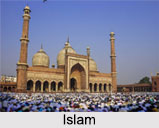
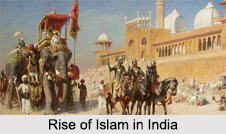
 Rise of Islam in India is the outcome of foreign invasion. In fact, the Indian history is dominated by the recurrent theme of foreign invasion. The most significant among the invaders were the Muslims, who invaded India as early as the 8th century. Each wave of invasion brought its own distinctive cultural practices and religious beliefs in the society of India.
1st Invasion of Islam in India
Islam was first ingrained in the lower Indus Valley by the Arab governors of the Umayyad Caliphs. In 711, Muhammad Ibn Qasim conquered Sindh on the crest of the earliest wave of Arab success. Qasim had been ordered by the Iraq governor to fight against piracy on the sea routes between the Arab lands and the western coastal regions of India and Ceylon. He stormed the pirate stronghold of Debal, defeated the Brahmin King Dahir, and reached the west bank of the Indus, before broadening his conquests with the capture of the cities of Bahmannadad and Alor. This initial wave of conquest was significant since it implanted Islam for the first time on Indian soil and also brought the Arabs large numbers of slaves for use in the conquered lands, enabling the economic potential of the agricultural heartlands of the Fertile Crescent to be fully exploited.
Impact of Islamic Invasion in India
After Muhammad Ibn Qasim, there was no large-scale Arab immigration. Arab influence slowly declined. This early Arab conquest had important consequence for the future policy of Muslims in India. As per Muslim practice, Qasim treated the idolatrous Hindus with religious tolerance, as "people of the book". He bestowed on them the status of zimmis or the protected. By the time of the constitution of Muslim supremacy at Lahore and Delhi, this liberal tradition was already well-established, diluting the rigorous provisions of the sharia with regard to idol-worshippers and non-believers.
Expansion of Islam in India
This initial link was maintained for over 300 years, a local event in the history of Islam but a major one in the history of India. The early traces of the rise of Islam in India were extinguished almost entirely by subsequent raids and in particular by the multiple invasions of the Afghans and the Turks in the coastal areas of Gujarat and the Deccan. There was widespread peaceful contact with the Islamic world.
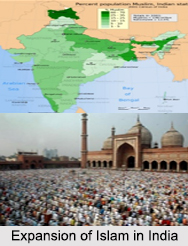 At Bhadreshwar in the Kutch, the Solah Khambi Masjid predates the great wave of the invasion of Muslim in the later parts of the 12th century and offers a tangible historical link with the remote coastal trading enclaves of early settlements of Muslims in India. From these coastal colonies at ports such as Cambay and Chaul, and that further south on the Malabar Coast, the Muslim missionaries travelled to spread Islam to Malaysia and Indonesia.
The full blow of Muslim military hit India in the earlier parts of the 11th century when the Turkish Ghaznavids under Mahmud of Ghazni conquered many of the Rajput rulers of the north-west, penetrated as far as Varanasi in the east, and sacked the legendary Somnath temple in Saurashtra on the west coast in 1026. These annual raids were restricted when the Seljuk Turks took Ghazni in 1038. With the rise of the Ghurids under Muhammad of Ghor in the 12th century, a considerable portion of northern India was absorbed into an Islamic Empire extending as far as the Caspian Sea.
In 1192, the Ghurids defeated Prithviraj Chauhan, the legendary Rajput ruler of Ajmer and Delhi, on the second battle of Tarain. The mounted archers of the army of the Muslims were formidable shock troops. They wreaked havoc among the Hindu and Rajput forces very often, who were cramped by their dependence on ponderous elephants and battle trains. Within 12 years of the death of Prithviraj Chauhan, the Hindus of northern India were reduced to tributary status under the rule of the Slave dynasty in India of the Muslims. The leader of the Muslim invasion,Qutb-Ud-Din Aibak , was the most successful of all the commanders of Muhammad of Ghor. Appointed viceroy and placed in charge of all the conquests of his master in India, he used his semi-autonomous position to carve out an extensive empire. He laid permanent foundations for the institution of Muslim power in northern India.
At first he strengthened his hold on Punjab, then, in rapid succession, he seized Ajmer, invaded the Gwalior Fort and conquered Delhi and Kanauj, reaching the distant stronghold of Kalinjar in the remote territory of Bundelkhand in 1203. Another Ghuri general, Ikhtiyar-ad-Din Muhammad Khalji, break through Bihar and Bengal, seized the ancient city of Gaur and attacked Assam. With the death of Muhammad of Ghor in 1206, Qutb-Ud-Din Aibak assumed power at Lahore.
The Slave dynasty, begun by Qutb-Ud-Din Aibak and maintained by his successors until 1290, was called so since three of its most important sultans; Aibak, Iltutmish and Balban, were former slaves who had received manumission before achieving royal power. The Delhi Sultanate was the first prominent centralized Muslim kingdom in India. The power of the Sultanate was recognized throughout the north and west. The Sultanate also helped in the rise and growth of Islam in India.