


 Religious Iconography is concerned with chronological art form which deals with the depiction, recognition, account and interpretation of the content or subject of images. The significance of the icons varies according to the difference of regions, periods and denomination of the followers. The Indian religions are abounding with several iconographies which bear different meanings. Religious iconography in India has incorporated various symbols and mudras. With the help of those symbols a devotee is able to relate to the deity more closely. Hence it can be said that iconography especially in religion is an essential part of human life. Religious Iconography is concerned with chronological art form which deals with the depiction, recognition, account and interpretation of the content or subject of images. The significance of the icons varies according to the difference of regions, periods and denomination of the followers. The Indian religions are abounding with several iconographies which bear different meanings. Religious iconography in India has incorporated various symbols and mudras. With the help of those symbols a devotee is able to relate to the deity more closely. Hence it can be said that iconography especially in religion is an essential part of human life.
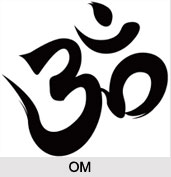
Different Religious Iconographies in India The religious iconography in India can be distinguished in following main heads on the source of popular sects: • Hindu Iconography: In Hinduism both male and female deities occupy a very prominent position. The chief male icons of Hinduism are Lord Shiva, Lord Vishnu, and Lord Brahma; while the prominent female icons of Hinduism are essentially Goddess Durga, Goddess Kali, Goddess Lakshmi and Goddess Saraswati. All these deities are actually Puranic ones and their prominence continue to this day in the Hindu iconography. Besides the various images of the deities of the Hindu gods and goddesses, there are several sacraments which form an integral part of Hindu iconography. They are Tilak, vibhuti and Rudraksha Mala. Vibhuti is also an auspicious ingredient of Hindu worship. Vibhuti is used on the forehead of a devotee to represent Lord Shiva. The other important symbols of Hindu iconography includes the symbol of 'OM'. OM in Hinduism represents the ultimate reality or the Brahman. Swastik on the other hand represents purity and truth of the soul. Sri Chakra Yantra is a mandala of 9 interlocking triangles. 4 of the 9 triangles represent the masculine power or Lord Shiva and the remaining 5 represents the female power. The 9 triangles together represent the cosmos and the reality of creation. 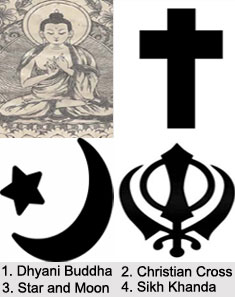 • Buddhist Iconography: The early figures of Buddha were different and distinctive from those of human because of their distinct lakshans. Description of 5 Dhyani Buddhas with their mantras, Mandalas, sakties or female counterparts started appearing. These Dhyani Buddhas represent the five Skandhas or the five cosmic elements of which the world is composed. Buddhist Lotus Flower symbolizes purity and balance which are generally associated with blossoms. • Buddhist Iconography: The early figures of Buddha were different and distinctive from those of human because of their distinct lakshans. Description of 5 Dhyani Buddhas with their mantras, Mandalas, sakties or female counterparts started appearing. These Dhyani Buddhas represent the five Skandhas or the five cosmic elements of which the world is composed. Buddhist Lotus Flower symbolizes purity and balance which are generally associated with blossoms.
• Christian Iconography: Christian Cross represents the cross on which Jesus was put to death; it is also a general sign which predates Christianity. The cross represents the harmony of two contradictory lines and in several early religions represented fire as it can be seen as two sticks being rubbed jointly. • Islamic Iconography: Divine symbols such as the star and moon imply soaring aspirations as well as the existence of a deity, both of which are significant in this and many other religions. The star and moon symbol is both culturally significant and transcending for Islam community. • Sikh Iconography: The Sikh Khanda traits some symbols which are significant to the religion. The logo is in a usually circular shape, with the circular Chakkar in the centre, which shows the harmony and all-encompassing nature of the religion and culture. In the centre there is the double edge sword, a common symbol in warrior culture. The two swords on either side symbolize the dual nature of the guru who leads the religion. • Jain Iconography: The icons in a Jain temple are organized in a hierarchical order. The head among them is the mula-nayaka like Rishabhanatha or Parsvanatha. The depiction of 24 Tirthankaras is called Chaturvimsati. To a superficial observer, the image of a Jina and Buddha look similar. |
| |||



Religious Iconography in India
| Religious Iconography in India is very prominent. Religious Iconography in India is most popular for the several symbols which are used in Hinduism. |
| ||||||||||||||||||||||||||||

