


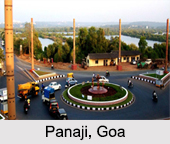
 Panaji is known to be the first city in India to be planned on a grid system with steeped streets and a 7 km long promenade. The city is a part of the Ilhas de Goa sub district and is nestled by the banks of the Mandovi River estuary. Panaji is one among the 100 cities to be developed as a smart city under the Smart Cities Mission. Panaji is known to be the first city in India to be planned on a grid system with steeped streets and a 7 km long promenade. The city is a part of the Ilhas de Goa sub district and is nestled by the banks of the Mandovi River estuary. Panaji is one among the 100 cities to be developed as a smart city under the Smart Cities Mission.
Etymology of Panaji The Portuguese name of the city is Pangim which in the year 1843 was officially renamed as Nova Goa to replace the city of Goa, currently known as Old Goa, as the capital of Portuguese India. But since the 1960s after the Indian administration, it was renamed to Panjim in an attempt to wipe out all Portuguese influence from the state. In Sanskrit, the word Panaji is derived from the panjani and khali, which means a boat and a small creek respectively. Thus the modern word Panjim is believed to be a corruption of the old word Panjanakhani as inscribed on the excavated Panjim copper-plates dated 1059 CE, belonging to the rule of Kadamba king Jayakesi I. History of Panaji Known to the 12th century ruling Kadambas as Pahajani- “the land that does not flood”, Panaji was once little more than a handful of fishing settlements. Eventually, in the later 15th century when Goa came under the control of the Muslim Emperor Sultan Yusuf Adil Shah, the city stood fortified with 5 hilltop forts and 55 cannons which would guard the mouth of the Mandovi River. Until the mid 18th century, Panaji used to be a tiny village but went on to become the capital of the erstwhile Portuguese rule in India in 1843. With the end of Operation Vijay, the Portuguese rule in India ended and the city along-with the other Portuguese territories came under the dominion of India in 1961 and became a state-capital on Goa's elevation to statehood in 1987. Over a span of almost 2 decades from 1961 to 1987, Panaji served as the capital of the Union Territories of Daman and Diu and Goa. A new Legislative Assembly complex was formed in the month of March 2000, over the Mandavi River in Alto Porvorim. Currently, the city of Panaji also serves as the administrative headquarters of the district of North Goa. 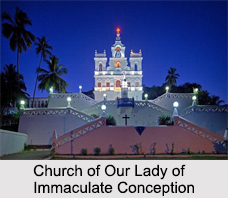 Geography of Panaji Geography of Panaji
Standing at an average elevation of 23 feet, the city of Panaji has a tropical monsoon type of climate. The city receives significant amounts of rainfall most months with short dry seasons. The average annual temperature here is 27.4 degree Celsius with an average precipitation of 2774 mm. In the month of July, precipitation reaches its peak, with an average of 930 mm. The warmest month is May when the highest temperature recorded is around 30.2 degree Celsius. The month of January is known to be the coldest month of the year with an average temperature of 25 degree Celsius; it is also known to be the month which receives the least amount of rainfall. Demographics of Panaji As per the reports of Census India 2011, the total population of Panaji was 114, 405 out of which the constitution of males and females were 52 percent and 48 percent respectively. The average literacy of the city is almost 91 percent with the male literacy being 95 percent and the female being 87 percent. The population of children between the ages 0 to 7 years old is at 9.6 percent. Tourism in Panaji With a hint of the Portuguese style setting, the city of Panaji is a remarkable place with ancient heritage sites and concrete structures of red tiled terracotta roof, promenade and churches. The street boulevards are lined with arrays of acacia and gulmohar trees; the city bears resemblance to Lisbon and mesmerizes the tourists with their Goan culture. Discussed below is a list of few popular tourist spots in the city. Our Lady of the Immaculate Conception Church: Standing on a small hillock, this colonial Portuguese Baroque style church was initially built as a chapel in 1541. The Our Lady of the Immaculate Conception Church was reconstructed as a church in the 1600s as a part of Portuguese Goa’s religious expansion. This white-washed church houses the second largest bell in Goa that weighs about 2,250 kg and was originally a part of the Augustinian Monastery. The main altar of the church is dedicated to Virgin Mary whereas the other three side altars are in honour of Jesus’ Crucifixion and Our Lady of the Rosary respectively. There is an annual festival of Our Lady of the Immaculate Conception held on 8th December, when the church is brightly illuminated and a fair is held, where tourists throng to. 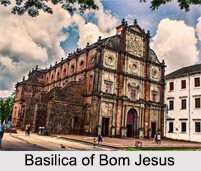 Ali Adil Shah Palace: This quintessential yellow and white building is the only Palace in Panaji. Also popularly known as the Old Secretariat, the Ali Adil Shah Palace used to be an ancient structure which was renovated by the Goa Government to house Goa Legislative Assembly in 1963. Currently, the palace is home to the art exhibitions and is now the Goa State Museum. Ali Adil Shah Palace: This quintessential yellow and white building is the only Palace in Panaji. Also popularly known as the Old Secretariat, the Ali Adil Shah Palace used to be an ancient structure which was renovated by the Goa Government to house Goa Legislative Assembly in 1963. Currently, the palace is home to the art exhibitions and is now the Goa State Museum.
Goa State Museum: Currently located in the Ali Adil Shah Palace, the Goa State Musuem displays the evolution of the history and culture of the Goan culture. With a wide variety of artefacts that belong to the different eras in the history of Goa, it thematically shows the importance of the traditions of the native people at different points in time. The museum has a display of about 8000 artefacts including stone sculptures, wooden objects, carvings, bronzes, paintings, manuscripts, rare coins, and anthropological objects. The Basilica of Bom Jesus: One of the oldest church in India and is a fine example of Jesuit architecture. The construction of the church began in the last decade of the 16th century and was sanctified in 1605. The Basilica of Bom Jesus was declared as a world heritage site by the UNESCO and is revered to be a holy place by Christians worldwide. Salim Ali Bird Sanctuary: Entrenched in the low mangrove forests on the western edge of the Chorao Island, the Salim Ali Bird Sanctuary spreads over an area of 440 acres. The excellent geographical location of the sanctuaryon the banks of the Mandovi River makes it the home to local and migratory avifauna. The sanctuary is accessible by a ferry ride but it remains restricted during the high tides. The sanctuary also has a watch tower to have a better view of the birds. Fiddler crabs and mudskippers are an easy spot with some other species of mangrove habitat. Birds like red knot, little bittern, pintails and coots can be seen here. Other popular tourist attractions in the city of Panaji are the famous beaches of Miramar and Bambolim, the promenades of Mandovi and Dona Paula, along with the Maha Lakshmi and Maruti Temples, etc. Visiting Information on Panaji The nearest airport to the city is the Dabolim Airport at a distance of about 28 km whereas the closest railway station is the Karmali station which is at a mere distance of 13 km from the city. |
| |||



Panaji
| Panaji, the capital city of Goa has always been a major tourist attraction. |
| ||||||||||||||||||||||||||||

