


 Mysore is situated about 138 km from Bengaluru and lies in a valley formed by two ridges. Steeped in history, the city speaks of the glory and grandeur of the Wadiyars as seen in the magnificent palaces, imposing buildings, sacred temples and beautifully laid out gardens. Haunted by the pervasive aroma of sandalwood and incense, the city is well maintained with wide, spacious streets, numerous parks and a high standard of visual amenity. Under the Wadiyar family Bangalore was developed as the administrative centre and Mysore became the focus for state spectacles. Mysore is situated about 138 km from Bengaluru and lies in a valley formed by two ridges. Steeped in history, the city speaks of the glory and grandeur of the Wadiyars as seen in the magnificent palaces, imposing buildings, sacred temples and beautifully laid out gardens. Haunted by the pervasive aroma of sandalwood and incense, the city is well maintained with wide, spacious streets, numerous parks and a high standard of visual amenity. Under the Wadiyar family Bangalore was developed as the administrative centre and Mysore became the focus for state spectacles.
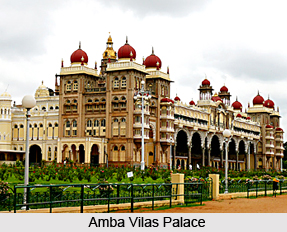
Modern Mysore is not particularly old; the entire town was leveled by Tipu Sultan in 1793 in order to build a new city. The old palace was reconstructed in the early 19th century along the lines of its predecessor, but this was never successful. In February 1897 it was severely damaged by fire. Today the centre of the city is dominated by the Amba Vilas Palace, which stands within the old Fort. A number of historical as well as religious monuments are found in abundance in the city of Mysore. Historical Monuments in Mysore 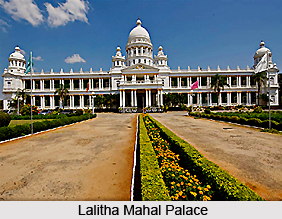 Mysore Palace is the most attractive monument in Mysore. Also known as the Amba Vilas Palace, it is located in the heart of the city at Mirza Road. It was the residence of the Wodeyar Maharajahs of the Mysore state. The original palace was built of wood and got burnt down in 1897.It was rebuilt for the twenty fourth Wodeyar Raja in 1912.The new Amba Vilas was designed by Henry Irwin, the versatile architect of the Viceregal Lodge, Simla.
It is a glorious construction in the Indo Saracenic style made of grey granite dominated by a five-storey minaret with a gilded dome. The building has a series of square towers with arches that are covered by domes. The palace is built around a courtyard. It faces a large square, which is enclosed by ornamental walls and triumphal gateways. To the east is the Elephant Gate, 20 m high. On the north side are the armory, library, lifts and staircases, above which he the music room, ladies' drawing-room and bedrooms. On the west side of the inner courtyard lies what remains of the old palace of 1800 and the zenana. To the south is the beautiful peacock marriage pavilion and beyond, on the second floor, the great Durbar Hall. The Peacock Pavilion or Marriage Pavilion is octagonal in plan, with stained glass from Glasgow and beautiful chandeliers from Czechoslovakia. There is also a dome carried on triple iron pillars. A purdah gallery encircles the hall. The floor is enriched with elaborate geometric patterns. 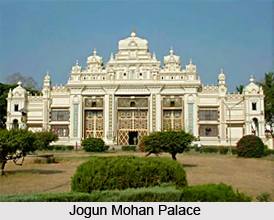 The Durbar Hall is one of the most exuberant rooms in India, a blaze of colour and sinuous forms. On the west wall are some decorative pictures from the Hindu epics painted by Ravi Varma and Raja Varma of Travancore. Between the pillars is fine Agra inlay work in jacinth and jasper, carnelian and carbuncle, amber and lapis lazuli. The ceiling is made of teakwood, enriched with spectacular stained glass. Every door has different details, which repay close inspection. One panel depicts the tiny Krishna kissing his baby toe. The throne, originally of fig wood overlaid with ivory but now of gold and silver, is remarkable. According to palace legend, it may have been the ancient throne of the Pandus.
The Armory has a collection of over 3,000 weapons and several 'Tiger's claws', fearful iron talons used to tear an adversary to pieces. In the inner courtyard are eight enormous bronze tigers by Robert William Colton, RA. The Music Room has elaborate European plaster-work and furniture. Immediately to the West of this lies the Jogun Mohan Palace. This palace is in two parts. On the East is a spacious pavilion with massive carved doors. It was built for the marriage of the Maharaja. It was also the scene of his installation by Lord Curzon in 1902. The western building is the Sri Chamarajendra Art Gallery and Museum. The Palace was converted into an art gallery in 1875 and houses paintings from that period. The famous Mysore Gold leaf paintings can be found exhibited in the gallery. 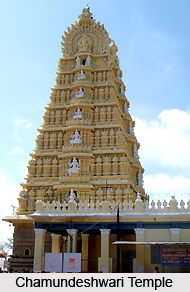 The Lalitha Mahal Palace was designed by E. W. Fritchley in 1930. It has a pedimented, two-storey centerpiece behind which rises a huge dome. The design has been derived from the St Paul's Cathedral, London. There are long, attenuated wings of paired Corinthian columns culminating in secondary domed pavilions. The Palace has now been converted into a hotel.
The interior of the Palace has been well preserved, with stained glass, ornamental plasterwork and delightful suites of principal rooms. The Palace can be approached via a long boulevard. On one side are the attractive lines of the Maharaja's Bodyguard. On the other are a series of simple Gothic bungalows. The Government House is a fine example of a European-style house of the period, with extensive verandahs and a small, open, central courtyard. Its construction was begun in 1800 under Colonel Wilks and by 1805 it had been enlarged and completed. It. The Banqueting Hall was added in 1807 to the designs of Captain Thomas Fiott de Havilland, who created the largest room in south India with a roof unsupported by pillars. It is an elegant and tasteful room with Venetian arches to the flanks. The house is well maintained for state guests and retains a marvelous period atmosphere from the days of the Raj. The northern entrance to the estate is marked also by a triumphal gateway. To the east of the long main drive is the old Maidan, used for polo and as a parade ground. 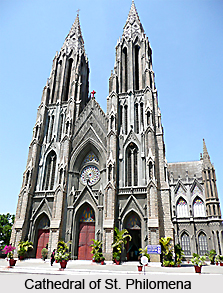 Wellington Lodge lies opposite to the west gate to Government House. It was the residence of the Commissioners of Mysore after the restoration of the Raja in 1799. There is a plaque which testifies to the occupation of the house by the future Duke of Wellington, then Colonel Arthur Wellesley, between 1799 and 1801.
Religious Monuments in Mysore Chamundi Hills can be reached by 13 km road or by climbing up the 1,000 steps laid out by the Mysore Maharaja in the 17th century. Halfway up the hill is a 4.8 meter monolith of Nandi, Shiva's bull. It has been hewn out of a single block of basalt in 1659.At the top is a Temple of the Goddess Chamundeshwari, the patron goddess of the Wodeyars. There is also a huge statue of the demon Mahisasura close to the temple. During the month of November December, the groundnut festival is held at the temple which is attended by hordes of worshippers. Also at the summit is the Palace Bungalow, a substantial mansion with breathtaking views of the city and countryside. The house embraces the core of a building erected in 1822 by Sir Arthur Cole. Azam Mosque or Great Mosque (1799) is one of over twenty mosques in the city. On the south side of Railway Station Road is the Jami Masjid (1830). It was erected by Tipu Sultan in the year 1787.The mosque has an elevated prayer hall and minarets on either side. The new Cathedral of St Philomena is an imposing example of the Gothic style. The construction started in 1931.However it was consecrated only in 1959. Its two peculiar spires are a local landmark.St.Philomena's is a beautiful Cathedral harking back to the medieval architectural style. The stained glass works and huge lofty windows make the Church a rather remarkable structure. St Bartholomew's (1830-31), the Anglican Church instigated by Francis Lewis, is unprepossessing but historically interesting. |
| |||



Home > Art & Culture > Indian Monuments > Indian Regional Monuments > Monuments of Karnataka > Monuments Of Mysore
Monuments Of Mysore
| Monuments of Mysore include several ancient palaces and temples. These edifices are known for their classic architecture and reflect the glory and grandeur that once surrounded the city. |
| ||||||||||||||||||||||||||||

