 Besides these there are later recorded visits by a friar, Jordanus, in 1347, Chinese travellers in 1409 and a Persian in 1442.Pepper was taken to Portugal for the first time by Cabral, and he was followed by a number of fellow adventurers including Vasco da Gama, who in 1502 established a factory in 1502. Later Albuquerque established a fort here. Portuguese friars who travelled with him founded a chapel on the site of the Church of St Francis. From 1530 onwards St Francis Xavier preached here and made many converts. Though the English were able to set up a factory here after repeated attempts, in 1663 the Dutch managed to establish a stronghold over the town. They did much to improve it. The Franciscan church was made into a Protestant chapel and the cathedral used as a warehouse. In 1778 the fort was reconstructed and seven strong bastions were also built. With the fall of Holland to France in 1795, the British seized the Dutch possessions in India. Kochi was captured on 20 October 1795 by Major Petric. Nine years later the cathedral, most of the fort and the quays were blown up by the British.
The Christian influence in Kochi or Cochin was quite strong. A number of churches built by the European still stand today.
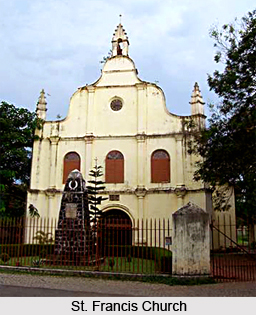
 The St Francis Church, for instance, is the oldest European Church in India. It was built by the Portuguese in Fort Cochin. It is a plain, massive structure built by the Portuguese Franciscan friars who sailed with Pedro Alvarez Cabral. The original wooden church was replaced in stone in 1546. The church with a simple fa‡ade became a model for the later churches. Vasco Da Gama was initially buried here, before being removed to Lisbon. After the occupation of Kochi by the British in 1795 the church became Anglican. Today it is used by the Church of South India. Within the church there are numerous gravestones with inscriptions, the earliest a Portuguese epitaph. The earliest Portuguese tombs date from 1546 AD while those of the Dutch date back to 1664 AD.
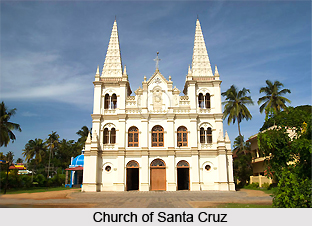
The Church of Santa Cruz was also constructed by the Portuguese in 1505. It was named a Cathedral in 1558. The British later destroyed this Cathedral and the Church as it stands today was built in 1905. It was raised to the Status of a Basilica by pope John Paul II in 1984.
The Pallipuram fort at Vypeen, the oldest surviving European in India, was built by the Portuguese in 1503. Legend has it that the fort was captured by the Dutch in 1661. However the History of Cochin states that it was sold to the state of Travancore in 1789. The various western influences that have shaped Kochi are evident here in the architecture, decoration and materials used which are symbolic of a different era of life.
The Catholic Church at Pallipuram is an important pilgrimage site and attracts a lot of tourists.
 Pallipuram fort can be easily reached by means of a ferry service operating from Ernakulam boat jetty and Fort Kochi to Vypeen. Buses are also available for getting to Vypeen and then to Pallipuram.
Amongst the historical edifices there is the Mattencherry or Dutch Palace. It was originally built by the Portuguese in the mid 1500. It was later renovated by the Dutch in 1663. It was presented as a token to the Cochin Rajah in lieu of greater trading privileges. The palace basically comprises of a two storey building set around a quadrangle. There is a shrine of Goddess Bhagavati contained in the Courtyard. The main hall on the first floor was the Coronation Hall of the Rajahs. The adjacent Halls and bed chambers are adorned with exquisite seventeenth century murals depicting scenes from the Hindu epics of the Mahabharata and the Ramayana.
The palace is today a museum with rare collection of murals and royal artefacts. The central Durbar Hall, where coronation ceremonies were once held, is today a portrait gallery of Kochi rulers; it also displays textiles. There is an interesting exhibition of court dress and other artefacts from the palace.
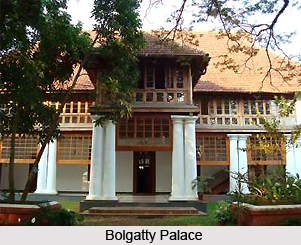
 Other than this the Bolgatty Palace is one of the oldest Dutch Palaces outside Holland. It was built in 1744 by a Dutch trader. It was later extended and a beautiful garden was built around it. It was initially built as a palace for the Dutch Governor. In 1909 it was leased to the British. From then on it continued to serve as the seat of the British Resident of Cochin till India attained independence in 1947.It was then handed over to the state and is today a heritage hotel set in lush greenery. The palace is a two-storied building with bath attached well-decorated bedchambers and a huge lounge wherein historical portraits are displayed.
The Jewish quarter is located at the end of the long main street in Mattencherry.There are two synagogues here-one belongs to the black Jews and the other to the white Jews. The Black Jews arrived in India much earlier in 567 BC whereas the White Jews arrived later.
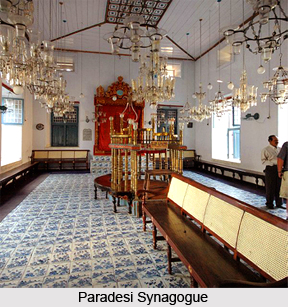
The synagogue of the White Jews, built in 1568, is the oldest in the Commonwealth. It is located near the Dutch Palace ion Mattencherry. The building was destroyed by the Portuguese in 1662 but reinstated by the Dutch.
Also known as the Paradesi Synagogue, it has a floor of white, willow-pattern Chinese tiles brought from Canton in the mid-18th century by Ezekiel Rahabi, who was also responsible for the clock tower above. Among the possessions are the Great Scrolls of the Old Testament and copper plates recording the grant of privileges by King Ravi Varman (962-1020) to the Jewish merchant Joseph Rabban.
The narrow lanes around the synagogue are crammed with Dutch-style residences. These are now used as antique shops.
The largest archaeological museum in Kerala is the Hill Palace. It is located near Tripunithura and was constructed in 1865 as the administrative office of the Kochi Rajahs. The palace complex consists of 49 buildings spread across 54 acres, built in te traditional architectural style of Kerala. Within the complex are an archaeological Museum, Deer Park, a Pre-historic Park, a Heritage Museum and a children`s museum. The surrounding land is full of rare medicinal plants. The museum displays the splendour and wealth of the Rajahs of Kochi including the throne and the crown. There is also a large collection of archaeological findings.
The mix of cultures and religion here have resulted in the construction of a number of beautiful monuments which are a must see in Kochi.