


 Allahabad is one of the largest cities of the state of Uttar Pradesh. This former capital of the North-West Provinces is also known as 'Prayag'. It is one of four spots of the very popular 'Kumbha Mela'. Allahabad, a religious center, has a significant position in Hindu scriptures as it stands symbolically at the confluence of the Ganges and Yamuna. This point is the 'Triveni Sangam', of three holy rivers, Ganges and Yamuna and Sarasvati. This town has always been of deliberate importance. It was held effectively during the Mutiny. Again in the year 1885, the first Indian National Congress was held in Allahabad. At this city, an annual Hindu religious festival is organized every year that is known as the 'Magh Mela' in between 15th of January and 15th of February. Allahabad is one of the largest cities of the state of Uttar Pradesh. This former capital of the North-West Provinces is also known as 'Prayag'. It is one of four spots of the very popular 'Kumbha Mela'. Allahabad, a religious center, has a significant position in Hindu scriptures as it stands symbolically at the confluence of the Ganges and Yamuna. This point is the 'Triveni Sangam', of three holy rivers, Ganges and Yamuna and Sarasvati. This town has always been of deliberate importance. It was held effectively during the Mutiny. Again in the year 1885, the first Indian National Congress was held in Allahabad. At this city, an annual Hindu religious festival is organized every year that is known as the 'Magh Mela' in between 15th of January and 15th of February.
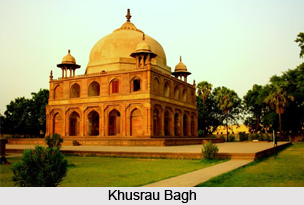
This old historical city has several ancient places of interest. For instance, the bridge over the Yamuna River (1865), just above the confluence is a great example of the British engineering. It is over 3,300 feet long. Immediately to the south of the railway station of this city is the 'Khusrau Bagh'. The area is entered through an old doorway that is 60 feet high. Khusrau was the elder brother of the Emperor Shah Jahan. He died in the year 1615 and the tomb was completed seven years later. The actual burial chamber is underground. It was enriched with plasterwork and was painted with birds and flowers and Persian inscriptions. West of the tomb is another tomb, which is believed to be the tomb of Khusrau's sister. North of the railway station is Canning Town, the European quarter, designed and laid out on a framework pattern by Cuthbert Bensey Thornhill in the 1860s. It is an impressive cantonment with broad tree-lined streets. Here, among the principal buildings are the 'Old High Court' and other Public Offices, four two-storey blocks of sandstone built in classical style by Colonel Pick in 1870s. 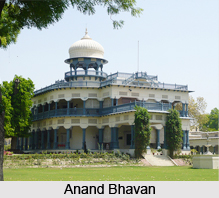 All Saints' Cathedral, designed by William Emerson (later President of the Royal Institute of British Architects) in complete Gothic style, was commenced in the year 1877. Standing in a grass compound at a major junction, it is in white stone with red sandstone dressings. The pavement to the choir and sanctuary is constructed pure Jaipur marble. At the east end of the station there is the Alfred Park, established in the year 1870 to commemorate the royal visit by the Duke of Edinburgh. At the end of the park is the Thornhill and Mayne Memorial (1878), made by R. Roskell Bayne. The memorial has a lofty tower and arcaded cloisters. Nearby in the park there is an open limestone canopy which once covered a large statue of Queen Victoria, but was ultimately removed in the year 1957. All Saints' Cathedral, designed by William Emerson (later President of the Royal Institute of British Architects) in complete Gothic style, was commenced in the year 1877. Standing in a grass compound at a major junction, it is in white stone with red sandstone dressings. The pavement to the choir and sanctuary is constructed pure Jaipur marble. At the east end of the station there is the Alfred Park, established in the year 1870 to commemorate the royal visit by the Duke of Edinburgh. At the end of the park is the Thornhill and Mayne Memorial (1878), made by R. Roskell Bayne. The memorial has a lofty tower and arcaded cloisters. Nearby in the park there is an open limestone canopy which once covered a large statue of Queen Victoria, but was ultimately removed in the year 1957.
To the north of this park, there is the Muir College, founded by William Emerson. Its designs reflect an excellent and imaginative Indo-Saracenic architecture. Commenced in 1874 and opened in the year 1886, it comprises an arcaded quadrangle which is dominated by a 200 feet high minaret tower in cream-coloured sandstone with marble and mosaic floors. The domes are covered in glazed tiles and the whole exercise is wonderfully well-planned. To the west of this College is the Mayo Memorial Hall (1879), comprising a large hall with a tower 180 feet high; it is an extraordinary and far less composed as compared to the Thornhill and Mayne Memorial. The interior is decorated with designs by Professor Gamble of the South Kensington Museum, London. At the west of Alfred Park is St Joseph's Roman Catholic Cathedral (1879), constructed in the Italian style, and the Bishop's Palace. The 'Anand Bhavan', formerly the home of the Nehru family, is a national monument. Another popular monument is 'Holy Trinity Church' (early 19th century), on the road to the Fort. It is a fine composition based on Gibbs's prototype of St Martin-in-the-Fields, London. The Allahabad Fort, built from the year 1583 onwards by Akbar, stands at the junction of the two great rivers. It was the largest of Akbar's forts, and although its original form has been much impaired by early restoration work, the splendid Zenana Palace still survives. It is a fine pavilion, with a central square hall carried on sixty-four columns bordered by a deep veranda of double columns and there are clusters of four in each corner. 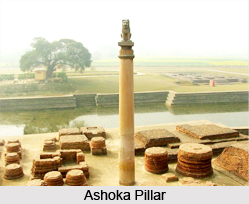
Under the wall of the palace, there is the so-called 'Undying Banyan Tree' or Akshai Vata. In front of the entrance to the-Fort is the 'Ashoka Pillar', 35 feet high, it is made up of polished stone. Edicts of Ashoka are inscribed on it. A number of other buildings are of there in the city of Allahabad of architectural interest. The Law College and University Library (1911), in Indo-Saracenic style by Sir Samuel Swinton Jacob, are such instances of popular monuments. The new High Court (1916), by Frank Lishman, is one of the best expressions of Edwardian Baroque architecture in the country, subtly adapted to the climate. Conceived in a grand manner, it has a domed, pediment centrepiece, but the arcaded wings have pierced stone railings and engrailed arches in a very stylish synthesis depicting Eastern and Western influences. Out to the west of the Fort is 'Minto Park', with a memorial pillar to the Royal Proclamation of the Assumption of Rule by the British Crown in the year 1858. The pillar is enriched with royal medallions and it has four lions carrying the Imperial coronet. The Municipal Museum is a wealth house of remarkable archaeological artifacts with a fine collection of early Indian coins. Here, the exhibition of terracotta works is unique. There is also a fascinating display of paintings by the Russian artist Nicholas Rocrich reflecting haunting landscapes of Central Asia. Adjoining the Museum is the Library, which contains thousands of ancient Sanskrit manuscripts, which are priceless. Monuments of Allahabad bear great historical and traditional importance. They attract the people from various parts of the world. |
| |||



Home > Art & Culture > Indian Monuments > Indian Regional Monuments > Monuments of Uttar Pradesh > Monuments of Allahabad
Monuments of Allahabad
| Monuments of Allahabad are simply majestic and narrate the incidents of the bygone era. This historical place has a number of ancient monuments that are of immense significance both culturally and historically. Monuments of Allahabad are chief attractions for the tourists. They stand as memories of the colonial as well as Mughal past of the city. |
| ||||||||||||||||||||||||||||

