


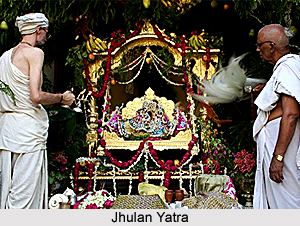
 Jhulan Yatra, an Indian religious festival, celebrates the divine love of Lord Krishna and Radha. It is known as the swing festival, is celebrated in the month of Shravan and on the day of Pavitra Ekadasi. This festival is usually observed for five days till the Balaram Purnima or the Shravan Purnima. There are several temples in Brajabhumi where this yatra is observed for a longer or shorter duration. There are also temples where the festival of Jhulan Yatra is celebrated with lot of pomp and glory only for a single day whereas in various other temples the same is observed on all the five days, starting from Ekadasi till Purnima. Jhulan Yatra, an Indian religious festival, celebrates the divine love of Lord Krishna and Radha. It is known as the swing festival, is celebrated in the month of Shravan and on the day of Pavitra Ekadasi. This festival is usually observed for five days till the Balaram Purnima or the Shravan Purnima. There are several temples in Brajabhumi where this yatra is observed for a longer or shorter duration. There are also temples where the festival of Jhulan Yatra is celebrated with lot of pomp and glory only for a single day whereas in various other temples the same is observed on all the five days, starting from Ekadasi till Purnima.
Jhulan Yatra festival is not a mere ritual. Besides commemorating the divine love of Lord Krishnaand Radha, it also celebrates the love of the devotees towards them. It is believed that Sri Krishna is the ultimate enjoyer and that he only arranges several situations wherein he could incorporate his different parts and parcels into his service which is regarded as the natural condition of human beings in the spiritual environment. The weather changes from Vasant Panchami (spring) onwards when each and every individual is dressed in yellow and visits the fields, does the fertility rites, and plants some new crops, etc., and in the Dol Purnima, when scented flowers and powders are spread over the body of the Lord in a jovial mood, and dancing and singing goes on to please the Lord. With the rise in temperature in the summer, the Chandan Yatra is organized, where, from the Akshaya Tritiya for a duration of twenty one days, the body of the Lord is oiled with the help of a cooling paste of scented sandalwood which is also mixed with musk, camphor and saffron. However, the paste is not enough to cool the body of the Lord and then the Snan Purnima is celebrated in the Jyestha month with the ceremonial bath of the Lord with the help of cool scented water, yoghurt, milk, etc. This festival is celebrated well in the abode of Jagannath, i.e. Puri; however the main event originated in Vrindavan with the worshippers bathing the Lord Krishna and Lord Balaram for their pleasure and after that bathing themselves too. In this festive season there is nothing better than to bathe in some kind of pleasant and cool water. Every temple of Vrindavan celebrates this festival, and a large number of devotees follow a chain of pilgrimage from one temple to the other from early in the morning till late evening. 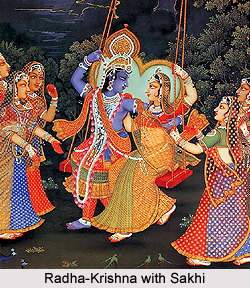 The other famous festival is the Rath Yatra which is celebrated every year where the followers of the Lord symbolically carry Lord Krishna (Jagannath), his brother Balaram and the Goddess, Devi Subhadra on chariots, with attractive flapping covers, back to rural Vrindavan. Then comes the famous Jhulan Yatra festival in which a number of the deities of the Lord Krishna wearing different green clothes until the Balaram Purnima. The season of monsoon is extremely humid, and severe rain has not been able to lower the temperature. This period thus asks to get some cool breeze, since the air is heavy due to the humidity of the rains. Therefore, the followers of Lord Krishna arrange for the satisfaction and pleasure of Srimati Radharani and Lord Krishna by positioning them on a swing or a Jhulan and forming their own breeze from the to and fro motion. This is one of the most beautiful and satisfying festivals with the swings elegantly decorated with forest creepers, streamers of garlands and jasmine or malati which has blossomed newly in the season. Fine rose water spray is also directed towards the Divine Couple of Radha and Krishna on the swing. The other famous festival is the Rath Yatra which is celebrated every year where the followers of the Lord symbolically carry Lord Krishna (Jagannath), his brother Balaram and the Goddess, Devi Subhadra on chariots, with attractive flapping covers, back to rural Vrindavan. Then comes the famous Jhulan Yatra festival in which a number of the deities of the Lord Krishna wearing different green clothes until the Balaram Purnima. The season of monsoon is extremely humid, and severe rain has not been able to lower the temperature. This period thus asks to get some cool breeze, since the air is heavy due to the humidity of the rains. Therefore, the followers of Lord Krishna arrange for the satisfaction and pleasure of Srimati Radharani and Lord Krishna by positioning them on a swing or a Jhulan and forming their own breeze from the to and fro motion. This is one of the most beautiful and satisfying festivals with the swings elegantly decorated with forest creepers, streamers of garlands and jasmine or malati which has blossomed newly in the season. Fine rose water spray is also directed towards the Divine Couple of Radha and Krishna on the swing.
Among different festivals arranged in Vrindavan, the favorite festival of Lord Krishna is Jhulan Yatra. During the Yatra Lord Krishna and Srimati Radharani meet in Vrindavan's sylvan woods, where the sakhis have arranged a fascinating jhula designed with flowers, which hangs from the branches of a Kadamba tree. The stretched golden ropes are tangled with madhavi and jasmine creepers and several fragrant flowers. Lord Krishna pulls Radharani towards the swing next to him and sometimes the Lord jumps to the swing suddenly to the utter surprise of Radharani. Then the sakhis spread the flowers on the Divine Couple and aarti is performed for the God and Goddess. The sakhis also serve garlands, sweet scented paan and also spray cool rose-water. After that two manjaris smoothly start pushing the swing. The heavenly goddesses observe the glorious Jhulan Yatra of Sri Radha Govinda and admire their respective good fortune. They modestly contribute to the celebration of the festival by respectfully showering heavenly flowers over the youthful couple. Then the clouds also shower an excellent spray of cool and misty rain over the forest. In order to please the Lord Krishna and Radharani, the sakhis sing melodic jhulan songs. Pleased utterly, Lord Krishna, who is considered to be the king of Pranksters, starts to swing faster and faster. Finally, the swing attains such a height that the back of Radhika touches the leaves on the higher branches of the tall kadamba tree. Thus afraid of it, Radha would beg Krishna to get shower and the sakhis also start shouting at Krishna to stop. Krishna pretends not to have heard them and starts to swings even faster than before. The long braid of Radhika loosens and the veil flies off. Afraid of that she might lose her ghagra in the process, Radhika tries to catch it tightly with the help of her two legs. At this state of Radharani, Krishna laughs heartily. Krishna again increases the pace of the swing and Radha, with eyes full of fear, clings to Krishna firmly. The union of Radha Madhava on the swing resembles a brilliant flash of lightning in the middle of a dark rain cloud. Ultimately, Krishna having accomplished his objective and slows down and permits the sakhis to hold the swing to stop. Radharani then sits Lalita besides Krishna in the swing and pushes it herself and sings divinely. Krishna repeats the same thing with Lalita which he did with Radhika and he continued with the same work with Vishakha and a number of other gopis. He then expands his self in several forms to swing on a large number of swings along with two sakhis on both the side. Each and every gopi feels that Krishna was swinging with her alone. After all this, Vrinda Devi escorts the divine couple to an elegantly designed swing which is in the shape of a big open lotus. Krishna sits on the centre seat and his left arm is placed around the shoulder of Radhika. The eight sakhis grace their seats on the eight petals of the Lotus Swing surrounding Krishna and the other sixteen assistant sakhis position themselves on the outer sixteen petals. Vrinda Devi then provides cool paanaka drink and tasty dates, grapes, jamun and various other fruits to the Radha Madhava. After that the sakhis eat the remaining fruits. After the refreshment is over, Nandimukhi and Vrinda smoothly push the swing back and forth. The Jhulan Yatra is not simply a ritual but a divine message from the Lord Krishna to be one with nature. In order to enjoy the monsoon season one needs to swing on a swing in the charming and cool monsoon breezes. It is believed that in order to understand Lord Krishna, one is required to get a clear understanding of the Mother Nature. Jhulan Yatra is celebrated with fervour in Vrindavan, Mathura, Orissa and in various Lord Krishna temples across India. In the ISKCON temples Jhulan yatra is one of the major festivals to be organised in a grand manner every year. |
| |||



Home > Art & Culture > Indian Festivals > Indian Religious Festivals > Hindu Festivals > Jhulan Yatra
Jhulan Yatra
| Jhulan Yatra is celebrated in the monsoon season to commemorate the divine love of Radha and Krishna. |
| ||||||||||||||||||||||||||||

