|
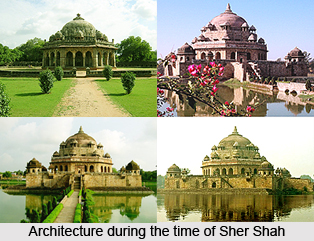 Indian Architecture during the rule of Sher Shah Suri can be segregated into two distinct periods, with the first phase starting from the capital of Sher Shah Suri at Sasaram, in the Indian state of Bihar, between 1530 and 1540 and the second phase was between 1540 and 1545. Indian Architecture during the rule of Sher Shah Suri can be segregated into two distinct periods, with the first phase starting from the capital of Sher Shah Suri at Sasaram, in the Indian state of Bihar, between 1530 and 1540 and the second phase was between 1540 and 1545.
During the first phase which runs from 1530 to 1540, a group of tombs were constructed taking the Lodi style to its ultimate expression. During the second phase from 1540 to 1545, when Sher Shah Suri wrested control from Humayun, he patronized a list of architectural innovations which represent an important development in the gestation of the subsequent Mughal architecture.
The first phase of construction of tombs at Sasaramin the state of Bihar clearly reflects the ambition of Sher Shah Suri to form a monument grander than anything available in Delhi. In the process of inspiring his dreams, he procured the services of Aliwal Khan, a master builder who was trained in the Imperial tradition. Aliwal Khan began with the construction of the tomb of Hasan Sur Khan, the father of Sher Shah Suri in the year 1525. This is a pretty conventional exercise in Lodi design, but his subsequent work, the tomb of Sher Shah Suri, is an amazing building, an architectural wonder, a huge and a noble composition set in a beautiful tank approached by a causeway. This remarkable monument, formed by the finest Chunar sandstone, had a significant impact on the architectural evolution of Indo-Islamic funerary architecture.
 The second phase of development of Indian architecture occurred at Delhi from 1540 to 1545, where Sher Shah Sur erected the Purana Qila or Old Fort; a defensive citadel meant to provide the focus of his sixth city of Delhi, Shergarh. Presently, only two isolated gateways survive. Far more influential in the subsequent development of the architecture of Mughals was the Qila-i-Kuhna Masjid, the royal chapel of Sher Shah Suri, constructed at about 1542, which exemplifies graphically the skill, confidence and expertise of the craftsmen of Suri Dynasty. The mosque is a realistic and eloquent essay, a disciplined and balanced composition with confidently contoured four-centred arches set in definite rectangular frames, counterbalanced by delicate spearhead fringes and merlons and formulated by the horizontal line of the projecting chajja into a well-integrated whole. The interior is also evenly accomplished.
The declared ambition of Sher Shah Suri was to construct such an architectural embellishment that foe and friend might render their tribute of applause, and that his name might remain honoured on the earth until the day of resurrection. The product of his strange egotism was the chief advance in the development of an architectural style which reached its apex under the rule of his successors. After the death of Sher Shah Suri, his son Salirn succeeded to the throne. With the exception of the Salimgarh, a defensive outwork to the Red Fort in Delhi, the architectural impulse which motivated his father so much, went down.
|





