


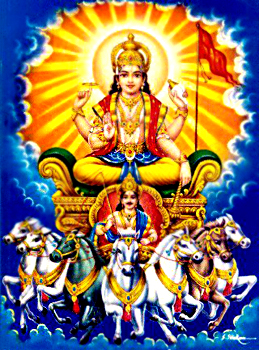
 Iconography of Surya had occupied a very important position in India. Surya has been worshipped in India from the early times. The Vedas refer to Surya and his various aspects namely Savitri, Pusan, Bhaga, Vivasvat, Mitra, Aryaman and Vishnu. Most of these deities along with a few others formed the class of gods called Adityas. The various aspects of Lord Surya have been numbered as twelve. The worship of twelve Adityas along with the Navagrahas came to occupy an important place in the religious life of the people. The Navagrahas are Ravi, Soma, Mangala, Budha, Brihaspati, Sukra, Sani, Rahu and Ketu. Among these nine names barring the first two and the last two all are planets. According to the Grahayaya or Svastyana-vidhi the Navagrahas are to be worshipped by all in times of danger, for it is believed that the troubles occur from the wrath of these planetary positions. As Surya is a deity of yesteryears for the Hindus it is obvious that the iconography of Surya will occupy a prominent position. Iconography of Surya had occupied a very important position in India. Surya has been worshipped in India from the early times. The Vedas refer to Surya and his various aspects namely Savitri, Pusan, Bhaga, Vivasvat, Mitra, Aryaman and Vishnu. Most of these deities along with a few others formed the class of gods called Adityas. The various aspects of Lord Surya have been numbered as twelve. The worship of twelve Adityas along with the Navagrahas came to occupy an important place in the religious life of the people. The Navagrahas are Ravi, Soma, Mangala, Budha, Brihaspati, Sukra, Sani, Rahu and Ketu. Among these nine names barring the first two and the last two all are planets. According to the Grahayaya or Svastyana-vidhi the Navagrahas are to be worshipped by all in times of danger, for it is believed that the troubles occur from the wrath of these planetary positions. As Surya is a deity of yesteryears for the Hindus it is obvious that the iconography of Surya will occupy a prominent position.
The figures of Lord Surya are generally represented in a standing pose on stone slabs. The deities are rarely represented in a seating position. The Sun God is generally represented by means of various symbols before the development of solar cult. Surya however appeared in human form from an early period in Indian history. The early Surya images seldom fail to show the alien features although gradual idealization of these traits and emphasis of Indian elements appear to have begun from the Gupta period. Sometimes the images made of bluish black stone forms the model of the iconic type. The figures of Dandi and Pingala generally occur on two sides of the main figure while the figure of Aruna is shown as the charioteer. The two arrow shooting goddesses namely Usha and Pratysha appear as accessories on either sides of the chariot. The chariot with seven horses and one wheel appear interestingly carved on the pedestal. The Kushana dress is absent, but the sacred thread on the body of the deity and his other attendants like Mahasweta and the two consorts namely Samjna and Chaya, Samjna's earthy double almost invariably found present in such images of the Pala period. The images of Surya which is found is generally ornamented in style with the floral sign at the top with a flying Vidhyadhara on either side of the deity. The girdle which holds the deity's cloth tight round the waist is decorated with artistic hangings and a dagger is shown attached to the right side of the girdle. The high foot wears which cover the legs of the god are partially visible. The god wears a necklace, a sacred thread and ear rings and an artistically worked elongated head dress. He holds two lotuses in his two hands which rise a little above his shoulders. The bearded figure of Pingala is shown on the right side of the deity with pen and ink stand in his hands, the figure of Dandi stands to the left with a sword in his right hand while his left hand rests on the staff. The two consorts of the deity namely Samjna and Chaya are shown as standing on the left and right sides of the main figure respectively. The figure of the goddess Mahasweta is placed in front of the god. The iconography shows that Aruna is driving the chariot of one wheel and drawn by seven horses. Two arrow shooting goddesses namely Usa and Pratyusha are shown to the right and left of Pinga and Dandi respectively. The agni kundas near the deity is issued a lotus on which the god is made to stand. Originally the sun-god is shown represented in a standing position holding a full blown lotus in each of his two hands. The deity also wears ornaments on the body and a square shaped and flat head dress. The graham-devatas found here are beautifully carved as standing in a row on low pedestals, with Ganesha in front of the row. All the deities are shown as two-armed and they hold their respective attributes excepting the fierce-looking pingalorddhakesa. In some of the iconographies of Surya Rahu whose hands are shown in the tarpana-mudra. In some cases the two-armed gods are shown standing in a row with raised holding lotuses with usual head-dresses. Their bodies are adorned with necklaces and yajno-pavitas. The lower portion of the panel is also broken. But the clothes which are worn by the deity of Surya are visible. |
| |||



Iconography Of Surya
| Iconography of Surya is ancient in India. The iconography of the deity is more common in a standing position. |
| ||||||||||||||||||||||||||||

