


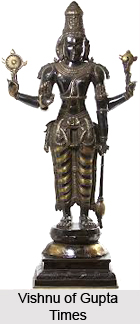
 Lord Vishnu of the Vedic tradition is noted therein for his exploit of traversing the whole of the Universe with three strides. He however had emerged as the most influential member of the Brahmanical triad in the epic and Puranic periods. This Vishnu round whom one of the major Brahmanical cults grew up was really a result of the syncretism of the three concepts: the man-God Vasudeva-Krishan, the Vedic sun god Vishnu and the cosmic god Narayana of the Brahmanas. Lord Vishnu of the Vedic tradition is noted therein for his exploit of traversing the whole of the Universe with three strides. He however had emerged as the most influential member of the Brahmanical triad in the epic and Puranic periods. This Vishnu round whom one of the major Brahmanical cults grew up was really a result of the syncretism of the three concepts: the man-God Vasudeva-Krishan, the Vedic sun god Vishnu and the cosmic god Narayana of the Brahmanas.
The popularity of the cult of Vishnu may be demonstrated by the discovery of numerous Vishnu images from all over undivided Bengal. After the Guptas, the Varmans and the Senas are known to have become staunch followers of Lord Vishnu. It was in the court of Laksmanasena where the great poet Jaydeva flourished and whose Gita-Govinda had acquired widespread fame as a lyric on the love of Radha and Lord Krishna-the incarnations of Lakshmi and Vishnu. The images of Vishnu generally in Bengal are four handed and they generally depict either one or other of the vyuhas in accordance with the fully developed Pancharatra theology. The human incarnations of Vishnu are two-handed whereas his Visvarupa form is to be endowed with many hands. In his four hands Vishnu holds the Conch-shell, the wheel, the mace and the lotus. Sometimes the two attribute namely the wheel and the mace are shown personified as Chakra Purusha and Gadadevi respectively. 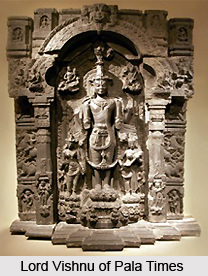 The God usually stands flanked by his two consorts, Goddess Saraswati to his left and Goddess Lakshmi, the goddess of wealth to the right. Garuda, the mount of Vishnu is generally represented as kneeling beneath his lotus seat. Gradually with passing time the avatars of Vishnu started getting stereotyped and became Dasavataras.
In the Varaha, Agni and Matsya Puranas there is mention of ten stereotyped incarnations of Lord Vishnu. In Krittumukha Vishnu has a hexagonal pose. He also has the usual ornaments, sacred thread etc on the pancharata pedestal. The attributes in his lower and upper left and upper and lower right hands are respectively sankha, chakra, gada and padma. The usual Sri and Saraswati are represented holding a lotus and a vina respectively on either side of the deity. The Garuda is shown with folded hands beneath the double-petalled lotus on which the god stands. Vishnupattas are also common form of representation of Lord Vishnu. Even his incarnations are represented in the pattas. The Visnupattas are also made of copper at times. In the copper Vishnupattas, Vishnu is shown seated in the middle in Padmasana with two front hands folded and two other hands holding gada and chakra. He is found flanked on two sides by two female figures each standing on double-petalled lotus. They may be identified as Lakshmi and Saraswati on the basis of the fly-wisk-lotus and vina held by them respectively. The mount Garuda with out-stretched wings has been depicted beneath the figure of the main deity and the Gaja-Lakshmi with two elephants pouring ablution on either side above. On the other hand, the reverse side of the patta contains a circle with a lotus in low relief within it. On the petals are to be found the incarnations of Vishnu in the following order: 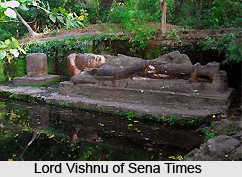
|
| |||



Iconography Of Lord Vishnu
| Iconography of Lord Vishnu is widely varied and in most places includes the ten incarnations of the Lord. |
| ||||||||||||||||||||||||||||

