


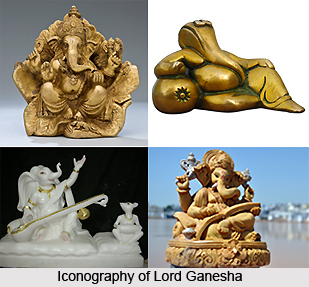
 Images of Ganapati, the god who became the principal object of worship of the Ganaptyas, are one of the five recognised Brahmanical sects. In fact it has been recorded that the worship of Lord Ganesha had begun during the Gupta Age. It has been claimed that all sorts of worship turn out to be meaningless if Lord Ganesha is not worshipped in the beginning. As the worship of this deity is important not only among the Hindus but also among the Jains and the Buddhists it is evident that the iconography of the Lord is very important to understand the worship of the deity to its fullest extent. Images of Ganapati, the god who became the principal object of worship of the Ganaptyas, are one of the five recognised Brahmanical sects. In fact it has been recorded that the worship of Lord Ganesha had begun during the Gupta Age. It has been claimed that all sorts of worship turn out to be meaningless if Lord Ganesha is not worshipped in the beginning. As the worship of this deity is important not only among the Hindus but also among the Jains and the Buddhists it is evident that the iconography of the Lord is very important to understand the worship of the deity to its fullest extent.
Most of the texts represent the deity as having four hands, but many of the earlier images of the deity represent him as having two hands. The Lord may also have more arms. He may have six, eight or even more number of arms. Essentially he has one tooth known as ekavisana. As the religious texts developed with time a mouse was included with the deity as his vahana or vehicle. He also came to be represented with his consort Sri, Vighnesvari, Bharati, Buddhi and Kubuddhi. The deity which has four hands is shown seated in the maharajalila pose on a double petalled lotus. The upper right hand holds an elephant a blue lotus, and the lower right an indistinct object, the upper left a blue lotus and the lower left a pot of sweetmeat into which the trunk of the lord is placed. Below the right leg of the deity the rat with a bell tied round its neck is shown seated on a pedestal looking up at its master. In between the rat and a devotee seated with folded hands also shown on the pedestal there is another pot of sweet meat. In the image of the Lord the well arranged Jata on the top of the elephant head, the rows of ornaments enclosing the temple, the pose of full grace of the deity adds the elegance to the iconography of Lord Ganesha. When Lord Ganesha is shown in a dancing pose the two ornamented legs are shown on a lotus. Similarly when the lord is represented in a seating position he is sometimes accompanied with a musical instrument. Sometimes the iconography of the Lord involves the deity resting its pendant right leg on his vahana the rat. He also holds a rosary and a radish with leaves in his lower and upper right hands respectively. The upper left and lower left hands hold respectively an axe and a pot of sweetmeat into which once again the trunk of the Lord is placed. Some of texts have also mentioned in the iconographies of the lord a tiger skin garment and a sacred thread made of serpent. Some of the deities are represented as Ganesha standing in an alidha pose towards the right side of Goddess Durga. In some of the iconographies not only a sacred thread made of serpent string is sent but also another snake serves as a belt around the belly of the deity. Though most often one comes across Lord Ganesha with four or more hands but it is not so that two arms Ganesha is completely unknown. The fact is during the medieval ages the image of Lord Ganesha with two arms was not very common. The present image of Lord Ganesha that is found holds the usual modaka bhanda or sweetmeat into which the trunk of the Lord is placed. The right hand of the Lord rests on the lower end of the elephant goad which is partially broken. Sometimes the figure is also represented without the right tusk. |
| |||



Iconography Of Lord Ganesha
| Iconography of Lord Ganesha includes is not much varied. Iconography of the Lord which is most common is the image which has four or more arms. |
| ||||||||||||||||||||||||||||

