


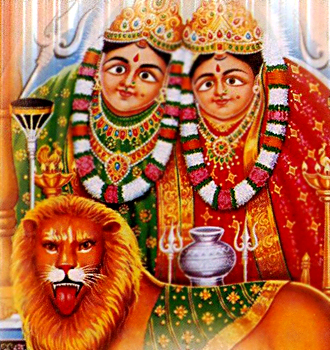
 Goddess Chamunda is one of the seven Matrikas. The Sapta Matrikas are generally carved in relief on a rectangular stone slab with the figures of Virabhadra and Lord Ganesha on either side. The worship of Chamunda was quite popular in India including the present Bangladesh. Goddess Chamunda is one of the seven Matrikas. The Sapta Matrikas are generally carved in relief on a rectangular stone slab with the figures of Virabhadra and Lord Ganesha on either side. The worship of Chamunda was quite popular in India including the present Bangladesh.
The general features of the goddess are as follows: The goddess has an emaciated body and shrunken belly which shows protruding ribs and veins and also is adorned with a skull garland, bare teeth and protruding tongue and sunken eyes. The hairs of the deity are represented as standing on end with snakes peeping out. She holds behind her the skin of an elephant. The deity is dressed in a tiger's skin and her abode is generally under a fig tree. The deity has a corpse, an owl or an ass or a plump boy as her vahana. The emblem of the deity is a vulture. This particular iconography of Chamunda symbolises universal Death and Destruction but at the same time also shows the abaha and the varada attitudes to her devotees. In some of the iconographies the deity is provided with a child who is either placed on the lap of the deity or the child is made to stand by her side. The goddess may be represented as standing, dancing, squatting or sitting with one leg pendant. The usual image of Chamunda is endowed with four hands. According to the Agni Purana there are eight different forms of Chamunda. The iconography of Rudra Chamunda is made of black basalt. Among the four right hands of the deity the three hands carry a knife, a kettledrum and one end the elephant-skin is carried and the upper portion of the fourth hand which is raised above the waist is broken. Of the four left hands the small finger of the first is raised to the lips as if the goddess is biting off her nail holding the mace to her shoulder. The rest of the hands are represented as carrying the elephant skin, a corpse and a kapala respectively. The iconography shows the goddess as dancing on a plump boy and sometimes is also represented as dancing on the pedestal. Another iconography of goddess Chamunda represents the goddess as wearing human heads and possessing an emaciated body, sunken eyes, pendulous breasts and a contracted belly with a scorpion painted on it. She is shown as holding the elephant skin over her head like a canopy. In fact it can be said the figure portrays in a remarkable manner the weird and terrible aspect of the deity. Some iconographies represent the image of the goddess as made of sand stone. The iconography of the ten-armed figure of Chamunda represents the image of Siddha-Chamunda. In such an image although most parts of the image are effaced yet some parts are visible. In such an iconography the goddess is represented as seated on a lalitasana pose placing her right leg on an indistinct object. She is flanked on either side by a dancing gana. She is shown as holding the elephant skin which serves as her canopy. The other objects which are held by the deity are not distinguishable. Thus it can be concluded saying that the iconography of Chamunda is such that it represents a fearful and an angry image of the goddess. |
| |||



Iconography Of Chamunda
| Iconography of goddess Chamunda is not much varied. The speciality of Chamunda images is fear, anger and destruction. |
| ||||||||||||||||||||||||||||

