


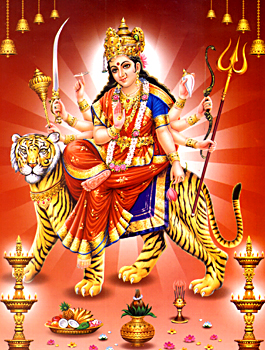
 Goddess Ambika is associated with the central figure of the Shakti cult. But at the same time from various early texts it has can well be concluded that Ambika represents the placid aspects of goddess Durga. Sometimes the texts even refer Ambika as the sister of Rudra while most of the other texts refer Ambika as the consort of Rudra. Goddess Ambika is associated with the central figure of the Shakti cult. But at the same time from various early texts it has can well be concluded that Ambika represents the placid aspects of goddess Durga. Sometimes the texts even refer Ambika as the sister of Rudra while most of the other texts refer Ambika as the consort of Rudra.
The most common iconographies of Ambika represent the goddess either with two hands or with four hands. But the most important aspect of all the images is to represent the motherliness of the goddess. Some of the dhyanas have described Ambika saying that she is red like the colour of vermillion and has three eyes. Her head is decorated with rubies and her crown is adorned with the moon. She bears a smiling face and her bosoms are full. The goddess holds a bejewelled drinking vessel full of gems in one hand and lotus on the other hand. Her face is benign and she stands with her left foot on a jar of gems. Some of the other iconographies of the goddess have represented her as seating on a lion and holding a lotus on the left hand and a fillet in the right hand. Her feet rest on lotus. With passage of time the iconographies of the goddess has evolved in different ways. Especially the iconography which is most common in the state of Bihar represents the goddess seated in lalitasana on a lotus pedestal. Her right hand is in a varada pose with a pomegranate in her palm. Her left hand rests on the left knee with her child seated on her left lap. The vahana of the goddess is the lion is placed upon the last tier of the pedestal on the right side of the goddess. The other images of Ambika represent the goddess as wearing a pointed Jatamukuta and have a few ornaments on her body with a tastefully decorated sirshachakra. The entire iconographical art has a simple touch of artistry. Sometimes the goddess is found seated in lalitasana on lotus pedestal. The right leg of the goddess is placed upon her mount lion which is placed below the lotus. She has four arms. Her back hands carry a trident and a lotus respectively. The front right hand is in a varada pose and the front left hand clasps her child seated on her lap. Generally the images of Ambika do not represent high ornamentation or decoration. Most of them are simple with high caliber of artistry represented in each piece of work. |
| |||



Iconography Of Ambika
| Iconography of Ambika is mostly simple and represents the motherliness of the God. |
| ||||||||||||||||||||||||||||

