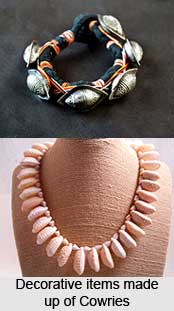
 Cowries in India are perhaps the best known group of shell-fish. They are world-famous for their handsome, highly polished, oval or globular shells. The young cowry has an elongated shell with a distinct conical spire and a long wide mouth aperture bounded by a thin outer lip. As the animal becomes adult, the mantle lobe on each side expands and grows over the shell, the edges of the two lobes meeting along a line. In this position the inner surface of the mantle secretes a thick layer of highly polished enamel of different colours over the shell. The last whorl of the shell grows somewhat excessively and rolls round the other whorls. This growth and the enamel deposit over the spire by the mantle completely conceal the actual spiral nature of the shell. Side by side with this transformation, the outer part of the shell, which was originally thin and sharp, gets curled inwards, thickened and toothed. The inner lip also thickens and its edge assumes a furrowed appearance. As a result of the thickenings of the two lips the mouth aperture of the shell, previously wide, becomes considerably narrowed. Thus the adult cowry shell is formed into a highly polished, oval shell with all trace of the young spiral masked by the deposit of enamel and with a long narrow mouth aperture on the ventral side.
Not only the shells but also the animals within them are beautiful. Few objects are more attractive than a large cowry crawling in a coral-reef pool; the mantle is bright with scarlet and yellow, beset with gracefully branched filaments. Cowries feed on tiny animals and plants. Coral reefs, the underside of boulders, mud-covered rocks where seaweeds abound, are all favourite haunts of these animals. Most cowries prefer moderately deep water. There are several species occurring in India out of which at least a dozen are exceptionally attractive. These are commonly found along the coast of Mumbai, in the Pamban area and around Lakshadweep.
A few of the outstanding Indian cowries are namely the Giant Cowry measuring nearly 12 cm long, the surface and sides are pale brown and violet in colour and it is decorated with chestnut spots mingled with numerous white dots; the Tiger Cowry measuring nearly 10 cm. It is pear-shaped, heavy, pale yellowish-white in colour and is decked with large brownish-black spots; thirdly the Mole Cowry which is 8 cm long, and oval in shape. It is yellowish-cream with brown transverse bands. The fourth type is the Serpent head Cowry which is about 4cm long, oval, brownish-black, the central portion of the creature is pale with numerous whitish dots; the fifth type of cowry found in India are the Eyed Cowry which is 3 to 4 cm long, oval, back dotted with greenish ringed structures which are rounded with yellow dots; the Money Cowries are the most popular and abundant cowry, and is recognised with uniform cream or shining yellow colour, with size ranging from 3 to 4 cm long. Besides these categories of cowries there are several other curious species of cowries are common.
There are many uses of cowries. In ancient times money cowries had exchange value and were useful coins as they are now being used in some villages of southern Africa.