Bombay Duck
|
The Bombay Duck is not a duck but essentially a lizard fish which is generally found in the waters of the Arabian Sea near Mumbai and Kutch.
|
|
|
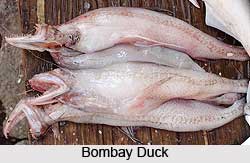 Bombay Duck is a small fish, about 25 cm in average length, with a peculiar soft, fleshy and cylindrical body. The actual English name of Bombay Duck is "bummalo" and in regional languages like Gujarati and Marathi it is known with the name of 'bumla' and 'bombil' respectively. When living the body of the fish is translucent. The jaws are red, the pectoral pelvic fins pale brown, and the dorsal, anal and caudal fins are dark black in colour. It has a rather gaudy appearance. Behind its normal dorsal fin it has a small adipose fin without fin-rays. The lateral line scales on the mid-body extend characteristically beyond the tail, making it tripointea. It is common from Diu in Saurashtra to Harnai in Maharashtra. After it disappeared from the south western and south-eastern coasts of India and appeared again along Andhra Pradesh, Orissa and Bengal coasts in small numbers. It has been explained by biologists on the ground that the difference of habitat of the Bombay Ducks is mainly the difference of climate that exists in various regions. Bombay Duck is a small fish, about 25 cm in average length, with a peculiar soft, fleshy and cylindrical body. The actual English name of Bombay Duck is "bummalo" and in regional languages like Gujarati and Marathi it is known with the name of 'bumla' and 'bombil' respectively. When living the body of the fish is translucent. The jaws are red, the pectoral pelvic fins pale brown, and the dorsal, anal and caudal fins are dark black in colour. It has a rather gaudy appearance. Behind its normal dorsal fin it has a small adipose fin without fin-rays. The lateral line scales on the mid-body extend characteristically beyond the tail, making it tripointea. It is common from Diu in Saurashtra to Harnai in Maharashtra. After it disappeared from the south western and south-eastern coasts of India and appeared again along Andhra Pradesh, Orissa and Bengal coasts in small numbers. It has been explained by biologists on the ground that the difference of habitat of the Bombay Ducks is mainly the difference of climate that exists in various regions.
Another feature of this fish is the soft noncalcareous bones and large jaw with recurved teeth like those in deep-sea fishes, though the fish in fact thrives in comparatively shallow coastal seas and sometimes enters the mouths of creeks. Its flesh, too, is jelly-like and without any firm muscles, like a deep-sea form. Its body emits a wonderful phosphorescent glow at night.
Bombay ducks are gregarious in habit, moving in large groups and feeding on small shrimps and other fish. They are at times so voracious that they gulp down fish longer than their own body, their stomach getting fully distended. They commence breeding when they are about 21 cm in length and have a long breeding season from November to February.
It is noteworthy that this single species gives an annual yield of about 100,000 tonnes and thus is of good commercial importance. Although fresh Bombay duck is relished, most of the catch is dried on scaffolds, tied in bundles, and sent upcountry where rural people appreciate ii to flavour curries.
|
|
|
|





