


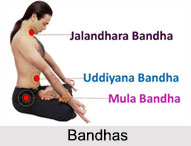
 Bandhas are essentially static postures which constricts a certain part of the body thereby re-directing the flow of blood and lymph to other parts. Bandhas are performed in order to channel prana in the body. Bandhas are included in the type of Pranayama. The practice of bandha requires more conscious effort. The duration of bandhas is lesser than mudras because they are practiced mostly with Antar-kumbhaka phase. Sometimes three bandhas are practiced together to intensify the practice of Pranayama and to generate a typical sensation. Bandhas are essentially static postures which constricts a certain part of the body thereby re-directing the flow of blood and lymph to other parts. Bandhas are performed in order to channel prana in the body. Bandhas are included in the type of Pranayama. The practice of bandha requires more conscious effort. The duration of bandhas is lesser than mudras because they are practiced mostly with Antar-kumbhaka phase. Sometimes three bandhas are practiced together to intensify the practice of Pranayama and to generate a typical sensation.
Meaning of the word ‘Bandha’ is to bind, to lock, or to tie. The particular neuromuscular junction is contracted to increase positive pressure and to generate visceroreceptive or proprioceptive impulse that would travel upward through ascending path in the spinal cord. Secondly, there is a specific type of sensation at the contracted area. One has to remain attentive in order to maintain the contraction for a few seconds. One has to develop awareness of these impulses and the sensitivity to experience them. Types of Bandhas There are three major bandhas in vogue. Jalandhara Bandha is for throat, Uddiyana Bandha is for abdomen and Mula Bandha is for perineum and anus. Apart from these three main bandhas, there is another Bandha known as the ‘Maha Bandha’. It is an advanced yogic practice that involves practicing three major bandhas together: Mula Bandha, Uddiyana Bandha and Jalandhara Bandha. These sensitive areas are stimulated during Pranayama by practicing these bandhas particularly during Kumbhaka. Then the Pranic energy passes upwards through Sushumna, which is to be experienced. Thus it may be said that the mudras will awaken the kundalini power while bandhas will help this serpent power to rise up along the chakras to bring about a specific effect. 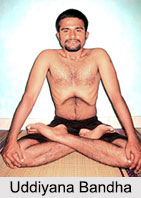
Similarities between Mudras and Bandhas There are some similarities between bandhas and mudras. There is a voluntary contraction of a particular neuromuscular junction or the sphincters of the body in both. This contraction is maintained for some length of time and this is done in a particular posture. Both of them require proper concentration on the technique. Bandhas and the mudras are practiced on the empty stomach. Both of these practices are concerned with the higher aspects of yoga in order to progress on the spiritual path, i.e., both of them activate particular chakras and produce typical sensations, which are experienced by the Sadhaka. Both these practices give rise to the internalized awareness. Both of them help to progress in deeper meditation. Differences between Mudras and Bandhas Apart from some similarities, there are some differences between bandhas and mudras. Bandhas are used especially during the pranayama, particularly during the Kumbhaka phase. Mudras are practiced at other times also or along with other Kriyas. While applying bandhas the breath is held outside or inside. Bandhas are practiced individually or all together. While practicing mudras, the breathing is continued and rarely is it suspended. The awareness may be on the neuromuscular contraction. Bandhas are mostly related with the throat and trunk (diaphragm, abdomen and pelvic flour). Mudras are mostly concerned with the face, fingers and also the abdomen. Moreover, bandhas are more related to important chakras and do not express any emotion. Eyes are kept closed. Mudras are used to express some kind of emotions or gestures. Eyes are mostly open. Effect of bandhas is seen immediately. Mudras are slow in action. Effects of Bandhas There is a definite voluntary neuromuscular or musculo-skeletal contraction in Bandhas, which is maintained for some period from a few seconds to minutes. These contractions are repeated to enhance the effect of asana or pranayama. Application of bandhas not only helps to cut off the connection between the individual and the external environment but also turns the individual’s attention inward. In bandhas there is an awareness of suspended breathing movement. This contributes to the tranquillity and stability of mind and also helps to detach it from the sensory inputs. Proprioceptors and visceroreceptors in these areas are stimulated during the contractions, which create special sensation and attract the attention of the practitioner. These stimulations give rise to special kind of nerve impulses, which are sent to the brain centres and translated as new sensations. One can feel and experience various kinds of sensations due to these practices, e.g., vibration, throbbing, creeping sensation, feeling of ecstasy, bliss, extreme joy, etc. |
| |||



Bandhas - Yoga
| Bandhas are an integral part of yogic practice. It helps to control and improve the function of body’s internal organ systems. |
| ||||||||||||||||||||||||||||

