 Bihar is a state in East India. It is the place where Buddhism and Jainism originated. Buddhist architecture in Bihar is seen in the ruins of the Nalanda and the Daibosatsuji Temple in Bodh Gaya. Vaishali in Bihar is the birth place of Mahavira and the Parasanad hills are a sacred place for Jains, but architecturally there is not much left here. From the 13th century Bihar came under the control of the Delhi sultans. They had developed an architectural style which is worth seeing, but they did not develop anything in the central provinces. It was the same during British rule too. Patna the capital of Bihar is also the land of Pataliputra, which was the capital of the old Magadha Empire.
Bihar was known as Magadha during the ancient time and the Maurya Empire originated here. During the 5th and 6th centuries, the kingdom of Magadha was the cultural centre of Bihar. The Gupta Empire of Magadha is known as the golden age of India. The University of Nalanda was set up during this time. During the 16th century Bihar came under the supremacy of the Mughal Empire under Akbar. With the decline of the Mughal Empire, Bihar came under the dominions of the Nawab of Bengal.
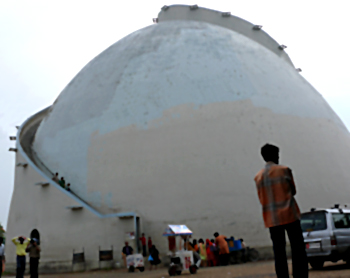
There is a Stupa and stambha built in the place where Buddha spent his last rainy season in Vaishali. Emperor Ashoka built more than thirty such memorial pillars in different regions. A statue of an animal was often sculpted on top of the Stupa. This style originated in Persia and was later continued by Jains in south India. In Patna the Golghar is an eccentric dome like an inverted rice bowl which was used as a storehouse during famines. It is twenty seven meters high, built with brick and mortar and is devoid of any decorations.
 It has a staircase to the top and a hole on top, through which grain was poured in. The design is one of the functional doctrines of the middle Ages. Bodh Gaya is a pilgrim place with temples, stupas and monasteries. The place where Lord Buddha sat is now sacred. The surrounding stone fencing dates to the 2nd century. The large temple beside the Bodhi tree was built in the 7th century. Though half complete, it is important as a relic that depicts the exceptional quality of Buddhist construction. The temple has four small towers in each corner and is of the five shrine style. The small towers were added in the 19th century. The main tower is made of bricks and finished with plaster. The original tower was curved, resembling the shikharas of Hindu temples. At present most Buddhist countries have constructed temples in Bodh Gaya and it has become the meeting ground and extensive storehouse of various Buddhist architectural styles.
The Choti Dargah is the earliest examples of Islamic architecture in Patna. The Choti Dargah belongs to the Mughal era and is similar in style to the ones in Agra and Fatehpur Sikri. The base of the dome has pillars, beams and broad eaves. There is a closed corridor and a small mosque in the precincts. The top of the big minaret in the southeast corner is broken. Architecture in Bihar during Akbar was a domain which was principally focused and concentrated upon the legendary and historic Rohtas Fort, the one still instance which remains unconquered. The mosques in Rohtas were the ideal picture that Mughal architecture in Bihar had rested in the tremendous shoulders of Akbar`s aristocracy. However, outside the purview of Rohtas hill fort, Akbar`s architectural dexterity in Bihar is also noticed in places like Hajipur, Patna and Munger. The Gurudwara in Patna is built in the Mughal style. Architecture in Bihar during Jahangir bears much similarity and likeness with Bengal and its Indo-Islamic touch under Mughal hands.
During Emperor Ashoka`s reign, unique developments in Indian architecture started with the cave temples. There are seven cave temples surviving from the early days, on Barabar and Nagarjuni hills. These do not belong to the Buddhist religion but to a religion called Ajivika which was prevalent in those days. The caves are small and simple, with very little decoration, for example, the Lomas Rishi cave on the Barabar hills.
 The region of Bihar in eastern Indian purview was a crucial one which has arrested attention since the times of Gautama Buddha in pre-Christian era. Regarded as an abode of ancient architectural as well as a religious epitome, Bihar could never be ignored by the Mughals. They needed to keep the place as a stronghold in order to establish their supremacy in far-off regions from Delhi. Indeed, as with their predecessors, the later Mughals had also assayed to emphasise their superiority in Bihar architecturally. In a strange and uncanny matter of ancestral and progeny competition, architecture of Bihar during the later Mughals is an issue of considerable wonder and interest for researchers and historians and readers of Indian history in contemporary times.
 In contrast to the fine late Mughal mausolea of Bihar is the austere Jami mosque of Silao in Nalanda District. This single-aisled three-bayed mosque, constructed in 1741-42 by a father and son, Sayyid Muhammad and Sayyid Ghulam Najaf, is enclosed by high walls, not common in eastern India during this time, yet one more feature of amalgamated architecture under later Mughals in Bihar. Each of the exterior walls bear inscriptions, again unusual for later Mughal architectural patterns in Bihar in eastern India. Like the exterior, the Jami mosque`s interior is sparsely ornamented. Cusped mihrabs (a niche in the wall of a mosque that indicates the qibla, i.e., the direction of the Kaaba in Mecca and hence the direction that Muslims should face while praying; the wall in which a mihrab appears is thus the "qibla wall") and a more complex form of pendentives than seen before in Bihar are the sole decorative devices in the Jami mosque of Silao. The contrast with such contemporary monuments as Ibrahim Husain Khan`s tomb in Bhagalpur indicates that in eighteenth-century Bihar no single ornamental style prevailed even under Mughal rule, probably because there was no single strong patron or model.
 Patna had remained Bihar`s leading commercial centre, a thing which has not changed in contemporary dates. The city was even enlarged under Prince Azim al-Shan, governor of Bihar during the early eighteenth century. Azim al-Shan had renamed Patna city as `Azimabad`, proclaiming his desire to give birth to a second Delhi. His efforts had failed though, as did his bid for the throne, but Patna still continued to benefit from the patronage of political figures and wealthy merchants. Amongst the structures they had provided, the most elegant is the mosque of Mir Ashraf, constructed by a Patna businessman in 1773-74. Its articulated facade with petal-like kungura, cartouches and arched niches is characteristic of those seen throughout India in the 18th century, much near to later Mughal rule from the British invasion. As such, tempted to be reiterated over and over, architecture of Bihar during later Mughals was an emulation and imitation of the earlier Mughals in every respect, though not even near to such masterworks. The interior of Mir Ashraf`s mosque, too, emotes ornateness from each angle, for cartouches and arch motifs embellish the walls and dome. The floor of the prayer chamber is composed of multicoloured tiles of the sort used on pre-Mughal Bengali structures. This unique flooring is in keeping with the mosque`s articulated surfaces, related to that of contemporary architecture in Murshidabad, for example, Munni Begum`s Chowk mosque erected in 1767.
 In Bihar province, the most important work of Akbar`s time was in the hill fort of Rohtas. In 1576, Akbar`s troops had captured Rohtas from rebel Afghan forces and had utilised the hill fort, some 45 km in circumference, as a garrison pivotal in controlling the rest of eastern India. As such, architecture in Bihar during Akbar comes down as a crucial point of time in Mughal architecture in Bihar, which was pivotal to the ruling and administration of the Mughal Empire from far-off Delhi/Agra.
 Both of the mentioned mosques adhere to a single-aisled three-bayed rectangular plan. Differences that lie till today are indeed slight. The central pishtaq of the Mughal mosque is lower and its facade bears intricately carved panels, recalling similar work on a gate at the Chunar Fort under Akbar. Although the Mughal mosque in Rohtas resembles the earlier Afghan one, situated approximately 3 km away, it bears an inscription over the central entrance arch that might be interpreted as a poignant statement of Mughal supremacy. Opening with the Quranic phrase, "With God`s help victory is imminent," most of this Persian inscription refers to Akbar`s victories and concludes with an appeal, in Arabic, to "deliver this good news to believers." Considering the wobbly political situation during that time, the inscription is mostly interpreted as a proclamation of Mughal authority over rebels in Bihar. Rebellious intervention was one major factor which was most commonplace during emperor`s Akbar`s time and his architectural circulation in eastern India. Yet, overlooking every kind of hardship, architecture in Bihar during Akbar was handsomely accomplished by the honest nobility and patronaged amirs who were brought under the good-will of the emperor regularly from the Mughal court.
 However, in association with Bihar`s architecture during Akbar and the mass connection with the fort of Rohtas, a single mosque is not enough to suggest an urban setting, the mosque which was erected by Habash Khan. There were, however, other Akbari structures on the Rohtas hill, which indicate the presence of a permanent and continuous large population. By far the largest and most important of these is the palace of Raja Man Singh. Numerous smaller buildings, mostly tombs, remain in the vicinity of the palace and Habash Khan`s mosque. Amongst these are a chattri and an unusual wall mosque, serving as the tomb of Saqi Sultan, who had expired in 1579-80, before he could attain the title khan, which he greatly coveted. Further testimony to the fort`s large population is a service town at the foot of the hill. It was - and still is - called `Akbarpur`, after the then-ruling monarch. Thus, although relatively inaccessible and robustly fortified, Rohtas Fort appears to have functioned as a major urban centre as long as it remained a significant administrative centre.
 Emperor Aurangzeb was much less involved in architectural production as compared to his predecessors, but he did sponsor some significant monuments, especially religious ones. Indeed, religious monuments and spiritualistic architecture in Bihar was one domain, which is most visible under Aurangzeb`s rule. Early during Aurangzeb`s reign, the harmonious balance of Shah Jahani-period architecture was rejected in support of an increased sense of `spatial tension` with vehemence on height. Stucco and other less expensive materials trying to outperform the marble and inlaid stone of earlier periods cover built surfaces under Aurangzeb. Immediately after Aurangzeb`s accession, the utilisation of forms and motifs, such as the baluster column and the bangala canopy, earlier reserved for the ruler alone, are visible on non-imperially sponsored monuments. This suggests both that there was relatively little imperial interference in architectural patronage and that the vocabulary of imperial and divine symbolism established by Shah Jahan was rather `devalued` by Aurangzeb. At the same time, architectural activity by the nobility had proliferated like never before - a fact which was mostly accentuated in architecture in Bihar during Aurangzeb, which can be comprehended as under. This very fact suggests that the noblemen and Aurangzeb`s Mughal court viziers were much eager and enthusiastic to fill in the `architect`s` role, previously dominated by the emperor.
 Daud Khan`s serai (a rest house for travellers and caravans, erected during Mughal era), in contrast to his Palamau mosque, is finely built. He had constructed it with the emperor`s permission for the protection of travellers in a robber infested area. This brick serai is in the town still referred to as Daudnagar (Aurangabad District). It remains today as the best-preserved example of seventeenth-century secular architecture in Bihar under Aurangzeb. The serai is entered on the east and west sides by arched portals with chamfered sides, harking back early statelier Mughal portals at the Ajmer Fort, built around 1570. Details, however, such as the stone pillars and cusped arches recalling those on the Sangi Dalan, built about a decade earlier in Rajmahal possess a more contemporary air. So do the small domed chattris atop the portal roof that probably derive from those on the gateway into the Taj Mahal complex.
 Throughout the `last Mughal` Aurangzeb`s reign, buildings were constructed in Patna, the capital of Bihar. Only one of them, however, is credited, at least by its inscription, to Aurangzeb as the emperor himself. The building being discussed under scanner is the Rauza mosque, dated 1667-68. It is, in fact, the only Mughal building in all Bihar that claims imperial Mughal sponsorship. This simple single-aisled three-bayed Rauza mosque was built in conjunction with the graves of two saints. It adheres closely to the form established by the early 17th century mosque of Mirza Masum. In spite of the brief inscription, the Rauza mosque`s unostentatious style and plan evoke that it was built in response to a general order encouraging the construction of mosques, but was not actually paid for by the ruler. Now the matter that strikes a reader the most might be that Mughal architecture in Bihar, precisely in Patna during Aurangzeb was nearly accomplished in absence of the emperor himself! Aurangzeb, its is known never had been in Patna, nor did he construct mosques at sites with which he did not have a strong personal interest.
 When still a young prince, Shah Jahan had rebelled against his father and Mughal emperor Jahangir in 1623, which is intimately associated with his consequent architecture in Bihar. Eventually, Shah Jahan is also known to have taken Burdwan in Bengal and then had established a counter-court in Rajmahal (in Bihar). Subsequently, Shah Jahan had spent time at Rohtas, where his son Murad Bakhsh was born. After his accession in 1628, however, Shah Jahan never had returned to the eastern hinterlands, with reason not known to the modern world. Instead, powerful and effective agents such as his son Prince Shah Shuja, Shaista Khan and Saif Khan were entrusted with their administration in Bihar and other parts of eastern India.
 Several mosques were constructed during this time along Patna`s main city street paralleling the Ganges, though only a few still remain. The best preserved instance of a mosque during Shah Jahan`s Mughal architecture in Bihar, is the masjid of Hajji Tatar. Exquisitely carved black stone frames the three arched entryways on the east façade. Such black stone was employed at times on Mughal structures in Bihar and Bengal, but was commonly found on the mosques of Bengal before Mughal times. It was never employed on structures outside the periphery of eastern India. The arched niches flanking the entrances of Hajji Tatar mosque and the facade`s ribbed engaged columns are typical of mid-seventeenth-century buildings in eastern India, for example on Habib Khan Sur`s mosque, built in 1638 at nearby Bihar Sharif. The mosque`s affiliations with local buildings are thus evident, despite its overall conformity with the prevailing Mughal aesthetic.
 Yet another structure influenced by those in Bihar Sharif, within the purview architecture in Bihar under Shah Jahan and his patronised men, is the mosque Raja Bahroz had constructed in Kharagpur in 1656-57. Kharagpur, today in Munger District, long had been the seat of a prominent Hindu family in Bihar. Although initially allied with the Mughals, the Kharagpur rajas were defeated by them during the late 16th century. One member of the family had acknowledged Mughal authority and had also converted to Islam. He was then reinstated on the Kharagpur throne. There, his successors had erected several mosques and many more tombs, suggesting that the newly converted Kharagpur rajas consciously had attempted to create a seat that very much had proclaimed their new religious affiliation.