Amoeba - Informative & researched article on Amoeba
  Indianetzone: Largest Free Encyclopedia of India with thousand of articles History of India


in  
Art & Culture | Entertainment | Health | Reference | Sports | Society | Travel
Forum  | Free E-magazine
History of India : Sources of History of India l Ancient History of India l Medieval History of India l Modern History of India l Indian Historical Dynasties l Indian Battles l Sepoy Mutiny 1857 l Indian Rulers l History of India l Indian Freedom Struggle l Indian Governor- Generals l British Indian Acts l Post Independence India l Iron Age in India
Home > Reference > Geography of India > Indian Natural History > Amoeba
Amoeba
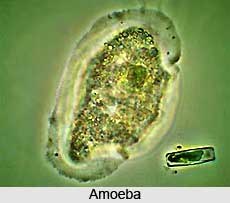
Amoeba belongs to the family of protozoa. The amoeba is remarkable for its very large genome.

AmoebaAmoebas are single-cell, animal organisms, belonging to the protozoa family. Most species are free-living and can be seen in the water of any small freshwater pond, the larger forms being just visible to the naked eye. Parasitic forms occur in many animals, inhabiting the intestinal canal, and are mainly saprophytic, though a few are causative of disease, like Entamoeba histo-lytka which is responsible for amoebic dysentery in man.

Within a single cell, the amoeba contains all the capacities necessary to maintain animal metabolism. The amoeba moves by throwing out cytoplasmic buds, or pseudopodia, into which the rest of the cytoplasm flows in a streaming movement. When a suitable nutrient particle is encountered, the amoeba throws out pseudopodia around it and engulfs it. The particle may remain in a bubble, or food vacuole, into which digestive juices are poured. When the nutrient material has been digested and absorbed from the vacuole, which acts like a primitive intestine, the amoeba moves away, leaving behind the indigestible remnants.

Reproduction in Amoeba is normally by binary fission. From time to time, a type of sexual reproduction, or conjugation between two individual amoebas, with some exchange of genetic material, occurs. The conditions necessary for conjugation to occur are not properly understood. Under unfavourable conditions like drying of the pond, or, in case of a parasite increased resistance of the host, the amoeba resorts to encystment for self-preservation. The cyst consists of a chitinous shell with which the amoeba surrounds itself and at the same time divides itself into 2, 4 or 8 daughter cells, enclosed with the cyst. When conditions are again favourable, the cyst bursts open to release the contained cells, each of which becomes an individual amoeba.

This article is a stub. You can enrich by adding more information to it. Send your Write Up to content@indianetzone.com
(Last Updated on : 31/05/2011)
  More Articles in Indian Natural History
 
Indian Natural History in Mauryan Period Indian Natural History in Mughal period Indian Natural History in British Period
Indian Natural History after Independence Ants Ark Shells
Cowries Amphibians Bombay Duck
Crustaceans Algae Amoeba
Arachnids Clams Air Breathing Fishes
Sea Anemones Sea Cucumbers Sea Horse
Sea Lilies Sea Perches Sea Urchins
Scallops Slugs Small Cats
Snails Spider Sponges
Squids Mudskippers Mullets
Murrels Naticas Barnacles
Barracuda Tuna Perch
Piddocks Pomfret Mackerel
Mahseer Mantid Hydra
Loach Horn Shell Flying Fish
Cockroach Dugong, Sea Cow Garden Harvestmen
Caecilian Bristle Worm Trout
Volutes Water Spider Whelk
Termites Threadfin Thrip
Trapdoor Spider Sea Turtle Turtle
Recently Updated Articles in History of India
  • Mughal Architecture
    Mughal architecture is a combination of Islamic, Persian, Turkish and Indian architecture. It is a style that was developed under the Mughal dynasty in the sixteenth and seventeenth centuries.
  •  
  • Mansabdari System in Mughal Dynasty
    Akbar introduced the Mansabdari System in the Mughal army which primarily meant the ranking of officers on decimal system.
  •  
     
  • Deccan Policy of Mughal Dynasty
    Deccan Policy of the Mughal dynasty was weak during the reign of Babur and Humayun but after the accession of Akbar on the throne, the political situation changed and the Deccan policy was a success.
  •  
  • Coins of Pandyas
    Coins of Pandyas bear the legend of different Pandya ruler in different times.
  •  
  • Art and Architecture of Mughal Empire
    Art and architecture of Mughal Art offers an aesthetic degree to all art lovers. The subtlety of the finesse and the dazzle of the aura create huge amount of interest among tourist.
  •  
    E-mail this Article | Post a Comment
    RSS Feeds
    Forum
    Forum on Geography of India

    Free E-magazine
    Subscribe to Free
    E-Magazine on Indian Crafts
     
     
    Amoeba - Informative & researched article on Amoeba
    Sitemap
    Contact Us   |   RSS Feeds
    Copyright © 2008 Jupiter Infomedia Pvt. Ltd. All rights reserved including the right to reproduce the contents in whole or in part in any form or medium without the express written permission of Jupiter Infomedia Pvt. Ltd.