





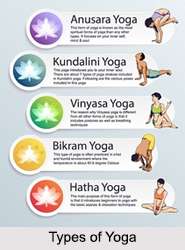
 Types of Yoga mostly involve the usage of different poses or Yoga Asanas, meditation and breathing exercises or Pranayama. While the ultimate goal of yoga is to unify body, mind and soul, there are different ways to achieve this aim. These various ways constitute the different types of Yoga. Most of them had been practiced in India since ages unknown. Certain factors, like, origin, history, style, technique and significance, differentiate one branch of yoga from the other. Types of Yoga mostly involve the usage of different poses or Yoga Asanas, meditation and breathing exercises or Pranayama. While the ultimate goal of yoga is to unify body, mind and soul, there are different ways to achieve this aim. These various ways constitute the different types of Yoga. Most of them had been practiced in India since ages unknown. Certain factors, like, origin, history, style, technique and significance, differentiate one branch of yoga from the other.
Bhakti Yoga One of the ancient branches of yoga is the Bhakti Yoga. As the name suggests, it stresses on 'Bhakti' or love and devotion to the Almighty. Bhakti Yoga has its roots in the Bhagavad Gita. The individual performing this type of Yoga purely concentrates on the existence of Almighty. Bahiranga Yoga The first written reference to Bahiranga yoga can be found in Sadhana Pada, the second chapter of Maharishi Patanjali's Yoga Sutras. It is also known as Ashtanga Yoga or eight-limbed Yoga or Raja Yoga. This type of yoga aids an individual in alleviating himself or herself from the emotional and mental conflicts. It also helps a person to co-exist peacefully with other creatures and the environment. Bikram Yoga Founded by Bikram Choudhury, Bikram Yoga is a modification of Hatha Yoga. It is practised ideally in a hot room with temperature about 40 degree Centigrade and 40 percent of humidity, and comprises of the same 26 set of postures and 2 breathing exercises. Bikram Yoga, also known as "Hot Yoga", bestows numerous benefits including increased strength, improved posture, weight loss, enhanced flexibility, clarity of mind and healing of injuries. Karma Yoga Karma in Sanskrit means action. This is also an ancient type of yoga that has been derived from the teachings of Lord Krishna compiled in Bhagavad Gita. Karma Yoga helps in reducing Ego. It purifies one's heart and helps to attain the knowledge of one's own self. The aim of a Karma Yogic is to practice his duty without expecting any rewards in return. 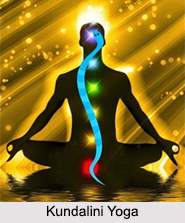 Kundalini Yoga Kundalini Yoga
Practice of Kundalini Yoga leads an individual to enlightenment. The concept of Kundalini has been an integral part of ancient Hindu philosophy. Kundalini Yoga aims at attracting the untapped energy or the Kundalini that remains coiled at the base of the spine, by using a set of technique that uses the individual's mind, senses and body. Apart from the physical postures or the asanas, the person performs meditation, chants mantras and awakens each of the seven chakras of the body. Hatha Yoga Hatha Yoga was founded by Yogi Swatmarama during 15th century. The "Hatha Yoga Pradipika" mentions this type of yoga in details. This Yoga involves the presentation of physical postures, namely asanas, breathing exercises or Pranayama, meditation, mudras and purification procedures known as 'Shatkriya'. Thus Hatha Yoga purifies the body and prepares an individual for the meditation. Jnana Yoga Jnana Yoga is another type of yoga in India that has been mentioned in Bhagavad Gita. Lord Krishna emphasised the significance of Jnana or knowledge stating that it enables an individual to comprehend his own self and his activities. However it was developed to its present form by Adi Shankara. Jnana Yoga, thus, is the Yoga of true knowledge and aims to detach the person from all the temporal things of the life. Mantra Yoga Mantra Yoga, as the name suggests, makes use of mantras to attain peace of mind and increase the concentration power. It has its roots in the Vedas. Mantra Yoga helps to remove a number of disorders, including emotional ailments and the problems of anxiety, stress and tension. Swara Yoga 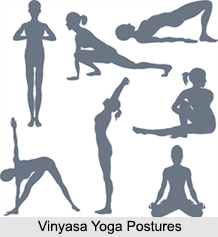 Dating back to the Vedic period, Swara Yoga refers to the control of the life force through breathing. It is said that by practicing Swara yoga an individual can find out about the consequence of his or her actions. Dating back to the Vedic period, Swara Yoga refers to the control of the life force through breathing. It is said that by practicing Swara yoga an individual can find out about the consequence of his or her actions.
Vinyasa Yoga Vinyasa yoga is a discipline that utilizes postures and breathing techniques. It is commonly referred as 'Flow Yoga' and is the most popular style of yoga in the world today. It confers benefits both at physical and mental level and re-energizes the body. Kriya Yoga Another form of yoga is the Kriya yoga. Though relatively a newer concept, it is said that Kriya yoga has been mentioned in Gita. However, it was Lahiri Mahasaya who taught the technique of Kriya Yoga which is based on Guru-disciple relationship. Other Types of Yoga Apart from all these, there are numerous other types of Yoga too, some of which are combination or modifications of the mentioned forms. These include Iyengar Yoga, Anusar Yoga, Jivamukti Yoga, Core Power Yoga, Kripalu Yoga, Forrest Yoga, Integral Yoga, Moksha Yoga, Restorative Yoga, Sivananda Yoga, Yin Yoga, Chair Yoga, Acroyoga, Aerial Yoga and Stand up Paddle Yoga. The different Types of Yoga, thus, render numerous benefits to the body and mind of the practitioner. However, practicing yoga should follow the speculation of the right one according to one's need. |
| ||||||||||||||||||||||||||||

