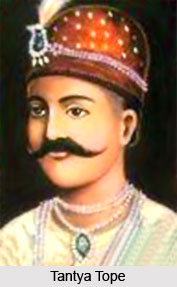
 One of the remarkable Indian leaders in the Indian Rebellion of 1857 was Ramachandra Pandurang Tope who was also known as Tantia Tope.
This efficient son of Pandurang Rao Tope was born in the village Yeola in Maharashtra and grew to become one of the important personalities during the Indian freedom fighting. His father was an important noble at the court of the Maratha Peshwa Baji Rao II. Tantia Tope later developed intimate friendship with the Peshwa`s adopted son, Nana Dhondu Pant (known as Nana Sahib) and Maharaja Madhav Singhji.
The first move of Tantia against the British was taken in 1851, when Lord Dalhousie deprived Nana Sahib of his father`s pension. He joined the political movements and established Nana Sahib`s authority in May 1857. The British people were in chance of seizing the wealth, kingdom and the whole empire of the country and this served as the biggest reason for the discontent and revolt. During the period of his revolutionary activities, he occupied Kanpur and then shifted to Kalpi to join Rani Lakshmi Bai to occupy Gwalior. After reaching Gwalior, he declared Nana Sahib as Peshwa with the support of the Gwalior contingent. Before being able to consolidate his position he was defeated by Hugh Henry Rose, 1st Baron Strathnairn and their unfortunate defeat in the battle resulted in the death of Rani Lakshmi Bai. After that the Britishers expanded their rule in Gwalior. The defeat in the battle led him to create a huge force to fight against British and he was successful in capturing many forts of India and he had established a center to manufacture arms in Kalpi. Being defeated in the Gwalior battle, he launched a successful guerrilla campaign in the Sagar and Narmada regions and in Khandesh and Rajasthan. When he came to know that Britishers are short of resources, he took advantage of it and confronted Kanpur. He had fought altogether 150 battles being involved in his revolutionary activities.
In 1857, the contingent of General Wheeler incurred heavy losses due to the successive bombardments, sniper fire, and assault when the force of Nana Sahib attacked the British entrenchment. The scarcity of food, water and medicine was an added problem for which they decided to surrender, in return for a safe passage to Allahabad. Due to the raise of some confusion at Satichaura ghat, the departing British were attacked by the rebel sepoys, and were either killed or captured in spite of the arrangements made by Nana Sahib. The British women and children who survived were moved from the Savada House to Bibighar, a villa-type house in Kanpur. As the Company forces started approaching Kanpur, the bargaining attempts of Nana Sahib had failed and revenge was occurred. Later it was informed that the British troops led by Havelock and Neill were indulging in violence against the Indian villagers. Nana Sahib along with his associates started thinking on the next step with the captives at Bibighar. In the meantime, some of the advisors of Nan Sahib had already decided to kill the captives at Bibighar, as revenge for the murders of Indians by the advancing British forces but the details of the atrocity remained in veil. The people indulged in the massacre had no intension to kill the women and children but the growing severity of the situation took several innocent lives.
Failing to restrain him, the British tried another way to teach him a lesson by betraying him by his trusted friend Man Singh, Chief of Narwar, while asleep in his camp in the Paron forest. He was captured and taken to Shivpuri. There in 1859, he was captured by British General Richard John Meade`s troops tried by a military court and was taken to Shivpuri and was executed at the gallows on April 18, 1859. He admitted the charges brought before him and said that he was answerable to his master Peshwa alone. On his memory there is a statue of Tantia Tope at the site of his execution in Shivpuri town in Madhya Pradesh.