|
The silk sarees are a part of the India silk industry which is an integral part of the Indian Textile Industry. This industry is among the oldest industries in India. The Indian silk industry produces basically three types of silks namely Mulburry, Muga, Tussore, and Eri silk. The major hubs of Indian silk industry are located in Karnataka, Andhra Pradesh, Tamil Nadu, Jharkhand, Chhattisgarh, Orissa, Jammu & Kashmir and West Bengal.
The silk industry in India has a huge number of employees and involves rearing of silkworm or "sericulture". The strength of Indian silk industry lies in huge production capacity, efficient raw material manufacturing capacity, large pool of skilled and cheap labor, entrepreneurial skills, huge export potential, large domestic market and flexible silk manufacturing systems. The silk sarees in India are the creations of these industries. Indian sarees are basically made of pure silks that are produced in abundance in the Indian silk industry. The weavers, who are employed in creating silks by rearing the cocoons and finally creating the pure silks, are the major part of the silk industry.
The traditional sarees like the Banarasi sarees, Kanjeevaram sarees,
Konrad sarees, Mysore silk sarees, Pochampally Ikat sarees, Chanderi sarees, Paithani sarees, Patola sarees, Baluchari sarees, Bomkai sarees, Tussar sarees etc are the exclusive creations of the artisans who use silk as the base material for these sarees. Among non-mulberry silks, Tussar is mostly produced by tribal people who are settled in different parts and regions of India. Tussar silk is produced in abundance in India and is the only producer of golden muga silk. Even, India is a major producer of eri silk.
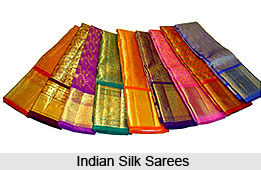 The Indian artisans create a huge range of sarees that are based on pure silk fabrics. The traditional Banarasi saree uses pure silk fabrics that are created by the supplementary thread designs, including dense border patterns, are almost always woven as discontinuous supplementary-weft with the highly decorated endpiece. Traditional Banaras brocade sarees usually have subtle colours which may be quite pale compared to western and southern Indian silks. Patola sarees that are another traditional saree of India are basically pure silk sarees. A silk Ikat saree industry has recently developed in Rajkot (Gujarat) that creates patola and modern geometric designs in the weft threads only. Block-printed silk sarees are also created throughout the region as well as in Srinagar, which has a small sericulture industry. Its silk fabrics are often of low quality but they make popular, relatively inexpensive silk sarees. The embroidered tinsel sarees are block-printed or silk-screened and are often designed with flakes of mica or gold dust. Sometimes, silk sarees are designed with both resist- and direct-printed designs in the Mughal style. Silk sarees are also woven in regions of West Bengal away from the delta, in the northern (Murshidabad) and south-western districts like Burdwan, Bogra, Bankura and Midnapur. Moreover, west Bengal is the abode of gorad sarees that are hugely used by the women during pujas. Baluchari sarees are created using the silk material and the artisans use their efficiency in creating embroidery work with zari threads on the endpiece and the borders. The sarees are the representation of exclusive thematic work by the artisans.
Apart from creating silk sarees the local artisans create mixed Tussar-cotton fabric. Many of these modern sarees also use Ikat-dyed cotton-warp borders imported from Orissa. The artisans of Bengal include weaving Bomkai, Jamdani sarees, Muga sarees, Pat sarees, Sambalpuri sarees etc. Apart from these sarees, India is known for creating Ikat silks, Pochampally sarees that are finely created of pure silk fabrics. Further south in the Kumbakonam, Thanjavur area, silk fabrics have been woven since at least the fourteenth century. In recent times, the artisans and weavers create heavy- to medium-weight Kornad silks similar in style and technique to Kanchipuram sarees. Thus for its élan, style and feel silk sarees have occupied a major part in the Indian saree scenario.
|





