


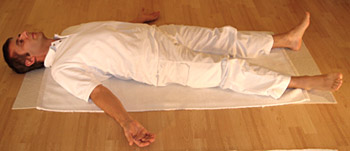
 Savasana is an important cultural asana that serves the important function of relaxing the body after the performance of more strenuous postures. This posture means the 'dead pose' in Sanskrit and effects a complete relaxation of the muscles as in a corpse. The practitioner of this yoga imitates a dead body in this posture. 'Sava' means a dead body in Sanskrit. Savasana is an important cultural asana that serves the important function of relaxing the body after the performance of more strenuous postures. This posture means the 'dead pose' in Sanskrit and effects a complete relaxation of the muscles as in a corpse. The practitioner of this yoga imitates a dead body in this posture. 'Sava' means a dead body in Sanskrit.
Yoga Texts and Savasana Savasana has been recorded in virtually all classical asana corpora, including the Hatha Yoga Pradipika (1400 AD), the Gheranda Samhita (1800AD), the Hatha Ratnavali (1700 AD) and the Shri Tattva Nidhi (1900 AD). In the Hatha Ratnavali, it is listed in the 84 classic yoga asanas said to have been taught by Lord Shiva. Practice of Savasana * The person is to lie on his back and fully relax his muscles. * It is to be noted here that the muscles remain slightly contracted even when we lie down for rest in a waking condition. Even this slight contraction is to be avoided in the Dead Pose. * This yoga asana requires will and concentration. * While practicing Savasana one should concentrate on a particular part of the body and thoroughly relax its muscles. Then he should imagine that every muscle tissue in that part is further relaxing. * Constant practice of this asana will enable an individual to bring about full relaxation of different muscles. * Usually, the practitioner should start with relaxing the thorax. * The abdomen should be taken up next. The lower and upper extremities should follow the abdomen, and the brain should come up last. * However, every individual can make his own choice of the sequence. It is easier to start with the extremities. One can concentrate on the trunk later on and finish with the brain. The eyes are to be kept closed. * While trying to relax the different parts of the body, one should attempt relaxation of more than one part conjointly, so that he can ultimately succeed in relaxing all the parts of his body at one and the same time. * After relaxing every tissue of the body, one should continue concentrating upon the relaxed tissues for some time. This completes the first part of the technique of Savasana. * In the second part while maintaining the bodily relaxation, exclusive attention is to be paid to the regulation of breath. * Complete relaxation of the whole frame is the final objective of Savasana. Effects of Savasana After Savasana, the muscles work more efficiently because of their relaxation. Venous blood circulation is promoted throughout the body and thus fatigue is relieved. The whole nervous system is toned up and mental energy is considerably increased. Savasana is helpful in reduc ing high blood pressure and can effectively overcome neurasthenia. The posture of Savasana aims at introducing rhythm in breathing as well. This rhythm can best be executed through certain stages. In the first stage of Savasana, the breath of the practitioner flows in and flows out. No attempt is to be made to control it either in volume or in length of time. Breathing should be allowed to have its own way. This practice of observation is to be slowly developed. For beginners, only two or three minutes may be given to it. Wholehearted perseverance in practice across a good length of time is the only path that surely leads to success in concentration. Precautions in the practice of Savasana Savasana if done properly soothes the nerves to an extent that there is always a tendency to fall asleep during its practice. This tendency is to be checked very studiously, especially by a spiritual culturist who should never get into the habit of lapsing into sleep while he is concentrating his mind. Patient work is essentially required for a student to achieve success in Savasana. There should be no hurry in going through the successive stages. The second stage should not be begun unless and until one has mastered the first. Rhythmical breathing should be developed very cautiously. At least in the beginning it involves an amount of mental strain. Under no circumstances is this strain desirable. Everything should be done very comfortably. Even after some practice, not more than ten minutes is allowed for patients with weak nerves to do Savasana, although healthy persons may devote as much time as they desire. The practice of Savasana may be repeated twice or even thrice a day. The Yogi who only needs to culture his physical self may be satisfied with the first step of Savasana, while the second part of the Dead Pose will be of great value in improving his nerves. It prepares him for his Pranayamic exercises which come after yoga asanas. |
| |||



Savasana Yoga Asana
| Savasana or the Dead Pose indicates the complete relaxation of muscles, aiding in muscular and circulatory systems. |
| ||||||||||||||||||||||||||||

