


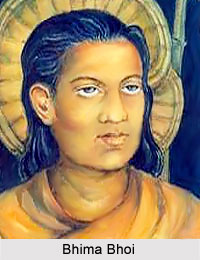
 The Satya Mahima Dharma of Orissa is a religious path or philosophy that was propounded and enriched mainly by three men, namely Mukand Das, Govinda Baba and Bhima Bhoi. Mukand Das became famous as Mahima Gosain at a later period and he spent several years during 1840-50 in Puri as an Achari Vaishnava. Govinda Baba was a talented organiser and he provided Mukand Das much of the skill required to establish a new religious movement. The third key man, Bhima Bhoi was an extremely talented poet from the Khond village of Kankanapada. The Satya Mahima Dharma of Orissa is a religious path or philosophy that was propounded and enriched mainly by three men, namely Mukand Das, Govinda Baba and Bhima Bhoi. Mukand Das became famous as Mahima Gosain at a later period and he spent several years during 1840-50 in Puri as an Achari Vaishnava. Govinda Baba was a talented organiser and he provided Mukand Das much of the skill required to establish a new religious movement. The third key man, Bhima Bhoi was an extremely talented poet from the Khond village of Kankanapada.
Mukand Das travelled a lot during the later 1850s and he also meditated for approximately twelve years. After completing the course of meditation, Mukand Das reappeared as a Siddhi (enlightened teacher) and travelled throughout Orissa with a new message of revived Hinduism. He met Govinda Baba at his Ashram sometime during his journey and then, the two started to tour together all over Orissa. They also took Bhima Bhoi with them. Bhima Bhoi was a prolific poet who composed hymns for the movement and also inspired numerous disciples with his songs and his personality. The Satya Mahima Dharma of Orissa movement gained significant strength during the 1860s and 1870s. The movement condemned orthodox Vaishnavism and as a result, it faced a strong opposition from different sections of the society. A petition was submitted to the Commissioner of the Orissa Division against the movement in 1873 and in the next year, the supporters and opponents of the movement also clashed with each other at the village of Malativiharpur. Mahima Gosain fell ill while avoiding an arrest for the clash and died in 1876 at Kamaksha Nagar in Dhenkanal state. The main principle of Satya Mahima Dharma of Orissa was to worship one deity, Alekh Param Brahma. According to Mahima Gosain, Alekh Param Brahma was an eternal being, who had no end and was without form or description. This deity assembled the universe, dissolved it and then reassembled it. The followers of Satya Mahima Dharma rejected all other deities as they did not exist and they also proclaimed the worship of idols useless. They declared the Brahman priests and their rituals as invalid. Mahima Gosain also appealed to the lower castes, the untouchables and the members of the tribal communities to join the Satya Mahima Dharma. The followers of Satya Mahima Dharma of Orissa were required to perform a simple combination of prayer and ritual twice daily. In the morning they used to pray seven times while facing east and sitting in certain yogic positions and in the evening they performed Darshan. On this occasion, they used to pray seven times while facing west. The followers of Satya Mahima Dharma of Orissa used to bury the dead in a sitting position, instead of cremating. The mourning period for the dead was restricted to ten days and a rite of purification was performed on the eleventh day. This rite signaled a return to the normal social life. The followers of Satya Mahima Dharma of Orissa were divided into two orders namely laity and monastic-mendicant, by Mahima Gosain. The laity (ashrikas) wore yellow clothing, married according to simple ceremonies and also refrained from killing animals. They were also prohibited to eat the meat of goats and deer if someone else supplied them. They observed some of the normal caste restrictions as well. Mahima Gosain also divided his disciples, who had taken vows of renunciation, into three classes. Each class represented a stage of religious advancement. The first group was consisted of initiates who lived under the discipline of senior monks whom they served. These people acted as cooks, cared for the temples and Ashrams and generally served the other classes of mendicants. The second group of disciples was under the supervision of the senior group and participated both in travel and preaching. The third group named the Para Sanyasis represented the highest level of monastic achievement and they formed the core of the movement. They were also in charge of managing various institutions. All these three levels were open to only the male members and the women could join the movement only as devotees. The women were also forbidden to enter the monastic orders. The death place of Mahima Gosain, Joranda gained an increasing importance with the expansion of the movement of Satya Mahima Dharma of Orissa. It became the central force of the movement and also a place of pilgrimage. Joranda was also the site of an annual festival, which was organised for the Mahima Dharmis to honour their founder. The followers of the Satya Mahima Dharma of Orissa also established two temples, namely the Sunya Mandir and the Dhuni Mandir. Various ceremonies were held at those two temples. The Satsang Ghost was the most significant festival celebrated by the Mahima Dharmis. All the followers of the Mahima Dharma used to participate in the Satsang Ghost and they had to confess their failings to one of the Para Sanyasis before they could join the feast. They also used to receive punishments, if necessary, after such confessions. The lay members also had to make their confessions. The common meal organised during the Satsang Ghost reflected the unity of Mahima Dharmis and also their transcendence of caste restrictions. With the expansion of Satya Mahima Dharma of Orissa, more centres of worship were established in various places. Tungls (small thatched huts) were built in those villages where a number of Mahima Dharmis resided. These places of worship housed sacred spaces. A second type of religious centre, the Ashram was also built by the Mahima Dharmis. However, the Ashrams were not as sanctified as the Tungls. Most Ashrams of the Mahima Dharma was established in Orissa and many Ashrams were also established in the other places like Bengal, Andhra Pradesh and Assam. However, the Satya Mahima Dharma of Orissa faced a split after the death of Mahima Gosain in 1876. A council was called a Joranda after his death to consolidate the movement and though Bhima Bhoi attended the council, he was disappointed with the council's actions. As a result, he decided to find a monastery for his own version of Mahima Dharma. He founded his monastery in the village of Khaliapali in 1877 and the Khaliapali Ashram became the main centre of Mahima Dharma within no time. Sri Ma Annapurna was the spiritual consort of Bhima Bhoi and she was also the supervisor of the Khaliapali Ashram. Bhima Bhoi introduced a few new rules and regulations for the Mahima Dharmis. He introduced the wearing of a rope made from Kumbhi bark to distinguish Mahima Dharmis from the general population. He also renamed the movement as Kumbhipatras. Vaishnavism and the worship of Lord Jagannath were highly criticized by the followers of Satya Mahima Dharma of Orissa, under the leadership of Bhima Bhoi. They described the famous temple at Puri as the centre of idolatry and responsible for many erroneous practices within contemporary Hinduism. Bhima Bhoi died in 1895 and was buried at the Khaliapali Ashram. However, the Satya Mahima Dharma of Orissa continued to exist after the death of Bhima Bhoi. It started as a transitional socio-religious movement in opposition to contemporary Hinduism and it drew most of its supporters from the lower castes. It also partially assimilated the tribal people who had a lower status and power in the society of Orissa. The Satya Mahima Dharma of Orissa actually bridged the pre-colonial and colonial worlds and also acted as a connector between the tribal and Hindu areas of Orissa and its surrounding territories. |
| |||



Home > Reference > History of India > Modern History of India > Socio-Religious Reform Movements in India > Satya Mahima Dharma of Orissa
Satya Mahima Dharma of Orissa
| Satya Mahima Dharma of Orissa is a religious path, aimed at worshipping one deity, Alekh Param Brahma. |
| ||||||||||||||||||||||||||||

