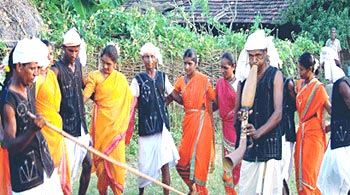
Puthia is the upper part of the attire of Rajasthani women. In Rajasthan, newborn babies, young unmarried girls, elderly women and widows wear the puthia as their upper garment.
Puthia indicates the non-fertile, sexually inactive phase of a woman`s life. Therefore, this Rajasthani costume is abandoned only after the girl attains puberty, even though she may marry in the tenure. This is, especially so, in case of child marriages where the bride goes to her marital home only after puberty starts. Puthia is worn among all Hindu communities with slight variations in style and construction that are analytical of the community to which the wearer belongs.
The Puthia is very much alike to the angarkha, especially it is the shorter version, the angarkhi and is similar in pattern. The antiquity and indigenous origin of these garments is derived from the roots of the term angarkha, derived from the Sanskrit: anga or body and raksha or protection. Usually unbleached, hand-woven khaadi cloth is used to create this garment though some communities may also wear printed cotton, brocades and plain coloured fabrics. The Puthia is a double-breasted garment with the higher flap crossing over the right side and tied with a cord under the left armpit. The entire length of the garment is constructed from a single piece of fabric, thus there are no joints at the waist and the garment ends gracefully at the hips itself. The sleeve-length may vary from short, elbow, to full-length. Though the garment is usually white, contrasting piping or magazi, usually in red poplin, is sewn along the edges.
The harsh landscape of the desert and scarce resources of the environment has taught rural communities in Rajasthan to be far-sighted, a quality evident in their judicious use of cloth. For instance, the pieces of the puthia are cut in geometric shapes-squares, rectangles and triangles-to minimise wastage. These are the most economical shapes and the style is reminiscent of patterns from the earliest times. The puthia is constructed of two front panels, one front extension, one back piece, two sleeves, four side panels and two gussets. The opening is in the front (centre), with one to three buttons or ties. The neck is deep, shaped like a horseshoe, with its widest portion over the chest. An inner flap or the parda covers the chest with a high rounded neck, and thus fastens on the inside of the right shoulder with a loop and cloth button. This flap is also held at the waist with cloth tie-cords and is further attached to the ridge, which runs along the side.
The back has a plain and straight cut, with hardly any shaping. Defined contours are added to the front and back by the addition of flared side-panels. These side-panels are left partly unstitched at the lower ends of the side seams, to form slits for the ease of movement. The puthia sleeves perfectly fit into a square or slightly circular arm-hole and taper towards the hem. The shape of the sleeve at the armhole may be either slightly egg-shaped or straight. Fullness and shape under the armhole come from the use of triangular gussets known as khankhi. The neck, centre-front, side-slits, hemline and sleeve edges arc trimmed with bias binding, approximately 2.5 cm wide. This bias is attached on the double. The fabric is turned, with the fold on the outside and the two unfinished edges stitched into the garment. This type of facing is also used to distinguish the upper and lower portions of a woman`s attire and is appliqued by topstitching at the chest area of the puthia. Most of the joints are closed and finished with clean seams leaving no raw edges on the inside, which makes this hand-stitched attire very comfortable.
The application of colour in a Puthia is also strongly indicative of the community and social order of the woman. A newborn wears a red puthia with green piping but among most communities, after the child`s first Holi, the festival of colour, the colour of the garment is transformed to white. An unmarried Bishnoi girl usually wears the traditional white pichodi with red piping, while Jat girls usually dress in printed red chhint with small floral designs. The unmarried Rajput girl wears a puthia of satin, cotton, brocade or velvet fabric that are usually in yellow, pink and white and, sometimes, red fabric with small bright green motifs.
Puthia is a traditional wear of women in Rajasthan and is distinguished for its simple elegance that not only gives the wearer a sobre look, but also comfort in the scorching heat of the desert region.