


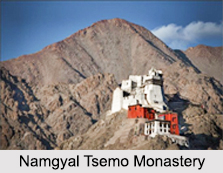
 Namgyal Tsemo Monastery was founded in the early 15th century, around the year 1430 AD. The monastery is located in Leh District, Ladakh region. The first recorded royal residence at Leh was Tashi Namgyal's fort at Namgyal Tsemo, the peak above the town. It is no longer inhabited, but the temples associated with the fort are maintained by a lama from Sankar Gompa. The monastery is mostly renowned for its three-storey high solid gold idol of Maitrieya Buddha. Another major attraction of this monastery is the Namgyal Tsemo palace, which is nine-storey high. The monastery complex consists of the gonkhang and the fort of Tashi Namgyal. The gompa was founded by King Tashi Namgyal. Namgyal Tsemo Monastery was founded in the early 15th century, around the year 1430 AD. The monastery is located in Leh District, Ladakh region. The first recorded royal residence at Leh was Tashi Namgyal's fort at Namgyal Tsemo, the peak above the town. It is no longer inhabited, but the temples associated with the fort are maintained by a lama from Sankar Gompa. The monastery is mostly renowned for its three-storey high solid gold idol of Maitrieya Buddha. Another major attraction of this monastery is the Namgyal Tsemo palace, which is nine-storey high. The monastery complex consists of the gonkhang and the fort of Tashi Namgyal. The gompa was founded by King Tashi Namgyal.
Murals in Namgyal Tsemo Monastery The monastery is dedicated to the wrathful deities and the murals, which contain representations of Gods and Bodhisattvas, mostly in their benevolent aspect. The temple's walls have recent paintings of figures including Sakyamuni, Avalokiteswara, Padmasambhava, Tson-ka-pa and Green Tara. In subsidiary position, there is Sron-tsan-gam-po, the strong man of ancient Tibet, with various manifestations of the White Tara. To the left of the entrance there is the famous presumed portrait of Tashi Namgyal. The styles of paintings are more Persian rather than Tibetan art in this monastery. The narrow slanting eyes are perfectly appropriate to the Persian style. The dress and turban are in Mughal style. Just to the right of this miniature court scene, there is a mounted figure, which is dressed and turbaned in the same way. Statues in Namgyal Tsemo Monastery The treasure trove of this monastery is a three-storey high solid gold idol of Maitrieya Buddha (future Buddha, also known as the laughing Buddha). Even this monastery possesses the statues of Avaloketesvara and Manjushri, which are approximately one storey high. At the back of Tashi's fort there are walls, which according to Francke used to be locally known as the Dard Castle. Visiting Information to Namgyal Tsemo Monastery The best time to visit this monastery is from June to September. In rest of the months, the roads are snowbound and the entire region gets inaccessible. The closest airport to the monastery is Ladakh Leh Airport. It is situated at a distance of around 10 km from the downtown area. By rail, Kalka is the closest railway station to Leh. By road, driving to Leh is considered as an adventure. Vehicles are available to arrange a street trek to Leh. |
| |||



Home > Travel > Indian Cities > Cities of India > Cities of Jammu and Kashmir > Ladakh > Monasteries in Ladakh > Namgyal Tsemo
Namgyal Tsemo
| Namgyal Tsemo Gompa is one of the well known monasteries of Ladakh that preserves the ancient touch. |
| ||||||||||||||||||||||||||||

