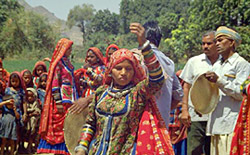
The Meghvals are also known as Bhambi, which in the local dialect means `drummer`. Even today people of this community play the `bhamb` or drum. There are various mythological tales regarding the origin of the Meghvals. The Meghval were originally associated with tanning and manufacturing of leather articles. The men of the Meghval community are expert weavers, just as the women excel at embroidery. This community has hailed from Marwar in Rajasthan but is also found in the western parts of Gujarat near the Pakistan border.
The Meghvals are considered as Scheduled Caste in India. The Meghvals are also known by the name of Meghwar and this word is derived from the Sanskrit words `megh` and `war` connoting the `people who pray for rains`. The humanitarian values and peaceful attitude of these people make them distinct from the other tribal communities. This community resides predominantly in Saurashtra region and in Bhavnagar District of Gujarat and in Mumbai.
The primary occupation of Meghval community was weaving fabric specially Khadi. But in present days the people of this community have become concerned about the importance of education and being educated citizens they are now employed in Government jobs in cities and in villages. Some of the people are also involved in agriculture and others in woodcarving and leather working. The people of Meghval community reside in small villages. The patterns of their houses display creativity and subtle detailing with mirror inlays and colourful geometric designs. The women of this community are known for their embroidery work and wool and cotton weaving. The embroidery work done by the women of the Meghval community are highly sought after for the unique usage of colour and the subtle use of red, which comes from a local pigment produced from crushed insects. The women artisans of Gujarat are reckoned as masters of the traditional embroidery and Ralli making.
The people of Meghval community are basically Hindu and are said to be the descendants of Rishi Megh. The Meghval people are the followers of "pir pithoro" and his shrine is located near Mirpur khas in Pithoro village.
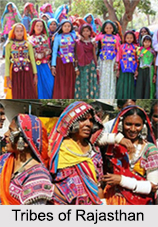
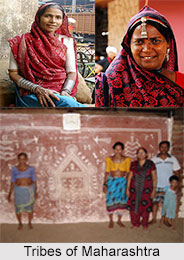
The religious, social and cultural side of the community is reflected in the costumes they wear. The people of Meghval community have separated the dressing code for men and women of different age groups. The unmarried girls wear a `puthia` which is usually made of red fabric for the newborn child and changes to white on the first Holi, after ceremonial rites are performed. The `puthia` is embroidered in various styles, like `kharak`, `suf bharat` or `humrichi` and silver `gota` are also used as edging. Young girls also wear the `ghaghra` made of cotton, in colours like green, blue and pink. They mainly prefer to wear `ghaghra` of hand printed fabrics like the `ghand bhal`. Young girls wear a red, yellow or green `odhna` with `ghaghras`. Popular prints are the `dhanak`, `chunri`, `reta`, `champabhat` and `kasumba` among others. There is a tradition in this community to wear a red `puthia` at the time of marriage. This is referred to as the `angarkha` or `jhabba` and worn with a `minahari` print `ghaghra`. Subsequent to the ceremony the bride changes into a `kanchli`. Her head is covered with a `bandhani chunri` having yellow and white designs on a red base colour.
The people of Meghval community display a wide array of variation in clothes. The married women of this community wear the `kanchli` as the upper garment. Those who live near the border and have been influenced by the Sindhi-Muslim way of dressing, wear long `kanchlis`, which reach down to their hips. Those Meghval women who live in other parts of the region wear a smaller `kanchli`. The sleeves of the `kanchli` are short, but the arms are not left bare. Bracelets called `chuda` are worn from the wrist all the way up to the shoulder. The `kanchli` seen here is especially striking because of its heavy embroidery in a variety of colours such as red, blue, pink, yellow and green. The women wear `kalidar ghaghras` with broad piping. The ghaghra is in bright colours like red and pink. The women wear a variety of wraps in winter and one of the most popular wraps is the `reta`, which is an embroidered shawl. A widow usually wears the `puthia orjhabba` as the upper garment. The `jhabba` is the most preferred and is worn with a ghaghra as a lower garment. The `odhna` may vary depending on age for example, a young widow wears a black `odhna` with an orange print, while older widows wear a plain tobacco coloured `odhna`.
The women of Meghval community are fond of jewelleries and they use then in their regular wears. Married Meghval women are often spotted wearing gold nose ring, earrings and neckpieces. The Meghval women wear head ornaments called `bor`, made of beads or silver, brass ear ornaments called `kudka`, elaborate necklaces called `chandan-haar` and a nose ornament known as `kanta` on the visible side of which has stones embedded in it and there is also a spring-like wire. The `kanta` is fixed with a wire that is passed through the hole in the nose. The nose rings and earrings for women are often decorated with precious stones of ruby, sapphire and emerald. Other varieties of necklaces include the `timaniya` made of `chid` or small glass beads and the `badla`, which is generally made of silver. The `dodia` is a circular silver bangle, worn on the wrist. The `hirmain`, a solid metal ring, is worn on the ankle all through life.
The dress of the men has a striking characteristic and their dresses are mainly white and are covered from head to toe. Traditional male attire consists of the `puthia`, dhoti and `safa`. The `puthia`, worn as the upper garment, is white. The dhoti, also white, is worn long, usually till the ankles. Sometimes a band is the only covering on the upper body. The `safa` is usually worn in white or yellow. The men also carry the `gamcha`, a striped piece of cloth, thrown casually over one shoulder or round the neck. Apart from their traditional dresses the men in recent times wear `kurta pyjama`. In some places the upper garment is either the `chola` or the `kurla`.
The footwear for men is always the `juti`, which is made of thick leather, embellished with copper studs along the edges.