|
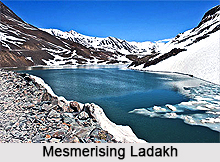
Leisure tourism in Ladakh comprise a number of mesmerizing tourist places where the tourists laze around and take pleasure in each bit of what the place has to offer. The Ladakh leisure tourism involves visiting the adjacent places near Ladakh which are well furnished and are worth visiting. Some of the traditional and adventure sports, monasteries, wildlife sanctuaries and valleys of Ladakh enable the tourists to enjoy the tour to Ladakh with sports, entertainment, the beauty of nature and the religious air of the land.
Ladakh is a land of religious influence and the people of this vicinity are basically the followers of three religions, namely, Buddhism, Christianity and Muslim religion and Buddhism being the predominant religion of the inhabitants. A whole lot of monasteries situated in Ladakh are the brilliant examples of artwork and the religious belief the people exert. The monasteries of Ladakh, located in scenic locations, on hills and mountains are the treasure trove of Buddhist Thangka paintings, art and artifacts and are exemplary of the architecture and art collections.
Another part of leisure tourism in Ladakh incorporates the visit to the valleys that surrounds the land and which are the real beauties of nature. The Rangdum Valley of Ladakh is situated 3657 metre above the sea level, at the remotest and most isolated region of the Suru valley. One side of the valley is adorned with the colorful hills while the other side showcases Rocky Mountains and glaciers. The panoramic view from this valley soothes and contends the mind of the tourists with pleasure. There is a monastery which appears like an ancient fort, in the valley and this is surrounded by a wild mountain stream. Moreover, Nubra Valley is known for the Bactarian camels around sand dunes, Deskit and Samstanling monasteries. Apart from these valleys, there are some other valleys like Markha Valley and Shayok Valley, Rupsho valley that are the pride of Ladakh and worth visiting. Each of these lands is known for some distinctness like nomads, wild animals, yaks, lakes and rare birds and view of nature that is coveted by the tourists who pay visit there.
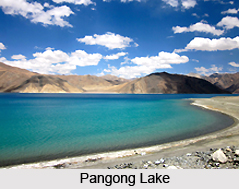
The leisure tourism of Ladakh also incorporate visit to the beautiful lakes like Tomoriri Lake which is an exquisite mountain bounded spread of water from Leh in Rupsho Valley. It is located at 14,000 ft. near a small village of Korzok. Tsokar (the salt lake) located in this area is also another major attraction of Ladakh. Apart from these two lakes, there are other lakes named as Pangong Lake, one third of which is in India and the rest comes under China. The colour of the water is the most striking feature of this lake. In the evening it becomes rich deep blue and remains light blue at morning time. The water of the Lake is as cold as ice. Moreover, Dhahanu, the land of Aryans, is situated to the south west of Leh, and the adjacent villages of Kaltsey, Domkhar, Skurbuchan and Achinathang are beautifully settled and attract the tourists. There are many small villages but only two villages of Dha and Hanu are open for tourist.
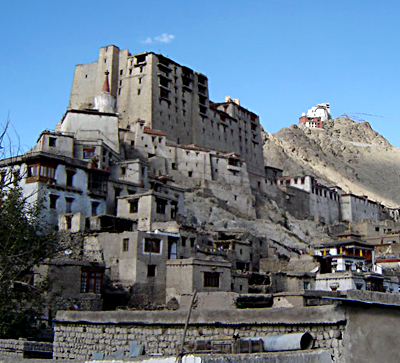
The Leh District, located to the north of the Indus River at an elevation of 3600m above the sea level, is also a place where the tourists flock around. The royal residence and the nine-storey Namgyal Palace built at this place are the major attractions of this district and the centre where the tourists pay visits. During the reign of King Graspa Bum- Lde, who ruled Ladakh from 1400 A.D to 1430 A.D, Leh became the capital of Stod, the upper Ladakh. Later, Leh was considered to be the centre for trade in Central Asia, along the Indus Valley between Tibet to the east, Kashmir to the west and ultimately between India and China. Leh houses an old mosque, a Sunni Muslim mosque which was constructed under the threat of military action by the Mughal Emperor Aurangzeb. This mosque exhibits the blend of Islamic and Tibetan architecture. Since the year1974, Ladakh has been receiving foreign tourists, and accordingly Leh also occupied the list and became a well preferred tourist destination for foreign as well as domestic tourists.
Another place that is part of the leisure tourism in Ladakh is the Kargil district. The city by the same name (Kargil) is around 204 kms to the east of Srinagar and 234 kms to the west of Leh. It is situated on the bank of the Suru River and the population of this district is mostly the followers of Buddhist religion. Ladakh has many places that are worth visiting like the Zanskar, Sani and several other monasteries which are of historical importance. Sani is said to house one of the 108 chortens constructed in the first century AD by the emperor Kanishka (Aka Kanika). The holy site at Sani is called Turtot Gyat and is one of the 8 holiest Buddhist sites in the world and the august monastery situated here contain ancient and medieval frescoes. The Rangdum Monastery that is located in Kargil possesses a tiny "museum" with interesting Tibetan and other artifacts and, thus, is the place of tourists` attention. Apart from these monasteries Ladakh is the abode of other monasteries like Zongkhul monastery, Karsha monastery, Stongday gompa, Phugthal monastery, Mulbekh Chamba and Shargole monastery which exhibit exclusive ancient art.
Apart from these, there are several wildlife sanctuaries situated in Ladakh. Sanctuaries like Changthang Wildlife Sanctuary, Noorichan Wildlife Sanctuary, Tsomoriri wetland conservation reserve, Pangong Tso wetland conservation reserve, Hemis National Park, Karakuram Wildlife Sanctuary are the places where the tourists visit to enjoy their holidays. Drass is the place is beautified with beautiful pasture grounds and majestic mountain peaks and the lovely view of Tiger hill are visible from Drass. Zangskar valley lies to the south west of Leh, is surrounded by the Himalayan and Zangskar ranges are another place that is also a place of great tourists` interest. Moreover, Kartse Valley is located in Kargil District of Jammu and Kashmir. An ancient village Kartse-Khar near the valley is situated there. The major attraction of this place is a 7 m tall rock sculpture of the Maitriya Buddha.
Including the visit of several valleys, religious places, palaces, wildlife sanctuaries etc tourists can also indulge in adventure sports that are enjoyed as one of the interesting way of enjoying leisure tourism. Apart from Polo and archery, there are several adventure sports that the Ladakhis enjoy with great zeal and excitement. The tourists who come from different places of India and abroad take great interest in trekking, mountaineering, water rafting etc. the hilly landscape of Ladakh offers trekking and mountaineering during June to October before the snowfall begins. There are so many challenging peaks for a mountaineer ranging from Stok Kangri Peak (6121 m) in Zanskar, Kangyaze Peak (6400 m) to the south east of Leh and the Nunkun Massif. People interesting in mountaineering and trekking flock in Ladakh during the season and take delight in adventure sports. Water rafting expeditions are organised from July to September in Ladakh. These adventure sports, usually, cover the stretches of the Indus River between Hemis to Choglamsar and Nimmu to Phey.
The leisure tourism in Ladakh has its own wide array to offer as the land is well furnished and is reckoned for the natural beauty that is prevailing throughout the land.
|