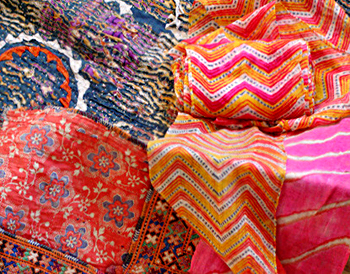
 Leheriya is a widely known variation of design in fabrics that is produced using the basic technique of tie and dye. The term Leheriya is derived from the Hindi word `leliai`; meaning `wave`. The dyer creates wave-like patterns by producing diagonal stripes on the fabric. This process is practised in Jodhpur, Jaipur and Udaipur. The leheriya was patronised in the nineteenth and early twentieth centuries by the Marvari merchant class of Rajasthan, who wore turbans of brightly coloured leheriya fabric.
To create diagonal stripes, the craftsmen of Rajasthan uses a special method of resist-dyeing, wherein the material is generally a turban or sari length that is rolled up diagonally across opposite corners and then tied tightly at intervals before the actual dyeing process begins. Delicate, light fabrics such as thin cotton voile, fine silk and chiffon are usually preferred, as they allow the colour to penetrate through the rolled cloth. The fabric is wrapped around a wooden pole, usually while it is still wet, though it may also be in a semi-dry or dry state. The thread that ties up the fabric acts as a resist, yielding a pattern of diagonal stripes after dyeing. The thickness of the thread and the distance between the ties may be varied to obtain snipes of different widths.
The dyer`s extraordinary talent allows him to create multi-coloured stripes after the first dyeing by opening up some sections of the rolled fabric, leaving other sections still bound, and tying up fresh sections, then dyeing the whole or part of the fabric in a different colour. A checkered pattern is called `mothro` and is produced by the intersecting of diagonal stripes. To achieve this, the fabric is unrolled and then rolled up from the opposite corner. The process of tying and dyeing the cloth is then repeated.
An astounding variety of leheriya textiles are produced using this simple process. A panchranga (five-coloured) design is considered the most auspicious, since the number five has a special position in Hindu mythology. Another beautiful pattern, `satranga`, flaunts the seven colours of the rainbow. Stripes that follow in one direction and colour are known as `leheriya`, while, when diagonal stripes intersect at right angles to form checks and the pattern is known as a `mothra`. Gandadar, pratapshahi, rajashahi, samudralehar and salaidar are again variations of stripes created by this similar technique.