


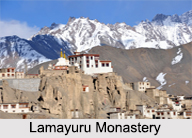
 Perched at an altitude of 11,520 ft., the Lamayuru Monastery is a Tibetan Buddhist monastery located at Lamayouro, Leh district, India. The monastery houses 150 monks but in the past it had housed 400 monks, many of which are now based in gompas in surrounding villages. Spiritual learners and travellers are lured to the monastery by its sacred aura. The monastery is currently affiliated with the Drikung Kagyu school of Buddhism. Perched at an altitude of 11,520 ft., the Lamayuru Monastery is a Tibetan Buddhist monastery located at Lamayouro, Leh district, India. The monastery houses 150 monks but in the past it had housed 400 monks, many of which are now based in gompas in surrounding villages. Spiritual learners and travellers are lured to the monastery by its sacred aura. The monastery is currently affiliated with the Drikung Kagyu school of Buddhism.
History of the Lamayuru Monastery Lamayuru or YungDrung Tharpaling is one of the most ancient and largest monasteries in Ladakh, and was famed to be the first monastery to propagate Bon religion, which was distinct from Tibetan Buddhism but with the same teachings and terminology. YungDrung means the Swastika which is a popular symbol in Bon for "eternity". Legends of the Lamayuru Monastery Legend says Lamayuru's valley was a clear lake at the time of the Sakyamuni. The lake was the dwelling place of the holy serpents. The Bodhisattva Arhat Madhyantaka visited the lake in Lamayuru and made offerings to the holy serpents, he then emptied the lake by making a crack with his walking stick. Madhyantaka prophesied that the teachings of Sutra and Tantra unified will flourish in this place. Thereafter, Mahasiddha Naropa visited the place in 11th century for a strict retreat and mediated in a cave, where he found a dead lion. Thus Naropa built the first temple on this sacred land and named it as the Singhe Ghang (Lion Mound). Another historical account states that the King of Ladakh ordered the construction of five temples at Lamayuru and 108 gompas in the 10th century under the supervision of Rinchen Zangpo. Out of the five temples, only one is in perfect condition in Lamayuru. Architecture of Lamayuru Monastery The oldest surviving temple at the monastery is called Seng-ge-sgang, it is at the southern end of the Lamayuru rock. The main dukhang is built around the opening to a cave in which, it is said, the sage Marpa rested and meditated. The cave mouth is in the right-hand wall, and the life-size images of the sage and his principal disciple Mila Respa are visible inside. Lamayuru, unlike the other foundations of Rinchen Zangpo's time, was not taken over in the 15th century by the Gelugspa. To one side an enormous chorten (beautifully crafted wooden Tibetan stupa) behind glass, apparently carved and painted in wood, proves it to be moulded in coloured butter. It is said to have been made in around 1975. Such pieces, commonly found in the gomapas of Ladakh, are living examples of an esoteric form of art. The dukhang also exhibits some old and worn thaigkas. An interesting characteristic of this monastery is that the inside walls are not painted, though the verandah has the usual Lords of the Quarters and Wheel of life. Festivities in Lamayuru Monastery All the lamas gather for prayers at the monastery twice a year, accompanied by three days of sacred masked dancing. These get-togethers are conducted in the second and fifth months of the Tibetan lunar calendar (corresponding usually to March and July). |
| |||



Home > Travel > Indian Cities > Cities of India > Cities of Jammu and Kashmir > Ladakh > Monasteries in Ladakh > Lamayuru Monastery
Lamayuru Monastery
| Lamayuru or Yuru Monastery is one of the oldest and largest monasteries in Ladakh. The monastery consists of a temple that exhibits the antique and exclusive workmanship. |
| ||||||||||||||||||||||||||||

