Introduction
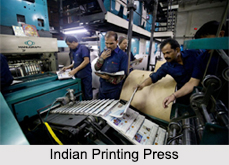 Indian press is said to be the largest section of print media in the globe. Indian printing houses publish more daily newspapers than any other country in Asia, covering a range of languages and educational topics that is unmatched in the world. According to a survey in 2000, there were over 27,000 newspapers and periodicals in India that were published in 93 languages. Some 5,000 dailies were read by more than 100 million readers in 14 languages. However, in a nation with a high rate of illiteracy, the effects of these newspapers and periodicals in those days were limited to an elite audience.
History of Indian Press
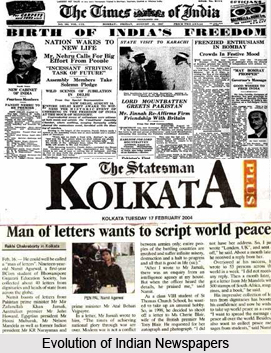 History of Indian Press accounts for the prestigious growth of Indian newspapers and its significance in Indian history as well.
James Augustus Hickey is considered as the "father of Indian press" as he started the first Indian newspaper from Calcutta, the `Bengal Gazette` or the `Calcutta General Advertise` in January 1780. In 1789, the first newspaper from Bombay, the `Bombay Herald` appeared, followed by the `Bombay Courier` next year. This newspaper was later amalgamated with the `Times of India` in 1861.
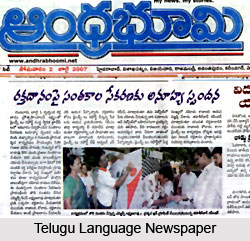
The first newspaper in an Indian language was in Bengali, named as the `Samachar Darpan`. The first issue of this daily was published from the Serampore Mission Press on May 23, 1818. In the very same year, Ganga Kishore Bhattacharya started publishing another newspaper in Bengali, the Bengal Gazetti. On July 1, 1822 the first Gujarati newspaper was published from Bombay, called the Bombay Samachar, which is still extant. The first Hindi newspaper, the Samachar Sudha Varshan began in 1854. Since then, the prominent Indian languages in which newspapers have grown over the years are Hindi, Malayalam, Marathi, Tamil, Urdu, Telugu, and Bengali.
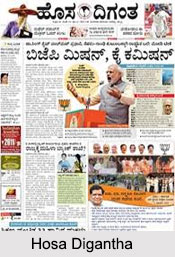
The status of Indian language papers have taken over the English press according to the latest NRS survey of newspapers. The main reasons include the marketing strategy followed by the regional papers, beginning with Eenadu, a Telugu daily started by Ramoji Rao. The second reason has been the growing literacy rate. Increase in the literacy rate had a direct positive effect on the rise of circulation of the regional papers. The introduction of mother tongue in the primary education stage brought about a great change. The people who learned their mother tongue at the least could read the regional newspapers fluently and thus became aware of the national and regional scenario. During this developmental period, sale of the regional paper in the respective state rose to a great limit.
Indian regional newspapers have several editions for a particular state for complete localisation of news for the reader to connect with the paper. Malayala Manorama has about 10 editions in Kerala itself and six others outside Kerala. Thus regional papers aim at providing localised news for their readers. Even the advertisers saw the huge potential of the regional paper market, partly due to their own research and more due to the efforts of the regional papers to make the advertisers aware of the huge market.
With a long history behind, Indian press has evolved with a supreme power in the contemporary times, where participation of press gives any incident a special value.
Indian Press Act 1910
 The Indian Press Act 1910 was a legislation propagated during the rule of British Empire in India that imposed stringent censorship and restriction of on all types of publications. The measure was put into effect in order to curtail and restrict the emerging Indian freedom struggle, particularly with the advent of World War I. In the year 1907 Herbert Hope Risley announced that the British administration was beleaguered with a collection of diverse material, some of which were misguided, and seditious. This was declared in reaction to a surge of descriptions that were associated with the Cow Protection Movement. Herbert Hope Risley drafted the main substance of the Indian Press Act 1910 as a result of these concerns.
The key instruments of control that were imposed by the Indian Press Act 1910 were financial securities. These were susceptible to confiscation and subtraction in case of occurrence of any breach of the remarkably extensive provisions of the legislation. Due to the disorganized socio-political scenario, the British Government of India issued a brand new Press Ordinance in the year 1930. This new Indian Press (Emergency) Act was intended to provide for the enhanced control on all kinds of publications and it revived the provision of the Indian Press Act 1910. In the year 1931, the British authorities imposed the Indian Press (Emergency) Act, which gave comprehensive authority to the provincial government in repressing the propaganda for the Civil Disobedience Movement.
Section 4 (1) of the Act sought to penalize the words, signs or visible representations, that encouraged the commission of any offence or murder or any other cognizable offence. These cognizable offence included hostility or directly or indirectly expressing approval or admiration of any such offence. According to the Indian Press (Emergency) Act, any person, real or fictitious, who had committed or alleged or represented to have committed the offence, would be punished. In the 1932, the Indian Press Act of 1931 was improved in the form of Criminal Amendment Act of 1932.
Section 4 was made all inclusive and extended to incorporate all possible actions that were considered to destabilize the authority of the British Government of India. During World War II (1939-45), the British administration exercised comprehensive authority under the Defence of India Act.
The Indian Press (Emergency) Act
Indian Press at Present
Indian press is playing a major role in contemporary India. It is helping in creating awareness about serious issues affecting the development of nation and links people belonging to different parts of India. Starting from the delivery of news and display of advertisement, newspapers play a vital role in the everyday life of Indians. Several media houses and private newspaper agencies have come up in India. Indian newspapers are owned mainly by individuals or private firms. Therefore, Indian press is relatively free from government control. The major national dailies like The Statesman, The Telegraph, The Times of India, The Asian Age, The Economic Times and others are read all over the country, while the regional newspapers have found profound audience in their respective regions. There are organizations in India, which gather news items and distribute them to newspapers or broadcasters. These organizations are called news agencies. India has several news agencies like the Press Trust of India, Hindustan Samachar and Samachar Bharti.
The Indian Press (Emergency) Act
The Civil disobedience movement in particular and the other fragmented political awakenings made the socio-political condition pretty anarchic. The chaotic socio-political situation moved government to issue a fresh new Press Ordinance in 1930. The new Press Act was aimed to provide for the better control of the Press. The Indian Press Act revived the provision of the Indian press Act of 1910. In 1931,the government enacted the Indian Press Act, which gave the sweeping powers to the provincial government in suppressing the propaganda for the civil disobedience movement. Section 4 (1) of the Act sought to punish the words, signs or visible representations, which incite or encourage the commission of any offence or murder or any cognizable offence. These cognizable offence included violence or directly or indirectly expressing approval or admiration of any such offence. According to the Act, any person, real or fictitious, who had committed or alleged or represented to have committed the offence, would be punished.
In 1932 the Press Act of 1931 was amplified in the form of Criminal Amendment Act of 1932. Section 4 was made very comprehensive and expanded to include all possible activities calculated to undermine the Government`s authority. During the Second World War (1939-45), the executive exercised exhaustive powers under the defence of India Act. Pre-censorship was reinforced, the Press Emergency Act and the Official Secrets Act. At the same time the publication of all news relating to the Congress activities declared illegal. The special powers assumed by the Government during the war ended in1945.