Gardens in Mughal Architecture, Architecture During Mughal Dynasty - Informative & researched article on Gardens in Mughal Architecture, Architecture During Mughal Dynasty
  Indianetzone: Largest Free Encyclopedia of India with thousand of articles History of India


in  
Art & Culture | Entertainment | Health | Reference | Sports | Society | Travel
Forum  | Free E-magazine
History of India : Sources of History of India l Ancient History of India l Medieval History of India l Modern History of India l Indian Historical Dynasties l Indian Battles l Sepoy Mutiny 1857 l Indian Rulers l History of India l Indian Freedom Struggle l Indian Governor- Generals l British Indian Acts l Post Independence India l Iron Age in India
Home > Reference > History of India > Medieval History of India > Islamic Architecture > Mughal Architecture > Gardens in Mughal Architecture
Gardens in Mughal Architecture, Architecture During Mughal Dynasty
Gardens in Mughal architecture stand as heavenly innovations of green watered wonders by majestic sponsoring.
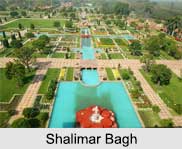
  Shalimar Garden      

Ram-bhagMughal architecture in India needs no preliminary introduction with regards to its grandeur, magnificence, lavishness, colossal in every attempt, monumental in proportions and meticulous in every work of art ever chiselled upon any Indian monument. The Mughals beginning from Babur and his advent from Persia, with the near culmination during the times of Aurangzeb, with little help from the later Mughals, indeed had been splendid and resplendent in every attempt they had made in relation to administration and its associated elements. The domain of `garden architecture` under the umbrella of Mughal architecture is one such area, which have not gained much of the limelight and veneration, with much of them perhaps lost to anonymity. The architectural geometry and its minute details, with special stress upon other architectures and its framework - Mughal architectural particulars of the gardens ever grounded in India, is not an element which can be captured by the naked eye. As a consequential answer, it can be stated that, gardens in Mughal architecture do demand a special space amidst the other imposing monumental builds.

Mughal gardens and their architecture possess a splendid and fragrant proud history. Indeed, some the gardenia instances of the Mughals in Kashmir or Delhi, do possess much popularity and respect owing to their stretch of being virtually unlimited in the length and breadth of flora and fauna. Gardens in Mughal architecture redefine the advent of overspreading gardens, slender streams flowing by all through the middle of the garden, the rare arrival of flora from the Persian landscape, the rainbow-tinted flowering of exceptional flowers dispersing their scent and fragrance in the nearby lands, the pastures of exotic-ness, the conception of being amidst Eden suddenly upon earth, or the umpteen other unique aspects that one can imagine. Together, the fact that the juicy and nutritious fruits had also accompanied the flora and uncommon trees like grapes, peaches or watermelons, indeed Mughal gardens and its architecture deserves thundering applaud from every quarter of the universe, with the emperors practically thinking in heavenly proportions to make out-of-this-world constituents a reality to human beings in India.

Gardens in Mughal architecture, as with various architectural detailed components, had historically arrived with Emperor Babur and his advent from Samarkand. It is acknowledged that even before the battle of Panipat, Babur had considered Punjab rightfully his, since earlier it had been conquered by his legendary ancestor, Timur. There, on a bitter cold, rainy day in February 1526, two months before his victory over the Lodis, Babur had discovered a site near the Ghaggar River that he deemed ideal for a char bagh. The garden, which the first Mughal had designed himself, was completed in 1528-29. Although it no longer survives, literary reports indicate that Babur`s first Indian garden in Punjab was built around a natural spring and that the garden itself was situated in a narrow mountain valley, a terrain close to that of Babur`s own Kabul. The char bagh mentioned earlier was the most sublime and most praiseworthy of Mughal garden`s architectural aspect, which was ever grounded by Babur. Since his arrival to India, the char bagh style was the most complied with and abided by the succeeding dynasties that have ever ruled India, a practice which is continued even today. Char bagh by Babur had redefined Mughal gardens and its architecture for the successors to come, only to make India magnificent by filling empty places up with trees, plants and more of everything green.

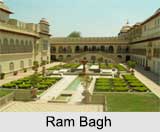
Only two of Babur`s Indian gardens can be identified with any certainty, in consideration with gardens of Mughal architecture. One is in Agra, today addressed as the Ram Bagh, the other being identified in Dholpur, today in Bharatpur District, Rajasthan. It is his Bagh-i Nilufar, or Lotus garden, had been described in his memoirs. Both of these mentioned instances do steep in legends and lores of reverence. It is the emperor Babur himself, who describes the process of finishing the garden architecture under a Mughal idiom. The details include a mosque, bath, well, twenty-six rock spouts, pillars, lotus-shaped pools, watercourses cut terrace-like into the terrain and stone platforms. Indeed, the notion of terraced symmetrical gardens divided into four quarters by courses of running water was introduced into India by Babur. His memoirs reveal a deep personal involvement with the cultivation of plants and flowers for his own gardens. In short, Babur knew all potential plantings for his garden and he had demonstrated himself as the ultimate master and creator of each garden.

Nishat Bagh Babur and his Mughal plan of garden architecture was such that he had issued orders of regular, symmetrical gardens and orchards which needed to be laid out in all large cities. Such four-part, ordered Mughal gardens and its architectural plan, represented a Timurid tradition. After Babur, Humayun who had ascended the throne, was much to occupied to consolidate his Empire from Sher Shah, which made him kind of neglect the Mughal architectural scenario, which thus rested in the hands of his son, emperor Akbar. Akbar is not however not much legendary to have lent life to any such celebrated gardenia or its strict Mughal architecture, which, on the other hand, had looked towards the future with Jahangir. Jahangir, the man with an exceedingly artistic bent of mind, was legendary to possess immense regard and respect for gardens and garden settings. He is also known to have rewarded most of the architects with premium richness. Just after returning to Agra in 1619, he had discovered much delight in witnessing the Gul Afshan garden, probably the same garden later owned by Nur Jahan and renamed the Nur Afshan Bagh. Huge sums of money and a smooth cash flow was guaranteed by this emperor, who was so much dedicated and ardent to the aesthetic side of life that Mughal garden architecture truly was ably carried forward after the arrival of Babur.

Indeed, during Jahangir, gardens in Mughal architecture had received its much awaited impetus and interest, which were thoroughly bestowed with affluence and architectural manipulations. In Kashmir`s capital city, Srinagar, emperor Akbar had constructed a massive fort on a high hill known as the Koh-i Maran or Han Parbat overlooking Dal lake. There Jahangir had ordered the completion of the unfinished portion of the fortifications and the restoration of the palace buildings in it, especially a garden and Public Audience Hall. Mutamad Khan was charged with this work. The architect had created a three-tiered garden there. The garden amidst Koh-i Maran by Mutamad Khan possessed a pavilion, which was embellished with the work of master painters. Again, in keeping with many of his earlier works, Jahangir had renamed this garden Nur Afza, or Light Increasing, after himself, continuing his long-standing fascination with light imagery, another fascinating facet of Mughal manicured gardens and architectural properties.

Indeed, emperor Jahangir is an absolute legend in connection with gardens in Mughal architecture. The captivating properties, never seen before elements, the exhaustive renovation work done to already built gardens, the disciplined supply of water flow in all the gardens are just some of the brilliance of every Mughal garden`s architecture, which was patronised by the emperor himself, under special guarantee. Just like his son Shah Jahan, Jahangir also had too much favoured to give birth to gardens in the verdant scenario of Kashmir. Jahangir did give special attention to gardens in the valley south of Srinagar, in Kashmir. The emperor was a professed lover of the natural streams and springs there and so had added to them canals, fountains and buildings to produce `terraced gardens` - a type of Mughal architectural specialty with regards to gardens, which would seen profusely during Shah Jahan`s times. One other outstanding instance of garden architecture by a Mughal Jahangir is the Ram Das Kachhwaha`s Macchi Bhavan garden in the similar direction in Kashmir. Yet another site in Kashmir most often mentioned by Jahangir is the spring at Vernag, approximately 10 km north of Achibal. While much of the garden and surrounding pavilions have disappeared today, the tank, with low walls containing arched apertures and blind arched niches, still exists as do descendants of the large fish that swim in the lucid waters, producing a spectacle of royal splendour.

Dal-lake Next in line to the Mughal throne, Shah Jahan, as well his architectural plannings of Mughal gardens, deserve to be specially mentioned. It was Shah Jahan as the man who was of the habit to scout out sites to give life to luxuriant garden architecture, adhering strictly to Mughal norms. The emperor had a life-long interest in the construction of superbly well-ordered gardens. Many of these had indeed also served as the setting for major structural works, for example the tomb of Mumtaz Mahal, legendary today as the Taj Mahal, or Jahangir`s tomb in Lahore. Palaces of Shah Jahan also had incorporated gardens into their layout. Other gardens of Mughal architecture, however, were developed independently of tombs and palaces. Royal structures had enhanced these gardens, but they were not the sole reason for the gardens` existence. Most of the gardens Shah Jahan had built or renovated were situated between Agra and Kabul.

As a prince, Shah Jahan also had grounded some garden pavilions in Ambala. Upon his accession the emperor had given the garden to Jahan Ara, his eldest and favourite daughter.

The climate and natural beauty of Kashmir had made the region the Mughal seat of rest and leisure. Indeed, Shah Jahan was also a man who had acclaimed Kashmir and Srinagar to serve as the idyllic places for accomplishing Mughal architectural garden as masterpieces. Shah Jahan had enjoyed the numerous Mughal gardens there - some imperially sponsored, others built by princes and high-ranking officials. Amongst those he had praised were the one at Avantipur constructed by Dara Shukoh, Asaf Khan`s Nishat Bagh and Nur Jahan`s Bagh-i Nur Afza - all located within the Srinagar Valley. But the most impressive of all are Shah Jahan`s own gardens in Kashmir, especially the world famous Shalimar garden.

Just like his predecessors, emperor Aurangzeb too had enjoyed garden settings and was also of the habit to reward gardeners and architects of such work of art for good work. He himself however had built only a few, mostly when still a prince under Shah Jahan`s patronage, including a garden and tank in the vicinity of Bijapur as well as one in Ujjain. Emperor Aurangzeb, again like his predecessors, was taken by the beauty of Kashmir and its gardens, although he had decreed in the sixth year of his reign that no king should visit there unless on military or administrative business; the pursuit of pleasure, he had believed, was inadequate reason for going to Kashmir. Yet, there existed reason enough for gardens in Mughal architecture to receive the most valuable of attention under every proficient Mughal ruler to have existed in India.

(Last Updated on : 19/09/2011)
  More Articles in Mughal Architecture
 
Sources Of Mughal Architecture Features of Mughal Architecture Mughal Architecture During Later Mughals
Mughal Architecture in Ajmer Mughal Architecture in Delhi Mughal Architecture in Bengal
Mughal Architecture in Bihar Gardens in Mughal Architecture Peacock Throne
Recently Updated Articles in History of India
  • Mughal Architecture
    Mughal architecture is a combination of Islamic, Persian, Turkish and Indian architecture. It is a style that was developed under the Mughal dynasty in the sixteenth and seventeenth centuries.
  •  
  • Mansabdari System in Mughal Dynasty
    Akbar introduced the Mansabdari System in the Mughal army which primarily meant the ranking of officers on decimal system.
  •  
     
  • Deccan Policy of Mughal Dynasty
    Deccan Policy of the Mughal dynasty was weak during the reign of Babur and Humayun but after the accession of Akbar on the throne, the political situation changed and the Deccan policy was a success.
  •  
  • Coins of Pandyas
    Coins of Pandyas bear the legend of different Pandya ruler in different times.
  •  
  • Art and Architecture of Mughal Empire
    Art and architecture of Mughal Art offers an aesthetic degree to all art lovers. The subtlety of the finesse and the dazzle of the aura create huge amount of interest among tourist.
  •  
    E-mail this Article | Post a Comment
    RSS Feeds
    Forum
    Forum on History of India

    Free E-magazine
    Subscribe to Free
    E-Magazine on Indian Crafts
     
     
    Gardens in Mughal Architecture, Architecture During Mughal Dynasty - Informative & researched article on Gardens in Mughal Architecture, Architecture During Mughal Dynasty
    Sitemap
    Contact Us   |   RSS Feeds
    Copyright © 2008 Jupiter Infomedia Pvt. Ltd. All rights reserved including the right to reproduce the contents in whole or in part in any form or medium without the express written permission of Jupiter Infomedia Pvt. Ltd.