
Gadia Lohar is a nomadic community of Rajasthan and this community literally means `blacksmith in a vehicle`. They are also found in Malwa region of Madhya Pradesh. The Gaduliya Lohars claim Rajput ancestry and are essentially metal workers. They profess superiority to all other nomadic groups. Historically, they were assigned the job of making weapons for the warrior Rajputs. The Gadia Lohar tribal community derived the name from their beautiful bullock-carts which are also called `gadis` in Hindi.
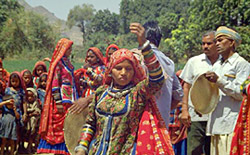
As per the legend, the forefathers of the Gadia Lohar which is also known as Gaduliya Lohar tribe were blacksmiths in the army of Maharana Pratap of Mewar. After the fall of Mewar to Mughals, the blacksmiths decided not to return to their homeland and to settle somewhere else until the restoration of Rana`s hegemony. The people of this tribal group spent most of their time in the bullock carts. They are buoyantly venerable and are well built people despite of the hard and uncertainties of their lifestyle. The costumes of the Gadia Lohar tribal people are the reflections of their culture, society and their living style.
The ensemble of a Lohar woman consists of `kanchli`, `kurti`, `ghaghra` and `odhna` that complete the attire of the Lohar woman. The `kanchli` is cut on the same lines as the one worn by a Rajput woman. It is fastened at the back, around the neck and the waist with cloth cords. The upper portion of the `kanchli` is profusely ornamented with tinsel, sequins, mirrors and silk threads. The `kurti` is a close fitting, sleeveless bodice reaching a little below the waistline. The neckline is finished with piping, which extends down the centre front opening to form a placket and is fastened with silver buttons. The neckline is usually quite deep and tattoos on the central part of the chest are visible. The cut of the `kurti` exposes the entire `kanchli` and a portion of the midriff.
The shin-length `ghaghra` is made up with 60-80 kalis. These are gathered and held together at the waist by a drawstring belt in a contrasting colour. The hem of the `ghaghra` is edged with narrow piping called the `guna` and a `magazi`. The colours of the `guna` and piping, contrast with the main fabric, which is usually a blue block-printed `pharad`. The Gadia Lohar women are tribal though elegant in appearance and dressing sense.
The single and married women of Gadia Lohar community wear bright colours, while widows wear deep blue, green or black. An interesting custom is observed among the widows of this community. The central front portion of the `kalidar ghaghra` is picked up, taken between the legs and tucked in at the back waist. The women use `odhna` and their draping style is similar to that of a Rajput woman. The `odhna` covers the head and its borders are appliquéd with tiny silver `gota` flowers. The `odhna` is either plain or patterned in floral designs.
`Borla` is the adornment of the forehead of the married women and ivory bangles cover the upper arms and wrists. The women are fond of jewelleries and they use a number of ornaments to bedeck themselves. They wear nose ring that is called `bhanvaria`, a `bichudi` or toe ring and silver anklets called `kadula` are worn as symbols of her marital status. The women also wear a `tabiz`, a pendant believed to ward off the evil eye and a necklace called the `kanthi`. Their neck jewellery is made from old silver coins, much like gypsies in other parts of the world.
Tattoos are popular among the Gadia Lohars and believed to ward off misfortune. The names of lovers and life partners are tattooed on their bodies. The eyes are rimmed with black and palms are decorated with `mehendi`. They sometimes decorate their teeth with gold nails fixed on their upper incisors. The hair style of the women of this community is remarkable and they decorate their hair with great artistry. They part their hair in the centre and have two thin plaits running along either side of the forehead, in addition to one at the back. All three are then braided together down the entire length of the hair and are fastened with the help of a `chutila`, which is made of strings and beaded tassels.
The attire of the Lohar men consists of an `angarkhi`, dhoti and turban. The `angarkhi` is made from white, unbleached, coarse, cotton `reza`. It is of hip-length and much the same as other `angarkhi`, is tied on the right-hand side. The full-length sleeves are plain, ending in short wristbands cut on the bias, which may or may not have slits in them. The turban is usually tied in the `gol safa` style. Turbans for daily wear are red or yellow and are white for elderly men. On festive occasions, vivid turbans in a variety of colours may be worn. The fabric of the dhoti is white cotton and it is usually worn in the `tilangi` dhoti style.
Not only the women, but also the men of the Gadia Lohar community prefer to wear gold `murki` and other ear-rings like the `jhela`. On weddings, they wear a gold or silver locket on a black thread tied round their neck, which they call a `phul`. Silver bangles called `kada` are worn on the wrists and, on special occasions, they also wear a hip girdle in silver called a `kanakti`. A thick silver anklet called `kadi` which is worn on their right leg.
The men dress their hair in a unique fashion. The older men shave off almost all their hair except for a lock or two, just over the temples. These little tufts of hair are allowed to grow into long, bushy whiskers that are visible even under their `safa`. They also wear long, luxuriant moustaches that almost touch their sideburns. Their footwear is usually the `juti`.
The Gadia Lohar community carries the ethnicity of their culture and tradition and reveals the utmost social settings of their community.
Gadia Lohar Tribe
Gadia Lohar is the group of the blacksmiths of Rajasthan and is of Rajput ancestry.
Recently updated articles in Tribes of India
Arakh Tribe
Arakh Tribe is one of the ancient tribes located in several parts of central India. Their origin dates back to the Tughlaq era. Arakh tribe appears to...
Traditional Dress of Nyishi Tribe
Traditional Dress of Nyishi Tribe is worn during festivals and social gathering. Men wear a cane helmet surmounted with the beak of the great Indian H...
Pasi Community
Pasi is an aboriginal race of India and are mainly distributed over the northern region of the country. The traditional occupation of Pasi is the extr...

Bhojas
Bhojas have been described as a very important tribe in the Aitareya Brahmana. Historical records have said that the Bhojas were settled towards the s...
Traditional Dress of Karbi Tribe
Traditional Dress of Karbi Tribe can be easily recognized by the artistic designs inherited from their forefathers. Karbis have their own traditional...
Related articles in Tribes of India
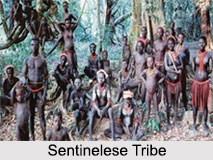
Sentinelese Tribe
Sentinelese tribal community is one of the most isolated and secluded tribes that are found in the whole world.
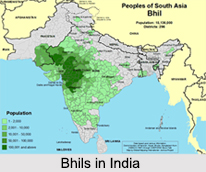
Bhil Tribe
The people of the Bhil tribe are the most widely distributed tribal groups in India.
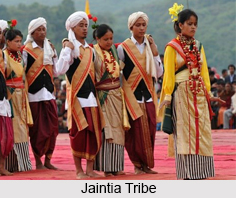
Jaintia Tribe
Jaintia Tribes are located in the Jaintia Hills of Meghalaya. They are also called the Pnars. They are famous for weaving of carpet, making of musical...
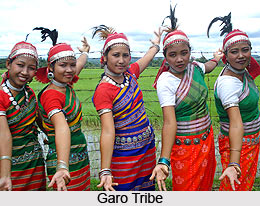
Garo Tribes
Garo Tribes are one of the matrilineal tribes of North-East India who reside in the Garo hills of Meghalaya. Historically, the tribe originated in Tib...
Garasia Tribe
The Garasia tribal community holds a significant position within Indian culture, renowned for their distinctive way of life and rich cultural heritage...