 coins, the French purposed to issue coins of their own. The French people decided to issue their own `Pagodas` on the pattern of the local `Pagodas`. As decided they issued their own coins with the figure of Lakshmi on the obverse and a granulated surface with a crescent on the reverse side of the coin. The use of Hindu deity on the coins earned disapproval of the Church. The Director General in Paris looked into this matter and turned down the objection of the Church. The coins were put back in circulation but with the formation of the new company, the Church again raised objection. As the directors did not agree to the withdrawal of the coins, they suggested to seek permission from the Mughal authorities to issue coins following the latter`s pattern. Though the Pagodas with Lakshmi were never struck, the Pondicherry mint struck `Three Swami Pagodas` on the pattern of the English `Pagodas`. Even the company also issued gold coins of the French type similar to `Fanons`.
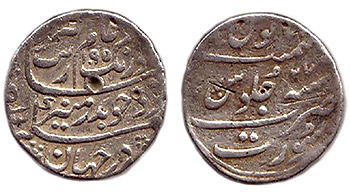
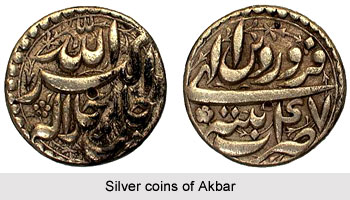
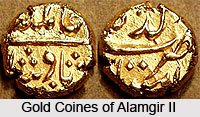
The French wanted eagerly to issue coins of their own in the Mughal style and probably in 1718; they started negotiations with the Mughal authorities. In the later years, the French issued silver `Rupees` from Pondicherry but the coins bore the mint name of `Arkat` and had Mughal inscriptions on both sides with a crescent. These coins were issued in the name of the Mughal emperors, Muhammad Shah, Ahmad Shah, Alamgir II and Shah Alam II. The coins in the name of Shah Alam II continued even after his death till the mint was closed. The coins of French in the Mughal style bore the Hijri year and the corresponding regnal year of the Mughal emperor. As the French issued coins of Mughal style, they used the mint name with a trident as distinctive mark of the coins.
In the later years, probably in 1733 or 1739, the French obtained permission to mint Mughal coins in Bengal also. After getting the permission thousand `Piastres` (a unit of currency) were sent to Murshidabad for being converter into `Rupees` for the use of the French settlement at Chandernagore. These coins had the Jasmine flower as the distinguishing mark. Later in 1749, the French achieved the privilege from the Nawab of Surat, of coining Mughal rupees for the use at their Surat factory. Even some coins bearing the name of Ahmad Shah with the regnal year were issued even the coins were issued from Surat and stand as the representative of native workmanship and without any mint mark.
The copper coins issued by the French were termed as `Doudo`, half `Doudo` and `Cash`. The coins that were issued by the French bore the `fleur-de-lys` on one side and `Puducheri` in Telegu on the other side of the coin. The `fleur-de-lys` on obverse side of the coin was replaced by cock and date as on the silver coins in 1836. Some copper `Biche` and half-`Biche` were perhaps issued from Mahe and these coins bore the `fleur-de-lys` on one side and the date in a beaded border on the other side of the coin.