


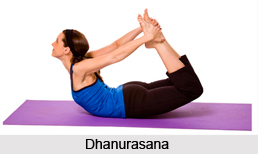
 Dhanurasana, or the bow curve pose, is a cultural asana that has a beneficial effect on several muscles in the body, including those of the back, the forearms and the abdomen. It is a simpler variant of the Dhanurasana, first mentioned in the Hatha Yoga Pradipika, a major Hatha Yogic text and was thenceforth described in subsequent yoga texts. Dhanurasana, or the bow curve pose, is a cultural asana that has a beneficial effect on several muscles in the body, including those of the back, the forearms and the abdomen. It is a simpler variant of the Dhanurasana, first mentioned in the Hatha Yoga Pradipika, a major Hatha Yogic text and was thenceforth described in subsequent yoga texts.
Meaning of Dhanurasana Dhanurvakrasana translates to the curved bow posture in Sanskrit, and is a close derivative of the Dhanurasana, or the bow posture. It is called as such because of the resemblance of the final posture to a curved bow. The trunk and the thighs of the practitioner represent the bow proper, whereas the hands and legs take the place of a string. Yoga Texts and Dhanurasana First described in the Hatha Yoga Pradipika (1400 AD), Dhanurasana formed part of the 84 Classic Yoga Asanas taught by Lord Shiva according to the Hatha Ratnavali (1600AD). It is mentioned and described regularly in several other texts including the Yoga Upanishads, the Gheranda Samhita and the Shri Tattva Nidhi. Practice of Dhanurasana A sequential process for performing Dhanurvakrasana follows. * Lie prone on the abdomen. * Bend the legs at the knee-joints from behind upward and fold them against their respective thigh. * With the arms to the back, at full length, grasp the ankles well with the hands. Then raise the neck simultaneously with a steady lift and pull upwards on the ankles, while inhaling. * Next, rest the entire body on only the area of the navel (umbilical region), assuming a somewhat circular position. In order to derive the highest benefit from this pose, the knees should be kept together. This pose has to be maintained as long as it is comfortable with retention of breath. * Then release the hold on the ankles, begin to exhale and assume the starting position-prone on the abdomen, the legs fully stretched out and the arms rested on the floor. It is best to pause before another round. * The practitioner may either repeat the pose of Dhanurvakrasana eight times in two minutes or maintain the pose for the duration. The latter posture is preferable only after a few months of practice. Effects of Dhanurasana The hygienic features of this posture are the extraordinary amount of pressure, due to the whole body being thrown upon the umbilical region only; the extreme stretching of the abdominal and pelvic muscles; and the steady pull anterior pull throughout the spinal column, with the alternate contraction and relaxation of the spinal muscles. Further, the venous drainage facilitates fresh supply of blood to the abdominal viscera, especially of the lower abdomen and the reproductory organs. Several muscles, including the extensors of the hip, elbow, wrist and drunk, and the abdubtors of the shoulder joints are exercised by this asana. The quadriceps and pectorals are also strained thanks to holding the legs in the bow curve position. Precautions in the Practice of Dhanurasana Dhanurasana requires brisk movement of the body. Hence care should be taken not to sprain any joint. Initially this yoga asana may be practised for five seconds. Later the tenure can be increased to three minutes or more, according to one's capacity. During the practice of Dhanurasana it is advisable to breathe normally. If one desires to control his/her breathe, this should be done without any damage to the lungs. It is desirable for a beginner to keep his knees apart because thereby, he would be able to secure a bigger curve for his body during this exercise. As the muscles become more and more elastic, the knees should be drawn more closely, till at last they should be made to stand together, thus carrying the intra-abdominal pressure to its highest limit. Practitioners should not fold the arms at the elbow while attempting this posture and those who have lumbar spondylitis should not perform the asana. |
| |||



Home > Health > Yoga > Yoga Asanas > Types of Yoga Asanas > Cultural Asanas > Dhanurasana Yoga Asana
Dhanurasana Yoga Asana
| Dhanurasana or the bow-curve pose is a cultural asana that exercises the muscles of the back, the chest and increases blood flow to the |
| ||||||||||||||||||||||||||||

