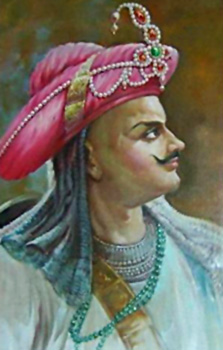
 The decline of the Maratha Empire was the result of a number of instability in the administration and set up of the empire. This also resulted in sinking of the Peshwa`s authority.
After the first Anglo Maratha War, the Maratha Confederacy was shaken by incessant quarrels and by civil war made lurid with sadistic executions. Dissatisfied with the ordinary methods of blowing from a gun and trampling by an elephant, Sarji Rao Ghatke invented such deaths as tying to red-hot cannons and festooning with rockets that carried the victim along in a whirl of explosions. As the century ended Sindhia and Yeswant Rao Holkar, marched and countermarched, fighting a series of battles, of which some of the fiercest took place when they were nominally at peace. The vast extent of territory which the Marathas occupied was swept with storm-winds. This brought the primary decline of the Maratha Empire.
Shahuji appointed Balaji Bajirao (Nanasaheb), the son to Baji Rao as a Peshwa. This Peshwa brought immense change to different sectors of social life including a marked improvement in the state of the territory. The brother of Nanasaheb, Raghunath Rao, witnessed continued expansion in 1756 by pushing into Punjab in the wake of the Afghan withdrawal after Ahmed Shah Abdali`s plunder of Delhi. The Marathas reached the acme of success after the defeat of the Nizam in the Deccan.
An army was sent by the Peshwa Balaji Baji Rao to challenge the Afghan led alliance of Indian Muslims composed of Rohillas, Shuja-ud-daula and Najib-ud-daula. On January 14, 1761 the Maratha army was decisively defeated at the Third Battle of Panipat. Suraj Mal and Rajputs abandoned the Marathas. The Maratha expansion towards Northwest was curbed by the defeat at Paniput and caused the disunion of the empire. This resulted in barring the Maratha Confederacy to fight as one unit and since then Mahadji Shinde controlled Delhi/Agra from Gwalior, Central India was controlled by Holkars from Indore and Western India was controlled by Gaikwads from Baroda.
Later Madhavrao Peshwa tried to reconstruct the empire and restored the Maratha authority over North India after 1761, 10 years after the battle of Panipat. Semi-autonomy was given to strongest of the knights to manage the large empire effectively. As a result, the autonomous Maratha states of the Gaekwads of Baroda, the Holkars of Indore and Malwa, the Scindias (or Shinde`s) of Gwalior (and Ujjain), Pawars of Udgir and Bhonsales of Nagpur came into being in far flung regions of the empire. Moreover, many knights in the Maharashtra were given semi-autonomous charges of small districts which led to princely states like Sangli, Aundh, Bhor, Bawda, Jat, Phaltan, Miraj etc.
The British East India Company intervened in a succession struggle in Pune, on behalf of Raghunathrao in 1775 from its base in Bombay. It caused the First Anglo-Maratha War and this ended in 1782 with a restoration of the pre-war status quo. Later the British intervened in Baroda to support the heir to the throne against rival claimants in 1802. They signed a treaty with the new Maharaja recognizing his independence from the Maratha Empire in return for his acknowledgement of British paramountcy. The Peshwa Baji Rao II signed a similar treaty in the Second Anglo-Maratha War (1803-1805). The final loss of Maratha independence was ushered by the Third Anglo-Maratha War (1817-1818) which was the last-ditch effort to regain sovereignty. This war left Britain in control of most of India and the Peshwa was exiled to Bithoor (near Kanpur, U.P.) as a pensioner of the British. The Maratha heartland, including Pune, went under the direct control of the British Empire. However the states of Kolhapur and Satara were retained by the local Martha rulers. On the other hand states of Gwalior, Indore and Nagpur were declared princely states under the British sovereign. Other small princely states of Maratha knights were retained under the British Raj as well.
The last Peshwa, Nana Sahib was one of the main leaders of the 1857 battles against British rule. He was the motivator who encouraged the people and the Indian Princes to defend against the British. Tantia Tope along with Rani Lakshmibai fought the battle courageously and created terror in the hearts of the British.