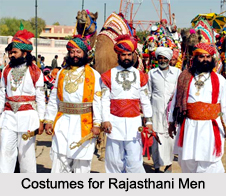
 Vibrant colours and patterns define the regal state of Rajasthan. This predominant vivacity is reflected in the costumes of Rajasthan as well. However, it must be noted that a lot of significant facts are closely related to the costumes for Rajasthani men and women. In fact, the costumes worn by the men of rural Rajasthan still reflect the clothing style of those who lived in the olden times. The apparel for Rajasthani men are somewhat more restrained than the women`s clothes and are still quite varied in form and texture.
Types of Costumes for Rajasthani Men
Traditionally, the lower garment of Rajasthani men is the unstitched "Dhoti", the truly native Indian costume, or a stitched garment such as the "Pyjama", which is a type of trouser. Some garments related to the pyjama include the Suthan, Izar, Shalvar or Salvor, Survala or Sural and Ghutanna.
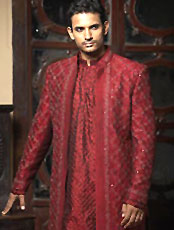
The upper garment of the Rajasthani men can include a "Bandi" and a "Kurta" or tunic that is commonly worn. During formal occasions men dress in the "Angarkha" and sometimes a garment called the "Achkan" or "Sherwani". The turban and a draped piece of fabric around the shoulders complete the ensemble. Interestingly, the Rajasthani men have a wide range of upper garments to satisfy their sartorial tastes.
Two other upper attires for the men of Rajasthan are the "Jama" and the "Choga" that plays an important role of the male ensemble in the Mughal era. Although superbly tailored and ornamented, the "Jama" and "Choga" are now seen mostly in museums. However, it would be inaccurate to say that they have disappeared completely. Some of the influential and royal families still wear such garments, although only on ceremonial occasions. The attire of the gentleman is incomplete without a long stole that depends on the section of society that could be an "Angocha" or a dupatta. Two other such Rajasthani men garments are the "Chapkan" and the "Chasuble". In addition to these are a large number of jackets like Sadri, Mirzai, Jarji, and Fatu.
The men in Rajasthan wear colourful headgears called the "Pagri" or the turban depending upon the climatic condition of the particular region. Shawls and blankets, usually made of camel and sheep wool, are seasonal additions that are useful for warding off the biting cold of Rajasthan"s winters. The tradition of wearing Bandhani clothes in Rajasthan, north India has been going on for time immemorial. Tie-dye drapes, dupattas and turban are common costumes for the men of Rajasthan.