Coins of Sher Shah Suri
|
Coins of Sher Shah Suri followed were predominantly made of copper and silver.
|
|
|
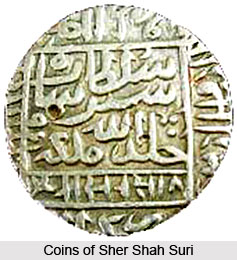 During the ruling period of Sher Shah Suri, he issued coins in different metals. He issued coins in silver and copper in his own name from a number of places. During the ruling period of Sher Shah Suri, he issued coins in different metals. He issued coins in silver and copper in his own name from a number of places.
After his formal coronation, Sher Shah Suri issued coins in silver and copper and eliminated the billon from the series of Indian coins. Though he had issued coins in silver and copper, no coins were found in gold. Perhaps he did not issue any coin in this metal. In the silver coins of Sher Shah, there was the trace of 'Kalima' and the name of four Khalifas on obverse side of the coin. On the obverse side of the coin contained his name and a pious wish: 'Khald Allah mulk.' The name of the mint and date along with the king's name in Nagari letters were inscribed on the reverse side of the coin. The legends were arranged in diverse ways on various coins. The coins were issued from different mints like Ujjain, Agra, Punduah, Chunar, Satgaon etc. Besides these mints, there were some coins which bore the word 'Jahapanah' in place of the mint name and suggest that they were issued from the court or from some camp mint. The practice of issuing coins from royal camps won great popularity in the Mughal period. Sher Shah had issued coins from various mints. In addition to these there were a large series of mintless silver and copper coins formed the currency during the early period of his conquests. In many cases they were struck after the practice of recording mint names on coins had become established. These may, thus, had been issued from the mobile camp mints. Most of the copper coins bore on the obverse 'fi ahad al-amir al-hami' and the reverse side of the coin had the name of the Sultan and their titles.
The coins of Sher Shah Suri were given a new dimension during the reigning period of Islam Shah, the successor of Sher Shah Suri. He followed the style of his father's coins. Among the silver, the mints Bayana, Raisen and Narnol were added and at the same time Ujjain, Panduah, Ranthambor, Fatahbad and Malot disappear. In copper coins the new mint names like Badaun, Raisen, Shahgarh and Shergarh (Qanauj) were added. The Suri silver coins did not conform to the weight of 170 grains of the earlier Sultans of Delhi. They weighed approximately180 grains and were known by the name of 'rupiya'. The copper coins were given the name of 'paisa' but their weights vary to such an extent that it was difficult to say about the standard weight of the coins. Such heavy coins were unknown in the earlier period.
With the accession of Muhammad Adil Shah the fortunes of the Suris declined and this was reflected in his coins. Ibrahim and Sikandar Sur issued silver and copper coins though they were very scarce.
|
|
|
|





