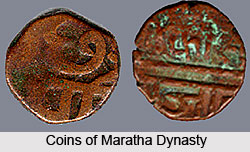
 Coins of Maratha rulers include the gold and which were issued by Shivaji and his successors and the southern Maratha family. The gold coins of both the kings were of `pagoda` type. The coins of Shivaji bore `Chhatrapati` in Nagari on one side and `Sri Raja Siva` on the other side of the coin. Some `pagodas` show a figure of Lord Shiva on one side and a granulated surface on the other without any inscription. These coins were ascribed to the South Maratha family. These gold coins are rare but the copper coins found in large numbers. The legends are the same in the copper and gold coins of Shivaji. The coins of the other rulers continue to use the title `Chhatrapati` on one side and the name `Sri Raja Shahu` or `Sri Sarabharaja` on the flip side of the coin.
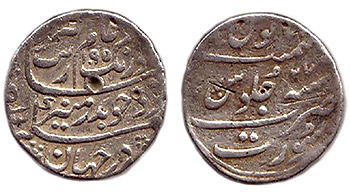
The historical evidences say that Shivaji had minted only one set of gold coins in his time. During the time of his coronation, seven lakh coins were showered upon him and issued for the first time. The coins are now rare as Mughal Emperor Aurangzeb had most of them melted as a result of his enmity with Shivaji Maharaj. With the usurpation of power by Balaji, the Peshwa, Maratha power grew and a great Maratha confederation was formed. In 1695, it reached its zenith and dominated Central India and influenced the north and east of the country. The power of this confederacy was broken by the Durrani invader Ahmad Shah at the battle of Panipat in 1761. At the time of the transference of the power of Marathas into the hands of Peshwas and their confederacy, they issued their own coins. They retained the name of the Mughal rulers and followed the pattern of the Peshwas` coins in silver. They set up a mint at Pune which came to be known as `Muhiabad Puna` on the coins. In addition to that, an umpteen number of mints issued coins under the Maratha power.
Some of the mints where the coins were issued at the time were Bagalkot, Mulher, Chandor, Kolaba, Sangli, Miraj, Panhala, Balwantnagar (Jhansi), Jalaun, Kalpi, Kunch, Balanagar Gadha (Gadha Mandla), Ravishnagar (Sagar). Moreover, on the coins of western mints the symbol of goad or the letter `Sri` in Nagari was found. The eastern mints had a bold trident and a cross with three forks at each end. During this period, copper coins were also issued though less is known about them. Even the Marathas issued some coins form Salsette near Mumbai. The coins bore the mint name `Sashthi` on one side of the coin and the Hijri era on the flip side of the coin in Nagari letters.